Hubert and Reba are Jon Arbuckle's elderly neighbors in the Garfield comic strip. They debuted in Garfield's first television special, Here Comes Garfield, which aired on October 25, 1982. They play a major role in the plot, as Hubert calls the pound on Garfield and Odie for messing with his dog, Honey Bun. Garfield escapes but Odie is captured, leading to Garfield having to try to get Odie back.
Hubert first appeared in the comic strip on November 7, 1982. Reba is mentioned but doesn't appear.
Reba first appears on November 11, 1982, in a non-speaking role.
To my knowledge, Honey Bun has never appeared.
Subheader
A forever in-work compendium of Marvel and DC canon immigrants. What's a canon immigrant? Go here to find out!
Showing posts with label 1980s. Show all posts
Wednesday, November 6, 2019
Friday, August 9, 2019
Flashback Friday: Ms. Lion
Each Friday, I take one of the entries from my old Super Posts and expand it into its own featured article.
This week: Ms. Lion!
Ms. Lion first appeared as Firestar's dog in Spider-Man and His Amazing Friends (1981), but she keeps Aunt May company whenever the heroes have to go fight crime.
He first appeared in comics as a member of the Pet Avengers in Lockjaw and the Pet Avengers #1 (May 2009).
He also appeared with the Pet Avengers in Thor and the Warriors Four #1 (April 2010) and Tails of the Pet Avengers: Dogs of Summer #1 (July 2010), although these are considered alternate realities.
Then the Spider-Man and His Amazing Friends version appeared in comics during the Spider-Verse event in Amazing Spider-Man #7 (October 2014), after Morlun has killed the heroes on this Earth.
Strangely, Ms. Lion is only yellow on Earth-1983. Every other time he's appeared, he's been white. I'm not sure why that is.
This week: Ms. Lion!
Ms. Lion first appeared as Firestar's dog in Spider-Man and His Amazing Friends (1981), but she keeps Aunt May company whenever the heroes have to go fight crime.
He first appeared in comics as a member of the Pet Avengers in Lockjaw and the Pet Avengers #1 (May 2009).
He also appeared with the Pet Avengers in Thor and the Warriors Four #1 (April 2010) and Tails of the Pet Avengers: Dogs of Summer #1 (July 2010), although these are considered alternate realities.
Then the Spider-Man and His Amazing Friends version appeared in comics during the Spider-Verse event in Amazing Spider-Man #7 (October 2014), after Morlun has killed the heroes on this Earth.
Strangely, Ms. Lion is only yellow on Earth-1983. Every other time he's appeared, he's been white. I'm not sure why that is.
Wednesday, July 24, 2019
Character Spotlight: Howard the Duck on Film (a 2-for-1!)
In SHIELD #10 (September 2015), guest star Howard the Duck has to deal with a cosmic entity called The Liverer, whose goal is to eat a cosmic pate made from the livers of one million Howard the Ducks. His torso has a portal through which you can see alternate worlds, and Howard the Duck enters it, causing him to see alternate Howard the Ducks.
Among the many versions of himself he sees, including Howard the Human, Spider-Howard, and Indiana Howard, he sees the two film versions of himself!
The scruffy-looking one is the MCU version of Howard. He first appeared in Guardians of the Galaxy (2014), and then later, Guardians of the Galaxy vol. 2 (2017) and Avengers: Endgame (2019).
The one with the guitar is the Howard that starred in Howard the Duck (1986), Marvel's first theatrical film.
I admit these aren't true examples because they are still presented as alternate realities, but if Spider-Verse counts, so do these!
Among the many versions of himself he sees, including Howard the Human, Spider-Howard, and Indiana Howard, he sees the two film versions of himself!
The scruffy-looking one is the MCU version of Howard. He first appeared in Guardians of the Galaxy (2014), and then later, Guardians of the Galaxy vol. 2 (2017) and Avengers: Endgame (2019).
The one with the guitar is the Howard that starred in Howard the Duck (1986), Marvel's first theatrical film.
I admit these aren't true examples because they are still presented as alternate realities, but if Spider-Verse counts, so do these!
Wednesday, March 20, 2019
Character Spotlight: Del Frye
I'm a big fan of The Immortal Hulk. I've never read it, I don't know much about it, but I still dig it. Why? Because after 40 years, there's a series that's finally introducing things from The Incredible Hulk television show into the comics.
This is crazy to me, and here's why: until, say, 2012's The Avengers, if you mentioned the Hulk, the average person would assume you were talking about the tv show (Yes, I'm aware The Avengers comes after two solo movies, and no, I didn't misspeak). The Hulk was Lou Ferrigno, his alter ego was David Banner, his catchphrase was "Don't make me angry...", and he was always on the run. End of story. The Incredible Hulk movie even arguably drew more inspiration from the show than the comics, going so far as to recreate the original experiment as shown in the show's opening credits each week. Yet, despite being a cultural touchstone and one of the most well-known comic book adaptations, it never made an impact on the comics...until now.
The first issue of Immortal Hulk, if you recall, introduced Jackie McGee, and in issue #2 (July 2018), the series brings over a much more minor character: Del Frye.
Del is the son of Dr. Frye, a scientist who was overcome with grief when his wife died. Seeing the Hulk as someone who couldn't die, he became intent on using gamma radiation to create a serum to prevent death. He tested the serum on Del, a football player and therefore prone to injury, but the serum didn't work and Del died. Del's body irradiated anyone who visited his grave and anyone they came into contact with, creating what came to be known as "the Chain of Grief". In addition, Dr. Frye became irradiated as well, and he turned into a creature not dissimilar to Batman Beyond's Blight.
This isn't quite how it happened on tv. Dell Frye - this version has two L's - first appeared in the Incredible Hulk episode "The First", a 2-part episode that aired during the show's fourth season in March 1981.
This version was the assistant of a doctor named Jeffrey Clive. He was dying from a rare blood disease, so Dr. Clive built a gamma ray chamber to try to cure him. As you can see in the picture above, it did not go according to plan. Dr. Clive managed to cure him, but Dell was still dying and getting worse, so in a strange turn of events, he kept trying to find a way to turn back into the creature - quite the opposite from the Hulk! Once Banner learns about a creature like himself who's been around longer than him, he goes to investigate and they agree to help each other: Banner will help Frye become the creature and Frye will help cure Banner. It doesn't work out, however, as Frye gets shot by police by the end of the episode and the Hulk has to escape.
Thanks to friend of the blog Thomas Parks for telling me about this one!
This is crazy to me, and here's why: until, say, 2012's The Avengers, if you mentioned the Hulk, the average person would assume you were talking about the tv show (Yes, I'm aware The Avengers comes after two solo movies, and no, I didn't misspeak). The Hulk was Lou Ferrigno, his alter ego was David Banner, his catchphrase was "Don't make me angry...", and he was always on the run. End of story. The Incredible Hulk movie even arguably drew more inspiration from the show than the comics, going so far as to recreate the original experiment as shown in the show's opening credits each week. Yet, despite being a cultural touchstone and one of the most well-known comic book adaptations, it never made an impact on the comics...until now.
The first issue of Immortal Hulk, if you recall, introduced Jackie McGee, and in issue #2 (July 2018), the series brings over a much more minor character: Del Frye.
Del is the son of Dr. Frye, a scientist who was overcome with grief when his wife died. Seeing the Hulk as someone who couldn't die, he became intent on using gamma radiation to create a serum to prevent death. He tested the serum on Del, a football player and therefore prone to injury, but the serum didn't work and Del died. Del's body irradiated anyone who visited his grave and anyone they came into contact with, creating what came to be known as "the Chain of Grief". In addition, Dr. Frye became irradiated as well, and he turned into a creature not dissimilar to Batman Beyond's Blight.
This isn't quite how it happened on tv. Dell Frye - this version has two L's - first appeared in the Incredible Hulk episode "The First", a 2-part episode that aired during the show's fourth season in March 1981.
This version was the assistant of a doctor named Jeffrey Clive. He was dying from a rare blood disease, so Dr. Clive built a gamma ray chamber to try to cure him. As you can see in the picture above, it did not go according to plan. Dr. Clive managed to cure him, but Dell was still dying and getting worse, so in a strange turn of events, he kept trying to find a way to turn back into the creature - quite the opposite from the Hulk! Once Banner learns about a creature like himself who's been around longer than him, he goes to investigate and they agree to help each other: Banner will help Frye become the creature and Frye will help cure Banner. It doesn't work out, however, as Frye gets shot by police by the end of the episode and the Hulk has to escape.
Thanks to friend of the blog Thomas Parks for telling me about this one!
Friday, March 1, 2019
Flashback Friday: Serpentino
Each Friday, I take one of the entries from my old Super Posts and expand it into its own featured article.
This week: Serpentino!
This is going to be a quick one, but sometimes you gotta take what you can get.
Back in the 70s, ads in comic books would sometimes be presented as a comics page itself. The most famous of these were Hostess, and you can check out a . . . host . . . of examples at seanbaby.com. Here's just one.
But they were created for other products, too, and one such ad for a Rubik's Cube kind of puzzle called the Magic Snake appeared in Marvel Team-Up #126 (December 1982). In the ad, Hulk fights a new villain named Serpentino, who is then distracted from the fight by a Magic Snake puzzle.
Serpentino WAS included in the Marvel Universe eventually, but don't be surprised if you've never heard of him. His only appearance was in a text feature in New Avengers Most Wanted Files (October 2005) that said he's remained in prison since his initial capture.
But hey, it still counts!
This week: Serpentino!
This is going to be a quick one, but sometimes you gotta take what you can get.
Back in the 70s, ads in comic books would sometimes be presented as a comics page itself. The most famous of these were Hostess, and you can check out a . . . host . . . of examples at seanbaby.com. Here's just one.
But they were created for other products, too, and one such ad for a Rubik's Cube kind of puzzle called the Magic Snake appeared in Marvel Team-Up #126 (December 1982). In the ad, Hulk fights a new villain named Serpentino, who is then distracted from the fight by a Magic Snake puzzle.
Serpentino WAS included in the Marvel Universe eventually, but don't be surprised if you've never heard of him. His only appearance was in a text feature in New Avengers Most Wanted Files (October 2005) that said he's remained in prison since his initial capture.
But hey, it still counts!
Friday, January 25, 2019
Flashback Friday: Firestar
Each Friday, I take one of the entries from my old Super Posts and expand it into its own featured article.
This week: Firestar!
Comic book adaptations in the past were much more willing to create original characters than they are today. If you take a look at a show like Young Justice, it has an enormous cast but all of them - perhaps with one or two exceptions - are characters from the comics, even if they're very minor ones that only made a couple of appearances. Compare that to something like Batman: The Animated Series, where it seems like half the characters are original to the show. It's that mindset that gave us Spider-Man and His Amazing Friends, a show where 1/3 of the main characters was somebody kids had never seen before.
There are many rumors about Firestar's appearance on the show. One is that she was originally meant to be the Human Torch, which makes sense because Spider-Man often hangs out with the Human Torch (and Iceman to a lesser extent) in the comics. There are a few reasons why people say the change happened, but the fact is that the Human Torch's rights were tied up in a solo animated series that never got made, so he would've never been considered for this show. The most likely explanation is that they knew they couldn't use him so created someone similar to him, and then decided that since they were creating an original character anyway, they may as well diversify and make her female.
Similarly, there's a popular rumor that her secret identity was originally going to be Mary Jane Watson instead of Angelica Jones. Other than the two characters having similar looks, this rumor has no grounding. Regardless, she first appeared in the first episode of the show ("Triumph of the Green Goblin", September 1981), and we eventually learn that she is a former member of the X-Men and one of their earliest recruits.
Her first comics appearance was in the tie-in Spider-Man and His Amazing Friends #1 (October 1981), an adaptation of the first episode...
...but her first appearance that counts was a few years later in Uncanny X-Men #193 (March 1985), although surprisingly not as an X-Man or even a potential X-Men recruit. Instead, she was part of the Hellions, a team of rivals to the New Mutants led by Emma Frost.
Her next appearance was the following year (January 1986), when she received a mini-series called Firestar that told how she ended up at the Massachusetts Academy and joined the Hellions, then left and became a solo hero. Notably, she was kept in the dark about their true intentions, so she didn't realize they were bad guys.
Since then, she's had a steady career as a B-list superhero. She was a main member of the New Warriors...
...and the Avengers...
...and the Young Allies...
...and finally the X-Men.
She also appeared in Spider-Man Family: Amazing Friends #1 (August 2006), a one-shot to celebrate the 25th anniversary of the show, in which she, Spider-Man, and Iceman team up for a story.
They also teamed up in Amazing X-Men #7 (May 2014) and Iceman #3 (November 2018).
I'll finish up by talking about a strange quirk of Firestar: no one really knows who owns the rights to her!
As you might know, in the 90s Marvel sold off the rights to nearly all of its characters to various production companies, but for the past ten years or so, there have only been three groups worth talking about: Fox, which owns X-Men and Fantastic Four; Sony, which owns Spider-Man; and Disney, which owns everything else.
So does Firestar fall within the X-Men rights because she's a mutant who's been a Hellion and an X-Man? Or does she fall within the everything else rights because she is mainly known as an Avenger and New Warrior? But maybe she falls under the Spider-Man rights because she was created for a Spider-Man show and was a Spider-Man supporting character in Ultimate Marvel. If any of these companies know, they're not saying. But I'm pretty sure nobody really knows and that's why nobody's used her in adaptations in any substantial way. Luckily, it soon won't matter now that Disney is buying Fox and has a deal to use Spider-Man characters in the MCU, but it's interesting to think about nonetheless.
This week: Firestar!
Comic book adaptations in the past were much more willing to create original characters than they are today. If you take a look at a show like Young Justice, it has an enormous cast but all of them - perhaps with one or two exceptions - are characters from the comics, even if they're very minor ones that only made a couple of appearances. Compare that to something like Batman: The Animated Series, where it seems like half the characters are original to the show. It's that mindset that gave us Spider-Man and His Amazing Friends, a show where 1/3 of the main characters was somebody kids had never seen before.
There are many rumors about Firestar's appearance on the show. One is that she was originally meant to be the Human Torch, which makes sense because Spider-Man often hangs out with the Human Torch (and Iceman to a lesser extent) in the comics. There are a few reasons why people say the change happened, but the fact is that the Human Torch's rights were tied up in a solo animated series that never got made, so he would've never been considered for this show. The most likely explanation is that they knew they couldn't use him so created someone similar to him, and then decided that since they were creating an original character anyway, they may as well diversify and make her female.
Similarly, there's a popular rumor that her secret identity was originally going to be Mary Jane Watson instead of Angelica Jones. Other than the two characters having similar looks, this rumor has no grounding. Regardless, she first appeared in the first episode of the show ("Triumph of the Green Goblin", September 1981), and we eventually learn that she is a former member of the X-Men and one of their earliest recruits.
Her first comics appearance was in the tie-in Spider-Man and His Amazing Friends #1 (October 1981), an adaptation of the first episode...
...but her first appearance that counts was a few years later in Uncanny X-Men #193 (March 1985), although surprisingly not as an X-Man or even a potential X-Men recruit. Instead, she was part of the Hellions, a team of rivals to the New Mutants led by Emma Frost.
Her next appearance was the following year (January 1986), when she received a mini-series called Firestar that told how she ended up at the Massachusetts Academy and joined the Hellions, then left and became a solo hero. Notably, she was kept in the dark about their true intentions, so she didn't realize they were bad guys.
Since then, she's had a steady career as a B-list superhero. She was a main member of the New Warriors...
...and the Avengers...
...and the Young Allies...
...and finally the X-Men.
She also appeared in Spider-Man Family: Amazing Friends #1 (August 2006), a one-shot to celebrate the 25th anniversary of the show, in which she, Spider-Man, and Iceman team up for a story.
They also teamed up in Amazing X-Men #7 (May 2014) and Iceman #3 (November 2018).
I'll finish up by talking about a strange quirk of Firestar: no one really knows who owns the rights to her!
As you might know, in the 90s Marvel sold off the rights to nearly all of its characters to various production companies, but for the past ten years or so, there have only been three groups worth talking about: Fox, which owns X-Men and Fantastic Four; Sony, which owns Spider-Man; and Disney, which owns everything else.
So does Firestar fall within the X-Men rights because she's a mutant who's been a Hellion and an X-Man? Or does she fall within the everything else rights because she is mainly known as an Avenger and New Warrior? But maybe she falls under the Spider-Man rights because she was created for a Spider-Man show and was a Spider-Man supporting character in Ultimate Marvel. If any of these companies know, they're not saying. But I'm pretty sure nobody really knows and that's why nobody's used her in adaptations in any substantial way. Luckily, it soon won't matter now that Disney is buying Fox and has a deal to use Spider-Man characters in the MCU, but it's interesting to think about nonetheless.
Wednesday, December 19, 2018
Batmobile Through the Ages
The Batmobile has been a mainstay of Batman's world since its inception, and it pretty much always has a very distinctive look in adaptations, which goes on to influence the Batmobile designs in the comics, when not outright being featured (usually as a cameo in a garage scene). I've posted about Batmobiles on this page before, but for my 300th post, I thought I'd try to do something a little more thorough. I don't pretend it's comprehensive, and it probably can't ever be, but it does give a pretty full picture regardless.
Batmobile '66
This vehicle from the 1966 Batman tv series is arguably the most influential and well-known of all the Batmobiles, its impact can still be seen today. Although rarely brought into the comics as-is, it changed how Batmobiles were drawn for a long time. Some examples:
The top left picture was a slow beginning, mainly taking the "double bubble" aspect of the tv car. And the Brave and the Bold example mainly highlights the addition of the rear afterburner, which becomes a design mainstay, especially in adaptations. But after that, it really takes shape.
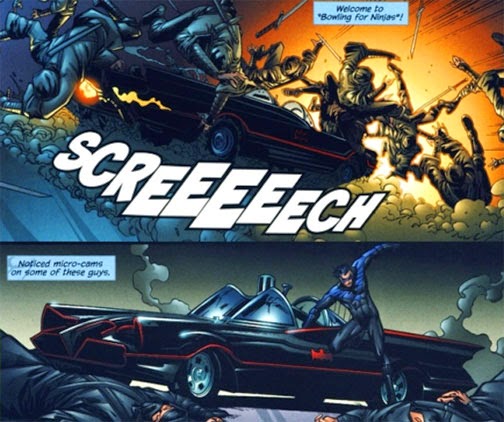
Also, the 60s Batmobile does appear in a show-accurate form a few times:
Batmobile '89
If the 60s Batmobile isn't the most influential, then this one is. Actually this one may have that one beat, since some of the following Batmobiles - each with their own share of influence - are ultimately based on this one as well. Some examples:
Just like with the 60s Batmobile, although the design is almost never 100% authentic, you can clearly see how the shape of these Batmobiles is inspired by Anton Furst's Batmobile. And occasionally a film-accurate design does emerge:
Batman: The Animated Series
This Batmobile is inspired by the one above, but as you can see, it went in its own direction. And since many people consider Batman: The Animated Series (1992) to be best depiction of Batman, you better believe it's influenced comics designs. Interestingly, the cars based on this design tend to be more accurate overall than most of the other ones.
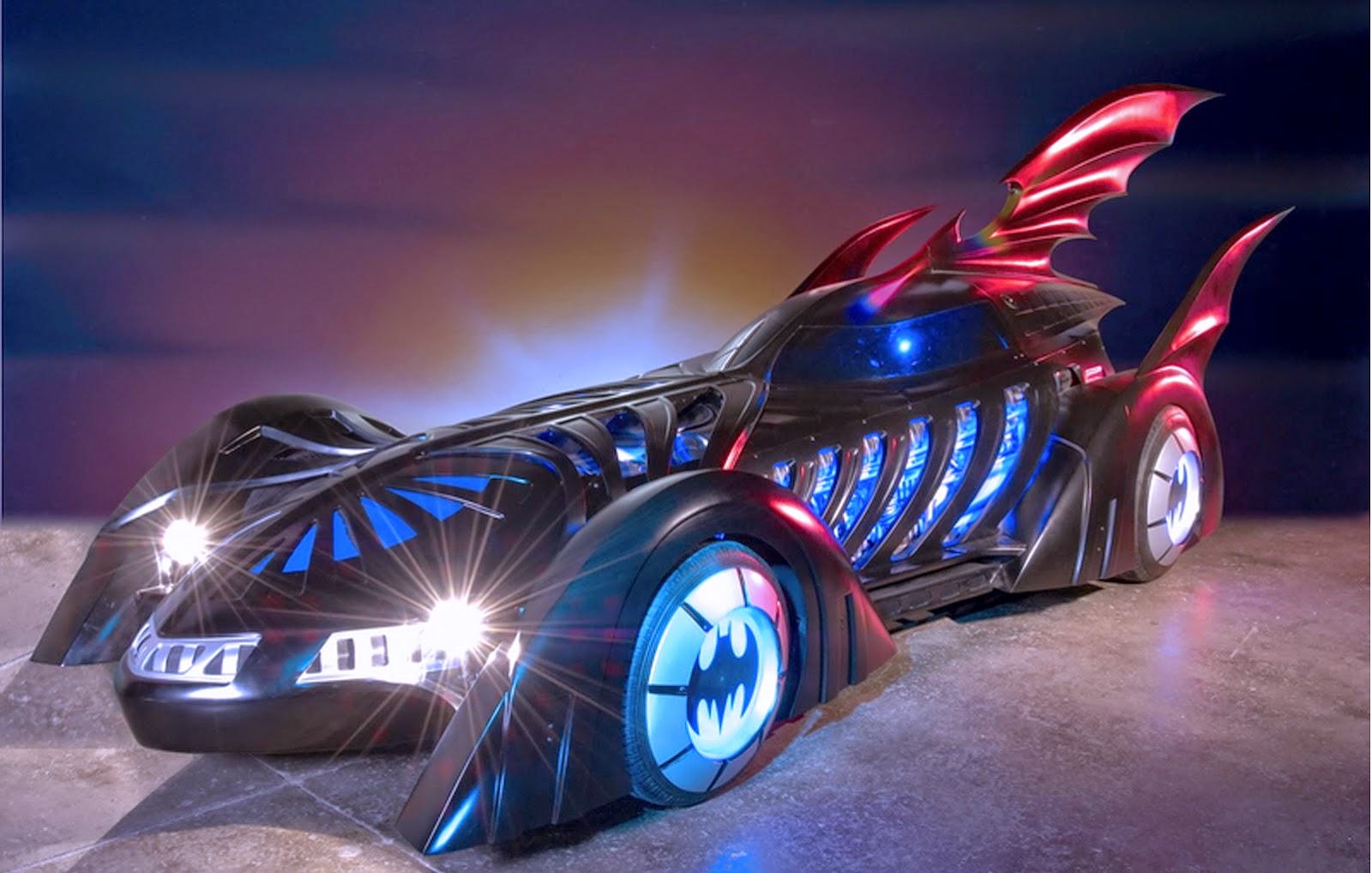
Batman Forever
This Batmobile was designed by H. R. Giger for Batman Forever (1995), with some Schumacher neon added, but at its heart, it's still has a lot in common with the previous two Batmobiles. Although as striking design, it has - to my knowledge - only inspired one Batmobile, the toned-down version seen below. But it has also appeared in group shots, as you can see at the bottom of the page.
Batman and Robin
This one has not yet appeared in the comics on its own or inspired any comics Batmobiles, but it does appear in a group shot below.
The New Batman Adventures
This one is possible my favorite Batmobile design, but again, it's essentially the Anton Furst Batmobile. Really, it's the back half of '89 with the front half of Batman and Robin. But hey, whatever works. It's appeared twice in somewhat modified forms.
Tumbler
Batman Begins (2005) took a different approach to the Batmobile. For one thing, it wasn't called that. For another, it was originally created as a military vehicle and then modified by Bruce Wayne. So it has more of a tank-like appearance than the sports car look it usually has.
Surprisingly, as successful as Christopher Nolan's trilogy of Batman films has been all around, the Tumbler hasn't made much impact on the comics. But that's not to say it's never appeared, and the one time it did (and was actually used, I mean) was pretty faithful.
DCCU Batmobile
Like the Batman & Robin Batmobile, this one has not yet appeared in the comics on its own or inspired any comics Batmobiles, but it does appear in a group shot below.
Group Shots
Occasionally, artists will like to do a wide shot of the Batcave featuring a wide variety of vehicles from Batman's history. I believe the first people to do this were Jeph Loeb and Jim Lee in Batman: Hush (seen below). In any case, these shots always include at least one screen Batmobile. I've provided three examples below. I don't believe these are the only time a shot like this is done, but they were the only ones I could find.
Detective Comics #988 (September 2018): (L to R) Batman v Superman: Dawn of Justice (2016), Batman (1989), Batman Begins (2005), Batman Forever (1995)
Batmobile '66
This vehicle from the 1966 Batman tv series is arguably the most influential and well-known of all the Batmobiles, its impact can still be seen today. Although rarely brought into the comics as-is, it changed how Batmobiles were drawn for a long time. Some examples:
![]() |
| Detective Comics #356 (Aug 1966) |
![]() |
| Brave and the Bold #68 (September 1966) |
![]() |
| Batman #204 (June 1968) |
![]() |
| Detective Comics #362 (Feb 1967) |
![]() |
| Detective Comics #371 (Nov 1967) |
![]() |
| Detective Comics #377 (May 1968) |
Also, the 60s Batmobile does appear in a show-accurate form a few times:
![]() |
| Superman/Batman #2 (September 2003) |
![]() |
| Detective Comics #850 (Nov 2008) |
![]() |
| Nightwing #152 (Jan 2009) |
| (Prime Earth) - Batman Beyond #14 (Nov 2017) |
Batmobile '89
If the 60s Batmobile isn't the most influential, then this one is. Actually this one may have that one beat, since some of the following Batmobiles - each with their own share of influence - are ultimately based on this one as well. Some examples:
![]() |
| Legends of the Dark Knight #29 (Feb 1992) |
![]() |
| Batman: Run, Riddler, Run #1 (Mar 1992) |
![]() |
| Batman: Black & White #2 (May 1996) |
![]() |
| Legends of the Dark Knight #64 (July 1994) |
![]() |
| Legends of the Dark Knight #95 (Apr 1997) |
![]() |
| Legends of the Dark Knight #156 (June 2002) |
![]() |
| Catwoman #35 (Sep 2004) |
![]() |
| Superman/Batman #21 (May 2005) |
![]() |
| Batman: The Return (Nov 2010) |
![]() |
| Batman & Robin #25 (July 2011) |
![]() |
| Batman & Robin #19 (Jan 2011) |
![]() |
| Batman #1 (Sep 2011) |
Batman: The Animated Series
This Batmobile is inspired by the one above, but as you can see, it went in its own direction. And since many people consider Batman: The Animated Series (1992) to be best depiction of Batman, you better believe it's influenced comics designs. Interestingly, the cars based on this design tend to be more accurate overall than most of the other ones.
![]() |
| Detective Comics #784 (July 2003) |
![]() |
| Detective Comics #840 (Jan 2008) |
![]() |
| Batman & The Outsiders #14 (Dec 2008) |
![]() |
| Batman #1 (June 2016) |
Batman Forever
This Batmobile was designed by H. R. Giger for Batman Forever (1995), with some Schumacher neon added, but at its heart, it's still has a lot in common with the previous two Batmobiles. Although as striking design, it has - to my knowledge - only inspired one Batmobile, the toned-down version seen below. But it has also appeared in group shots, as you can see at the bottom of the page.
![]() |
| Batman 80-Page Giant (2011) |
Batman and Robin
This one has not yet appeared in the comics on its own or inspired any comics Batmobiles, but it does appear in a group shot below.
The New Batman Adventures
This one is possible my favorite Batmobile design, but again, it's essentially the Anton Furst Batmobile. Really, it's the back half of '89 with the front half of Batman and Robin. But hey, whatever works. It's appeared twice in somewhat modified forms.
![]() |
| Legends of the Dark Knight #208 (July 2006) |
| Batman #5 (Oct 2016) |
Tumbler
Batman Begins (2005) took a different approach to the Batmobile. For one thing, it wasn't called that. For another, it was originally created as a military vehicle and then modified by Bruce Wayne. So it has more of a tank-like appearance than the sports car look it usually has.
Surprisingly, as successful as Christopher Nolan's trilogy of Batman films has been all around, the Tumbler hasn't made much impact on the comics. But that's not to say it's never appeared, and the one time it did (and was actually used, I mean) was pretty faithful.
![]() |
| Detective Comics #20 (July 2013) |
DCCU Batmobile
Like the Batman & Robin Batmobile, this one has not yet appeared in the comics on its own or inspired any comics Batmobiles, but it does appear in a group shot below.
Group Shots
Occasionally, artists will like to do a wide shot of the Batcave featuring a wide variety of vehicles from Batman's history. I believe the first people to do this were Jeph Loeb and Jim Lee in Batman: Hush (seen below). In any case, these shots always include at least one screen Batmobile. I've provided three examples below. I don't believe these are the only time a shot like this is done, but they were the only ones I could find.
Batman #615 (May 2003): (bottom left) Batman Forever (1995), (top middle) Batman (1989), (bottom middle) Batman (1966), (above Batman '66) Batman: The Animated Series (1992), (above Batman: TAS) Batman & Robin (1997)
Detective Comics #850 (November 2008): (L to R) Batman (1989), Batman Begins (2005), Batman: The Animated Series (1992), and The New Batman Adventures (1998)
Detective Comics #988 (September 2018): (L to R) Batman v Superman: Dawn of Justice (2016), Batman (1989), Batman Begins (2005), Batman Forever (1995)
Labels:
1960s,
1980s,
1990s,
2000s,
2010s,
52 Shakeup,
Animated,
Appearances,
Batman,
Batman 66,
Batman Beyond,
DC Appearances,
DCCU,
Film,
Gadget Spotlight,
Live Action,
Television,
Tim Burton
Subscribe to:
Comments (Atom)