Each Friday, I take one of the entries from my old Super Posts and expand it into its own featured article.
This week: Marsha, Queen of Diamonds!
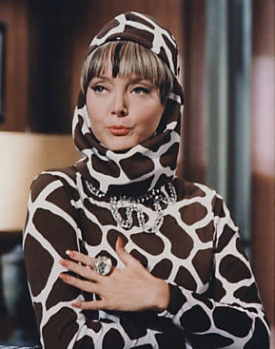
Marsha is a diamond thief who first appears in the episode of the same name (November 1966). She wants to get her hands on the Bat-Diamond, so she blackmails Batman into marrying her, which would have the added benefit of giving her access to the Batcave and his secret identity. Needless to say, Batman manages to find a way to escape and save Robin, Commissioner Gordon, and Chief O'Hara in the process.
Although this villain from the Batman tv series (1966-1968) hasn't yet made a real appearance in comics, she was mentioned by the Riddler in Secret Origins Special #1 (June 1989). At the time, the rights to the 60s series were in a strange sort of limbo, which is why the tv-original characters were never used in the comics. But that's all sorted out now, so there's no telling when Marsha will appear for real!
Subheader
A forever in-work compendium of Marvel and DC canon immigrants. What's a canon immigrant? Go here to find out!
Showing posts with label Character Spotlight. Show all posts
Friday, December 6, 2019
Wednesday, December 4, 2019
Character Spotlight: Dr. Chase Meridian
It's funny how standards slip as deadlines loom. Normally I don't include immigrants until they've been in a mainstream universe, but I didn't want the last couple weeks of this year to not have new content (even though I started doing Flashback Friday for just such an occasion), so here we are.
Batman Forever (1995) wanted to be a serious look into the psychology of Batman. You probably wouldn't recognize that from the final product, which had most of that particular plotline excised, but one artifact that remains is Dr. Chase Meridian, Bruce Wayne's love interest for the movie and a psychiatrist who is obsessed with Batman. Her name is a pun because she was supposed to help Bruce find a balance between his two personas; ie, "chase" the "meridian".
Despite being played by Nicole Kidman at her Nicole Kidmanest in a very successful movie (second highest-grossing movie of 1995 and highest-grossing opening weekend, which it held until 1997), Chase Meridian never made an impact on the comics. Even when she finally crossed over, it was only in an out-of-continuity digital comic. Specifically, it was Legends of the Dark Knight #77-79 (November 2013), which was later collected in Legends of the Dark Knight 100-Page Spectacular #4 (September 2014). Notably, she has a completely different look than the movie.
Personally, I think Dr. Meridian could fill a hole in the Batman universe. You'd think a series with an asylum as a major set piece would have a recurring psychologist/psychiatrist character. In fact, it has two, but they're both villains: Harley Quinn and Hugo Strange. It would be very beneficial, I think, to have Chase as a supervillain expert who also doesn't play their games.
Batman Forever (1995) wanted to be a serious look into the psychology of Batman. You probably wouldn't recognize that from the final product, which had most of that particular plotline excised, but one artifact that remains is Dr. Chase Meridian, Bruce Wayne's love interest for the movie and a psychiatrist who is obsessed with Batman. Her name is a pun because she was supposed to help Bruce find a balance between his two personas; ie, "chase" the "meridian".
Despite being played by Nicole Kidman at her Nicole Kidmanest in a very successful movie (second highest-grossing movie of 1995 and highest-grossing opening weekend, which it held until 1997), Chase Meridian never made an impact on the comics. Even when she finally crossed over, it was only in an out-of-continuity digital comic. Specifically, it was Legends of the Dark Knight #77-79 (November 2013), which was later collected in Legends of the Dark Knight 100-Page Spectacular #4 (September 2014). Notably, she has a completely different look than the movie.
Personally, I think Dr. Meridian could fill a hole in the Batman universe. You'd think a series with an asylum as a major set piece would have a recurring psychologist/psychiatrist character. In fact, it has two, but they're both villains: Harley Quinn and Hugo Strange. It would be very beneficial, I think, to have Chase as a supervillain expert who also doesn't play their games.
Friday, November 29, 2019
Flashback Friday: Livewire
Each Friday, I take one of the entries from my old Super Posts and expand it into its own featured article.
This week: Livewire!
These days, comic book adapters realize that Marvel and DC have thousands of characters and one of them will probably fit whatever story they want to tell. That wasn't always the case. Until the mid-00s (and possibly later), tv shows based on comics mainly used original characters, and the DC Animated Universe was no different. That brings us to Livewire.
Like Roxy Rocket, Livewire's first appearance wasn't really on tv. She debuted in Superman Adventures #5 (January 1997) in a story that has her attacking men because they've run the world for so long. What's interesting to me is that the issue is written as if everyone already knows Livewire, which makes me wonder if her premiere episode was originally planned for season one and then pushed back.
Either way, Livewire first appeared in Superman: The Animated Series in an episode of the same name (1997). In the episode, Leslie Willis is a shock jock who was struck by lightning during an outside concert. The lightning gave her electric powers and changed her appearance, and she blamed Superman for it. So she became Livewire to get revenge. She became a recurring antagonist, also appearing in The New Batman Adventures, Justice League, and Justice League Unlimited.
She first began appearing in the main DC Universe in Action Comics #835 (January 2006). Her backstory is mostly the same as her animated counterpart, except that she was born with her electric powers. The lightning strike only enhanced them and changed her appearance. She continued to appear and even reformed by 2011, just in time for the New 52.
In the New 52, Livewire made her first appearance in Justice League #30 (May 2014) during Forever Evil as a member of the Secret Society of Super-Villains. In Batgirl #42 (July 2015), she receives a new origin - now she was a vlogger who was electrocuted during a prank where she tried to make the lights of Metropolis spell out a dirty word.
And if comics to tv to comics weren't enough, she also made it back to tv - twice, actually. The first was in Smallville ("Injustice", May 2009), although you'd be forgiven for not realizing it's the same character...
...and the second was in Supergirl ("Livewire", November 2015), where she has once again become a recurring character.
This week: Livewire!
These days, comic book adapters realize that Marvel and DC have thousands of characters and one of them will probably fit whatever story they want to tell. That wasn't always the case. Until the mid-00s (and possibly later), tv shows based on comics mainly used original characters, and the DC Animated Universe was no different. That brings us to Livewire.
Like Roxy Rocket, Livewire's first appearance wasn't really on tv. She debuted in Superman Adventures #5 (January 1997) in a story that has her attacking men because they've run the world for so long. What's interesting to me is that the issue is written as if everyone already knows Livewire, which makes me wonder if her premiere episode was originally planned for season one and then pushed back.
Either way, Livewire first appeared in Superman: The Animated Series in an episode of the same name (1997). In the episode, Leslie Willis is a shock jock who was struck by lightning during an outside concert. The lightning gave her electric powers and changed her appearance, and she blamed Superman for it. So she became Livewire to get revenge. She became a recurring antagonist, also appearing in The New Batman Adventures, Justice League, and Justice League Unlimited.
She first began appearing in the main DC Universe in Action Comics #835 (January 2006). Her backstory is mostly the same as her animated counterpart, except that she was born with her electric powers. The lightning strike only enhanced them and changed her appearance. She continued to appear and even reformed by 2011, just in time for the New 52.
In the New 52, Livewire made her first appearance in Justice League #30 (May 2014) during Forever Evil as a member of the Secret Society of Super-Villains. In Batgirl #42 (July 2015), she receives a new origin - now she was a vlogger who was electrocuted during a prank where she tried to make the lights of Metropolis spell out a dirty word.
And if comics to tv to comics weren't enough, she also made it back to tv - twice, actually. The first was in Smallville ("Injustice", May 2009), although you'd be forgiven for not realizing it's the same character...
...and the second was in Supergirl ("Livewire", November 2015), where she has once again become a recurring character.
Friday, November 8, 2019
Flashback Friday: Mas y Menos
Each Friday, I take one of the entries from my old Super Posts and expand it into its own featured article.
This week: Mas y Menos!
Mas y Menos first appeared in the Teen Titans cartoon, beginning with the episode "Titans East, Part 1" (January 2005). They're speedsters who can only use their powers when they're touching, though this extends to touching something the other is also touching.
They first appear in comics in Teen Titans Go! #20 (June 2005), although this is a tie-in series to the show. They appeared in several issues of this series.
They debuted in the mainstream in Teen Titans #38 (July 2006), which established them as Titans during the 52/One Year Later gap year. This appearance would set the stage for all future appearances; they seem to only exist to cameo.
They appear on a screen in Teen Titans #66 (December 2008)...
Final Crisis #1 (April 2009) shows them in action for the first time, but only for two panels with no dialogue...
They're in Teen Titans #100 (August 2011), but only in a pinup after the main story...
And Multiversity: The Just #1 (October 2014) has them in a group shot at a pool party.
Not the most illustrious career, but at least they still exist in the post-Rebirth DC Universe (even if, right now, it's only on Earth-16).
This week: Mas y Menos!
Mas y Menos first appeared in the Teen Titans cartoon, beginning with the episode "Titans East, Part 1" (January 2005). They're speedsters who can only use their powers when they're touching, though this extends to touching something the other is also touching.
They first appear in comics in Teen Titans Go! #20 (June 2005), although this is a tie-in series to the show. They appeared in several issues of this series.
They debuted in the mainstream in Teen Titans #38 (July 2006), which established them as Titans during the 52/One Year Later gap year. This appearance would set the stage for all future appearances; they seem to only exist to cameo.
They appear on a screen in Teen Titans #66 (December 2008)...
Final Crisis #1 (April 2009) shows them in action for the first time, but only for two panels with no dialogue...
They're in Teen Titans #100 (August 2011), but only in a pinup after the main story...
And Multiversity: The Just #1 (October 2014) has them in a group shot at a pool party.
Not the most illustrious career, but at least they still exist in the post-Rebirth DC Universe (even if, right now, it's only on Earth-16).
Wednesday, November 6, 2019
Character Spotlight: Hubert and Reba
Hubert and Reba are Jon Arbuckle's elderly neighbors in the Garfield comic strip. They debuted in Garfield's first television special, Here Comes Garfield, which aired on October 25, 1982. They play a major role in the plot, as Hubert calls the pound on Garfield and Odie for messing with his dog, Honey Bun. Garfield escapes but Odie is captured, leading to Garfield having to try to get Odie back.
Hubert first appeared in the comic strip on November 7, 1982. Reba is mentioned but doesn't appear.
Reba first appears on November 11, 1982, in a non-speaking role.
To my knowledge, Honey Bun has never appeared.
Hubert first appeared in the comic strip on November 7, 1982. Reba is mentioned but doesn't appear.
Reba first appears on November 11, 1982, in a non-speaking role.
To my knowledge, Honey Bun has never appeared.
Friday, November 1, 2019
Flashback Friday: Inspector Henderson
Each Friday, I take one of the entries from my old Super Posts and expand it into its own featured article.
This week: Inspector Henderson!
Inspector Henderson first appeared in the The Adventures of Superman radio show during the 1940s, although I can't find a specific first episode. I can confirm, however, that he appeared by 1945, as he is included in the 15-part episode, "The Atom Man", which has been published in book form. His role was mainly to provide exposition for the story.
The radio show was very popular and had great influence on the comics, but Henderson wasn't one of them...yet. He did, however, appear in The Adventures of Superman tv show, as a way to keep Superman off-screen as long as possible (thanks to a limited budget).
His next appearance was also not in comics. It was in Filmation's "New Adventures of Superman" series. I can't confirm, but internet chatter leads me to believe he played a minor role in the episode, "Rain of Iron" (1968).
He finally made his first comics appearance in Action Comics #440 (August 1974) and became a minor recurring character until the New 52. He played a bigger part, however, in Black Lightning, which also took place in Metropolis.
He continued to be part of the Post-Crisis universe and made his first appearance there in Adventures of Superman #424 (November 1986).
Despite having a minor role in the comics nowadays, he has been a favorite of Superman adaptations, also appearing in Lois and Clark: The New Adventures of Superman, Superman: The Animated Series, and Smallville. Most recently, he is a major supporting character in the CW's Black Lightning.
I should also probably note that Supergirl introduced an Inspector Mike Henderson in 2009, after Bill Henderson had been promoted to commissioner, but I don't know if that's coincidence.
This week: Inspector Henderson!
Inspector Henderson first appeared in the The Adventures of Superman radio show during the 1940s, although I can't find a specific first episode. I can confirm, however, that he appeared by 1945, as he is included in the 15-part episode, "The Atom Man", which has been published in book form. His role was mainly to provide exposition for the story.
The radio show was very popular and had great influence on the comics, but Henderson wasn't one of them...yet. He did, however, appear in The Adventures of Superman tv show, as a way to keep Superman off-screen as long as possible (thanks to a limited budget).
His next appearance was also not in comics. It was in Filmation's "New Adventures of Superman" series. I can't confirm, but internet chatter leads me to believe he played a minor role in the episode, "Rain of Iron" (1968).
He finally made his first comics appearance in Action Comics #440 (August 1974) and became a minor recurring character until the New 52. He played a bigger part, however, in Black Lightning, which also took place in Metropolis.
He continued to be part of the Post-Crisis universe and made his first appearance there in Adventures of Superman #424 (November 1986).
Despite having a minor role in the comics nowadays, he has been a favorite of Superman adaptations, also appearing in Lois and Clark: The New Adventures of Superman, Superman: The Animated Series, and Smallville. Most recently, he is a major supporting character in the CW's Black Lightning.
I should also probably note that Supergirl introduced an Inspector Mike Henderson in 2009, after Bill Henderson had been promoted to commissioner, but I don't know if that's coincidence.
Wednesday, October 30, 2019
Character Spotlight: Cousin Ambrose
Cousin Ambrose is Sabrina the Teenage Witch's cousin. It's right there in the name. He's one of the lesser known Sabrina characters because he never appeared in the Sabrina the Teenage Witch TGIF series from the 90s, the version most people are familiar with.
That's somewhat ironic since he debuted on television. He first appeared in Filmation's Sabrina the Teenage Witch cartoon, in the second segment of the first episode, titled "Hiccups" (September 1969). He's a foppish gentleman with a mustache who Sabrina summons to help her cure her hiccups, which are causing her magic to malfunction.
He later appeared in Archie's TV Laugh-Out #1 (October 1969), which I've mentioned before. His comics version has a more modern style than his animated counterpart.
He's continually appeared in comics since then, including The Chilling Adventures of Sabrina. This series reinterpreted him as a young adult who has to live with the Spellmans as punishment for revealing himself to mortals.
He likewise appears in the Netflix series of the same name, as the same basic character. I assume this will be where most people know him from.
That's somewhat ironic since he debuted on television. He first appeared in Filmation's Sabrina the Teenage Witch cartoon, in the second segment of the first episode, titled "Hiccups" (September 1969). He's a foppish gentleman with a mustache who Sabrina summons to help her cure her hiccups, which are causing her magic to malfunction.
He later appeared in Archie's TV Laugh-Out #1 (October 1969), which I've mentioned before. His comics version has a more modern style than his animated counterpart.
He's continually appeared in comics since then, including The Chilling Adventures of Sabrina. This series reinterpreted him as a young adult who has to live with the Spellmans as punishment for revealing himself to mortals.
He likewise appears in the Netflix series of the same name, as the same basic character. I assume this will be where most people know him from.
Friday, October 25, 2019
Flashback Friday: Gray Ghost
Each Friday, I take one of the entries from my old Super Posts and expand it into its own featured article.
This week: Gray Ghost!
As most people know, Batman is inspired by earlier pulp heroes such as the Shadow and Zorro. In fact, "inspired" is putting it charitably, considering several of Batman's earliest stories were plagiarized Shadow stories. But the comics and other adaptations like to pay homage to this in various ways, with the main one becoming that the Waynes went to see a Zorro film on the day they died (which Zorro movie it was changes based on when the story takes place, but it's usually The Mark of Zorro).
Batman: The Animated Series, however, provided its own twist on this idea. In the episode "Beware the Gray Ghost" (1992), we learn of an old tv show that Bruce loved to watch as a kid. The Gray Ghost is very inspired by the Shadow, and Batman was, in turn, inspired by the Gray Ghost. In fact, Batman's Batcave is an exact replica of the Gray Ghost's base of operations. The episode involves the Simon Trent, the actor who played the Gray Ghost (voiced by Adam West), dressing as the Gray Ghost and teaming with Batman to help solve a series of bombings based on an episode of the series.
The first time the Grey Ghost was mentioned in comics was Batman: Gotham Adventures #3 (June 1998), when Scarecrow's fear formula made it seem like Batman was dressed as the character.
The Batman Adventures #14 (May 2004) featured Simon Trent as the Gray Ghost and the creation of a Gray Ghost movie.
But both of those are extensions of the DCAU. The first time the Gray Ghost was seen outside of that world was, surprisingly, the Grant Morrison Vertigo title, Joe the Barbarian #1 (January 2010). This series is about a boy who hallucinates a fantasy adventure involving his toys thanks to low blood sugar, and Gray Ghost - along with Batman - is one of the characters who appears.
When he finally appeared in mainstream DC comics, it was in a much different form. In Batgirl #15 (November 2010), the Grey Ghost appears as Clancy Johnson, Batgirl's self-proclaimed guardian angel. Incidentally, he's also the Mad Bomber (the villain of "Beware the Gray Ghost"). Clancy based his secret identity on the Grey Ghost tv show, which also now exists in DC Comics.
And then Simon Trent appeared as a theatre teacher in Gotham Academy, which I've previously discussed.
What I find most interesting about all of these appearances is that they keep the Gray Ghost a fictional entity. Writers could've easily made him a real hero, perhaps one active in the 30s. But they didn't. In some ways I prefer that.
The only (potential) example I can find otherwise is Batman Beyond 2.0 #40 (November 2014). I can't tell if this is Simon Trent taking up the mantle again or someone inspired by the Gray Ghost franchise. Either way, this series takes place on Earth-12, which is essentially the DCAU world in comics form.
This week: Gray Ghost!
As most people know, Batman is inspired by earlier pulp heroes such as the Shadow and Zorro. In fact, "inspired" is putting it charitably, considering several of Batman's earliest stories were plagiarized Shadow stories. But the comics and other adaptations like to pay homage to this in various ways, with the main one becoming that the Waynes went to see a Zorro film on the day they died (which Zorro movie it was changes based on when the story takes place, but it's usually The Mark of Zorro).
Batman: The Animated Series, however, provided its own twist on this idea. In the episode "Beware the Gray Ghost" (1992), we learn of an old tv show that Bruce loved to watch as a kid. The Gray Ghost is very inspired by the Shadow, and Batman was, in turn, inspired by the Gray Ghost. In fact, Batman's Batcave is an exact replica of the Gray Ghost's base of operations. The episode involves the Simon Trent, the actor who played the Gray Ghost (voiced by Adam West), dressing as the Gray Ghost and teaming with Batman to help solve a series of bombings based on an episode of the series.
The first time the Grey Ghost was mentioned in comics was Batman: Gotham Adventures #3 (June 1998), when Scarecrow's fear formula made it seem like Batman was dressed as the character.
But both of those are extensions of the DCAU. The first time the Gray Ghost was seen outside of that world was, surprisingly, the Grant Morrison Vertigo title, Joe the Barbarian #1 (January 2010). This series is about a boy who hallucinates a fantasy adventure involving his toys thanks to low blood sugar, and Gray Ghost - along with Batman - is one of the characters who appears.
When he finally appeared in mainstream DC comics, it was in a much different form. In Batgirl #15 (November 2010), the Grey Ghost appears as Clancy Johnson, Batgirl's self-proclaimed guardian angel. Incidentally, he's also the Mad Bomber (the villain of "Beware the Gray Ghost"). Clancy based his secret identity on the Grey Ghost tv show, which also now exists in DC Comics.
And then Simon Trent appeared as a theatre teacher in Gotham Academy, which I've previously discussed.
What I find most interesting about all of these appearances is that they keep the Gray Ghost a fictional entity. Writers could've easily made him a real hero, perhaps one active in the 30s. But they didn't. In some ways I prefer that.
The only (potential) example I can find otherwise is Batman Beyond 2.0 #40 (November 2014). I can't tell if this is Simon Trent taking up the mantle again or someone inspired by the Gray Ghost franchise. Either way, this series takes place on Earth-12, which is essentially the DCAU world in comics form.
Wednesday, October 23, 2019
Character Spotlight: Harvey Kinkle
Last week I showed you how Sabrina the Teenage Witch joined the Archie Universe, and today we'll continue along that path with the introduction of Sabrina's boyfriend, Harvey Kinkle!
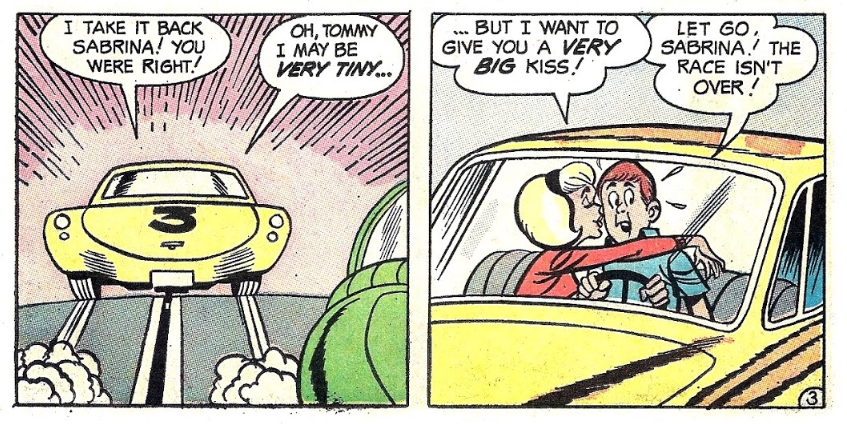
I should point out that Harvey was not the first boyfriend Sabrina had, which makes him all the more interesting. Information online is scant about Tommy Baker, but I know he at least appeared in Archie's Madhouse #55 and #59 (June and December 1967, respectively) and he was Sabrina's boyfriend in both appearances. He also knew about Sabrina's powers.
When the time came for Sabrina to have her own show, she needed a supporting cast. Filmation brought over Hilda, Zelda, and Salem from the comics, liberally used the existing Archie cast, and then also introduced Sabrina's best friend, Ophelia; Ophelia's crush, Spencer; and Sabrina's boyfriend, Harvey Kinkle. Why didn't they use the already existing Tommy Baker? I'm not sure, but Sabrina seemed to interact with people sporadically in her stories (usually only one or two per story, from what I've seen), so it's possible the writers didn't know he existed. Regardless, Harvey took his place and first appeared in the first episode, "The Fairy Godmother", in September 1969.
Notably, Harvey doesn't know Sabrina is a witch, because he's dumb as a brick and can't piece together obvious clues, like in this episode when he sees her in the window on the second floor and then she's instantly sitting in his car behind him.
Anyway, ComicVine says he first appeared in comics in Archie's TV Laugh-Out #1 (October 1969), the same comic that integrated Sabrina into Archie's world. Unfortunately, I could not find photographic proof of that, so here he is in Archie's TV Laugh-Out #3 (December 1969). He appears in nearly every Sabrina story in this issue, so they were really pushing him as a major member of the cast.
Since then, Harvey has become a mainstay of the Sabrina brand, appearing in everything from the TGIF series with Melissa Joan Hart to Sabrina The Animated Series and The Chilling Adventures of Sabrina.
I should point out that Harvey was not the first boyfriend Sabrina had, which makes him all the more interesting. Information online is scant about Tommy Baker, but I know he at least appeared in Archie's Madhouse #55 and #59 (June and December 1967, respectively) and he was Sabrina's boyfriend in both appearances. He also knew about Sabrina's powers.
When the time came for Sabrina to have her own show, she needed a supporting cast. Filmation brought over Hilda, Zelda, and Salem from the comics, liberally used the existing Archie cast, and then also introduced Sabrina's best friend, Ophelia; Ophelia's crush, Spencer; and Sabrina's boyfriend, Harvey Kinkle. Why didn't they use the already existing Tommy Baker? I'm not sure, but Sabrina seemed to interact with people sporadically in her stories (usually only one or two per story, from what I've seen), so it's possible the writers didn't know he existed. Regardless, Harvey took his place and first appeared in the first episode, "The Fairy Godmother", in September 1969.
Notably, Harvey doesn't know Sabrina is a witch, because he's dumb as a brick and can't piece together obvious clues, like in this episode when he sees her in the window on the second floor and then she's instantly sitting in his car behind him.
Anyway, ComicVine says he first appeared in comics in Archie's TV Laugh-Out #1 (October 1969), the same comic that integrated Sabrina into Archie's world. Unfortunately, I could not find photographic proof of that, so here he is in Archie's TV Laugh-Out #3 (December 1969). He appears in nearly every Sabrina story in this issue, so they were really pushing him as a major member of the cast.
Since then, Harvey has become a mainstay of the Sabrina brand, appearing in everything from the TGIF series with Melissa Joan Hart to Sabrina The Animated Series and The Chilling Adventures of Sabrina.
Friday, October 11, 2019
Flashback Friday: Reptil
Each Friday, I take one of the entries from my old Super Posts and expand it into its own featured article.
This week: Reptil!
Reptil is one of the very rare cases of a character being created for a toyline and then transitioning into comics. The only time I can think of that happening outside of Teenage Mutant Ninja Turtles is DC's Nite-Lik. (Of course, there are other examples that didn't occur to me.) He was created for Marvel's "Super Hero Squad" line of figurines, but strangely, the only figurine of his I can find online is from 2010, well after all the other appearances I plan to mention. His earliest appearance that I can find is a tie-in comic book one-shot Marvel Super Hero Squad: Hero Up! #1 (January 2009).
He later appeared in The Super Hero Squad Show episode, "To Err is Superhuman" (September 2009), but in between those two appearances, he appeared in Avengers: The Initiative - Featuring Reptil #1 (March 2009).
This week: Reptil!
Reptil is one of the very rare cases of a character being created for a toyline and then transitioning into comics. The only time I can think of that happening outside of Teenage Mutant Ninja Turtles is DC's Nite-Lik. (Of course, there are other examples that didn't occur to me.) He was created for Marvel's "Super Hero Squad" line of figurines, but strangely, the only figurine of his I can find online is from 2010, well after all the other appearances I plan to mention. His earliest appearance that I can find is a tie-in comic book one-shot Marvel Super Hero Squad: Hero Up! #1 (January 2009).
He later appeared in The Super Hero Squad Show episode, "To Err is Superhuman" (September 2009), but in between those two appearances, he appeared in Avengers: The Initiative - Featuring Reptil #1 (March 2009).
Reptil's real name is Humberto Lopez and he possesses a magic medallion that allows him to turn any part of his body into any part of any dinosaur's body. He was a main character in Avengers Academy and has likewise appeared in other teen-hero-centric things like Avengers Arena.
Wednesday, October 2, 2019
Character Spotlight: Gyoji
Teenage Mutant Ninja Turtles can occasionally be tricky in terms of canon immigrants because there are TWO official continuities: there's the original Mirage Comics continuity that ran off and on between 1984 and 2009, and there's the IDW continuity that ran from 2011 to present. For the most part, it's not a big deal: while Mirage was mainly interested in doing its own thing, IDW seems to want to pull in as many details as possible from every other continuity to create a single unified Ninja Turtles story. Therefore, whenever TMNT canon immigrants appear on this blog, it's safe to assume they're appearing in the IDW version. Imagine my surprise, then, when I learned this one happened in the Mirage continuity.
I've covered the Battle Nexus before, but a brief recap: the Battle Nexus is a cross-dimensional tournament that first appeared in the 2003 animated series but then was introduced into both the Mirage and IDW continuities.
But we're not here to talk about the Battle Nexus (yet), we're here to talk about Gyoji. Gyoji is a masked being who first appeared in the 2003 series episode, "The Ultimate Ninja" (February 2004), to referee a fight between Leonardo and the titular "Ultimate Ninja", aka Ue-sama. There is an air of mystery around Gyoji and why he appeared, especially once its revealed Ue-sama is from another dimension and from the same species as Gyoji's master, a species that claims to have taught humans ninjutsu. Splinter seems to know more about all this than he lets on.
Of course, this is all a set up for the four-part season finale, "The Big Brawl" (May - October 2004), which introduces us to the Battle Nexus. It's then we learn that Gyoji is the Battle Nexus's referee.
When the Battle Nexus started appearing in TMNT: Teenage Mutant Ninja Turtles, Gyoji came with it, although now his name is spelled "Gyogi". He first appeared in issue 29 (February 2008).
I've covered the Battle Nexus before, but a brief recap: the Battle Nexus is a cross-dimensional tournament that first appeared in the 2003 animated series but then was introduced into both the Mirage and IDW continuities.
But we're not here to talk about the Battle Nexus (yet), we're here to talk about Gyoji. Gyoji is a masked being who first appeared in the 2003 series episode, "The Ultimate Ninja" (February 2004), to referee a fight between Leonardo and the titular "Ultimate Ninja", aka Ue-sama. There is an air of mystery around Gyoji and why he appeared, especially once its revealed Ue-sama is from another dimension and from the same species as Gyoji's master, a species that claims to have taught humans ninjutsu. Splinter seems to know more about all this than he lets on.
Of course, this is all a set up for the four-part season finale, "The Big Brawl" (May - October 2004), which introduces us to the Battle Nexus. It's then we learn that Gyoji is the Battle Nexus's referee.
When the Battle Nexus started appearing in TMNT: Teenage Mutant Ninja Turtles, Gyoji came with it, although now his name is spelled "Gyogi". He first appeared in issue 29 (February 2008).
Subscribe to:
Posts (Atom)