Subheader

A forever in-work compendium of Marvel and DC canon immigrants. What's a canon immigrant? Go here to find out!
Showing posts with label Filmation. Show all posts

Wednesday, October 30, 2019

Character Spotlight: Cousin Ambrose

Cousin Ambrose is Sabrina the Teenage Witch's cousin. It's right there in the name. He's one of the lesser known Sabrina characters because he never appeared in the Sabrina the Teenage Witch TGIF series from the 90s, the version most people are familiar with.

That's somewhat ironic since he debuted on television. He first appeared in Filmation's Sabrina the Teenage Witch cartoon, in the second segment of the first episode, titled "Hiccups" (September 1969). He's a foppish gentleman with a mustache who Sabrina summons to help her cure her hiccups, which are causing her magic to malfunction.


He later appeared in Archie's TV Laugh-Out #1 (October 1969), which I've mentioned before. His comics version has a more modern style than his animated counterpart.


He's continually appeared in comics since then, including The Chilling Adventures of Sabrina. This series reinterpreted him as a young adult who has to live with the Spellmans as punishment for revealing himself to mortals.


He likewise appears in the Netflix series of the same name, as the same basic character. I assume this will be where most people know him from.


Wednesday, October 23, 2019

Character Spotlight: Harvey Kinkle

Last week I showed you how Sabrina the Teenage Witch joined the Archie Universe, and today we'll continue along that path with the introduction of Sabrina's boyfriend, Harvey Kinkle!


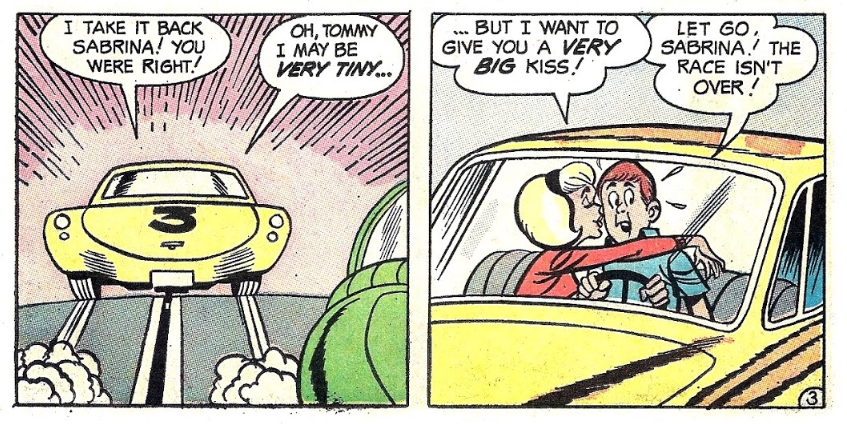
I should point out that Harvey was not the first boyfriend Sabrina had, which makes him all the more interesting. Information online is scant about Tommy Baker, but I know he at least appeared in Archie's Madhouse #55 and #59 (June and December 1967, respectively) and he was Sabrina's boyfriend in both appearances. He also knew about Sabrina's powers.


When the time came for Sabrina to have her own show, she needed a supporting cast. Filmation brought over Hilda, Zelda, and Salem from the comics, liberally used the existing Archie cast, and then also introduced Sabrina's best friend, Ophelia; Ophelia's crush, Spencer; and Sabrina's boyfriend, Harvey Kinkle. Why didn't they use the already existing Tommy Baker? I'm not sure, but Sabrina seemed to interact with people sporadically in her stories (usually only one or two per story, from what I've seen), so it's possible the writers didn't know he existed. Regardless, Harvey took his place and first appeared in the first episode, "The Fairy Godmother", in September 1969.


Notably, Harvey doesn't know Sabrina is a witch, because he's dumb as a brick and can't piece together obvious clues, like in this episode when he sees her in the window on the second floor and then she's instantly sitting in his car behind him.

Anyway, ComicVine says he first appeared in comics in Archie's TV Laugh-Out #1 (October 1969), the same comic that integrated Sabrina into Archie's world. Unfortunately, I could not find photographic proof of that, so here he is in Archie's TV Laugh-Out #3 (December 1969). He appears in nearly every Sabrina story in this issue, so they were really pushing him as a major member of the cast.


Since then, Harvey has become a mainstay of the Sabrina brand, appearing in everything from the TGIF series with Melissa Joan Hart to Sabrina The Animated Series and The Chilling Adventures of Sabrina.

Wednesday, October 16, 2019

Sabrina in the Archie Universe

I love when one of these surprises me, and this one certainly surprised me.

Sabrina the Teenage Witch is one of those characters that people know but don't necessarily know she's a comic book characters. I'd wager most people know her from her numerous adaptations, especially the 90s TGIF series starring Melissa Joan Hart (though I'm sure the numbers will quickly lean in favor of the current Netflix series, The Chilling Adventures of Sabrina). And I'm sure that many people who know she has comics don't necessarily know she's an Archie Comics character. I've pretty much always known that, but here's what I only just learned: although she's always been published by Archie Comics, she wasn't always part of their world. In fact, in her first appearance - Archie's Mad House #22 (August 1962) - she's watching Archie on tv!


This is especially strange because an Archie show - The Archie Show, in fact - wouldn't exist until 1968. And when it was created, it needed characters to play bit parts and Sabrina was pulled in. Although I can't find any definite screenshots from this first season, she did prominently appear (by name, even! Always helpful) in the video for "Sugar, Sugar", interacting with Betty. The video was released in May 1969.


Her appearances on this show led to her getting her own animated series - likewise called Sabrina the Teenage Witch - as part of The Archie Comedy Hour, which later became The Archie/Sabrina Hour. Over time, both The Archie Show and Sabrina the Teenage Witch would morph into other forms, with "Sabrina" becoming Sabrina and the Groovy Ghoulies and then Super Witch. As both series took place in Riverdale, characters and locations would also cross over frequently.


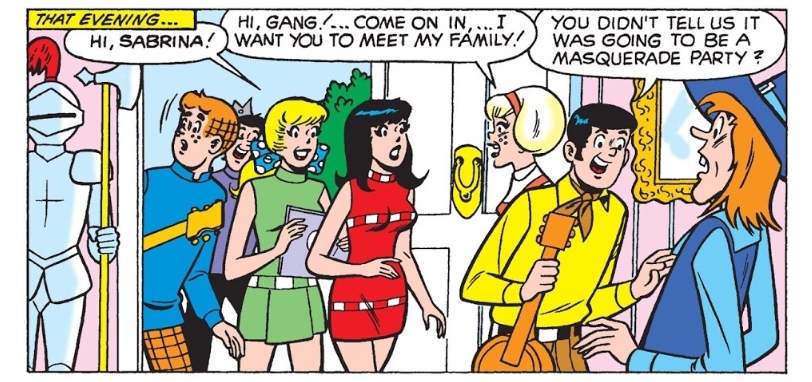
Sabrina was then integrated into Archie's comics world in Archie's TV Laugh-Out #1 (October 1969), in a story where Sabrina throws a party at home and the Archie gang attends.


She's been part of the universe ever since! She even almost appeared in Riverdale, although it didn't work out. But The Chilling Adventures of Sabrina still mentions Riverdale (and Riverdale likewise mentions Greendale), and the 1996 tv movie is set in Riverdale.

Friday, September 20, 2019

Flashback Friday: Hall of Justice

Each Friday, I take one of the entries from my old Super Posts and expand it into its own featured article.

This week: the Hall of Justice!


The Hall of Justice first appeared as the Justice League headquarters in first episode of the Super Friends animated series (September 1973). It quickly became a trademark of the series, especially during Challenge of the Super Friends when it was contrasted with the equally iconic Legion of Doom headquarters. Here's an interesting piece of trivia for you: the Hall was based on Cincinatti's Union Terminal:


The Hall of Justice first appeared in comics in Super Friends #1 (September 1976), but since DC TV comics are...complicated in terms of continuity, we'll keep going.


The designed was used in Kingdom Come (1996) as the United Nations headquarters...


...but the actual Hall of Justice debuted in Justice League of America #7 (March 2007) as one half of the JLA's new headquarters (the other half being the Satellite Watchtower).


Since then it has become a mainstay. It technically continued to exist in the New 52, although it was blown up in the first month, in Justice League International #1 (September 2011).


It was then rebuilt following the destruction of the Watchtower, and the new version debuted in Justice League #1 (June 2018).


It has also been featured as - or inspired the look of - headquarters in many adaptations. I won't list them all, but some examples include the Arrowverse...


...Young Justice...


...The Batman...


...and Batman: The Brave and the Bold.


Wednesday, July 31, 2019

Shazam's Animated Tie-In

A couple months ago, when I did my Flashback Friday on Isis, I talked briefly about how the 70s Shazam! comic was suddenly marketed as a DC TV comic even though it "isn't connected to the Shazam! animated series at all".

I was wrong.

Turns out, once the book became a DC TV comic, it was actually very strongly tied to the show. I'll explain.

See, when DC decided to launch a new Captain Marvel series in December 1972, they made it a continuation of his original series...which hadn't been published in 20 years. There are ways of doing that and having it work, but sales suggest whatever they did didn't work.


Luckily, a Shazam! tv series debuted in 1974 and it was a huge hit. Like many shows in the 70s, it involved Billy Batson travelling to a new town each episode and dealing with whatever trouble was there. Since he was still a minor, he was accompanied by an original character called Mentor, and they travelled together in a Captain Marvel-branded RV.


In Shazam! #25 (August 1976), Dr. Sivana threatens to attack a bunch of American cities. Billy doesn't know how he can protect all those cities since he has a job in New York, but luckily, his boss gets the idea to send Billy on a cross-country trip.


In Shazam! #26 (October 1976), several things of note happen. First, it's pointed out that Uncle Dudley grew a mustache and Billy's hair is getting longer, making them both look more like the leads in the show:


Second, the wizard Shazam tasks them with travelling across the country, and Shazam says Dudley needs to be like Mentor, the mythological character. (I find it interesting that Billy's boss had the idea to send him across the country but Shazam is carrying it out. Is Shazam secretly the manager of WHIZ?!)


Third, Shazam gives Billy a device called the Eterni-Phone to summon one of the people that make up the SHAZAM acronym (Solomon, Hercules, Achilles, Zeus, Atlas, and Mercury). This is based on a device in the show that performs the same function.


Finally, WHIZ-TV gives Billy an RV that strangely has the Captain Marvel lightning bolt on the front. (I'm telling you: Sterling Morris and Shazam are the same person.)


Interestingly, in the very same issue that moves the book to tie so closely to the tv show, there's also a reference to a recent team-up Captain Marvel had with the Justice League and Justice Society with a footnote to the relevant issues. More evidence to support my stance that DC TV comics are in continuity despite the title.

Friday, April 12, 2019

Flashback Friday: Isis

Each Friday, I take one of the entries from my old Super Posts and expand it into its own featured article.

This week: Isis!


Isis is a strange one because I'm not entirely sure how she's possible. But I suppose I should explain who she is first. See, Isis first appeared in the 1975 Filmation tv series, The Secrets of Isis, which was the second half of The Shazam!/Isis Hour.


The show was about a schoolteacher named Andrea Thomas, who discovered an amulet that she can use to harness the powers of the Egyptian goddess, Isis. As part of the Shazam!/Isis Hour, and probably because they have similar power origins, although I'm not sure whether that was a coincidence, the two characters crossed over frequently, with Isis appearing on three episodes of Shazam! and Captain Marvel appearing on three episodes of The Secrets of Isis.


An animated version of her later appeared in a very short-lived show called The Freedom Force (1978), which teamed up Isis with Hercules - from the Filmation animated series The Space Sentinels - to put together an international team of heroes. In addition to them, the team featured Merlin, Sinbad, and a character named Super Samurai. The whole thing lasted five episodes. The internet also claims she appeared in an episode of the animated series Hero High (the second half of The Shazam! Superpower Hour), but I can't find proof of that.


Isis's first comics appearance was, fittingly, Shazam! #25 (July 1976), but here's where the first bit of strangeness comes in: it's marked as a DC TV comic. DC TV comics were bizarre comics in the 70s of dubious canonicity. They were clearly marked tie-ins to tv shows, but written in a way that doesn't contradict the comic book universe. As an example of how strange they could be, Shazam! was an ongoing comic book series with no relation to the show. This DC TV comic issue was just dropped in the middle of the run, and afterward it's marketed as a DC TV for the rest of its run, but still isn't connected to either Shazam! show at all. All of that is to say that Isis is kind of an Earth-S character and kind of not. (See the Wonder Twins and the Global Guardians for more examples of this oddity.)


Isis then received her own series, The Mighty Isis, that began in September 1976 and ran for eight issues. All eight of them were marked as DC TV comics, so is this the same Isis that appeared in Shazam! #25, or a completely different one? As far as I know, there are no Captain Marvel appearances in the series, and no DC references at all...though the letters page does suggest - but doesn't state outright - that Isis's amulet was created by the wizard Shazam.


In 52 #3 (May 2006), DC introduced a character named Adrianna Tomaz, an Egyptian refugee who was brought to Black Adam as a slave. He killed her captors and freed her, and she helped convince him that he could be doing more good in the world. In return, he retrieved the Amulet of Isis, and in #12 (July 2006), he asked the wizard Shazam to confer the amulet's powers onto Adrianna, giving her the ability to transform into Isis. Adrianna Tomaz is obviously named after Andrea Thomas, and the series established that the Amulet's original owner, Hatshepsut, was one of Shazam's previous champions.


Here's where the strangeness really kicks in: DC DOESN'T OWN ISIS. Isis is a Filmation character. DC doesn't own Filmation. Warner Bros. doesn't own Filmation. How can they use her? Are they just skirting trademarks by the fact that Isis and Hatshepsut are historical characters in the public domain? Is the white dress generic enough that it's not actionable? Can they get by the transformation by the fact that Captain Marvel did it first?

I can't prove it, but I think DC got in trouble over it, and here's why. Less than a year after she was introduced, she was killed off, basically for good. Adrianna Tomaz later appeared in the New 52, in Justice League of America #7.4: Black Adam (September 2013), but she wasn't Isis and she hasn't been seen since.


She's appeared in adaptations, but those are peculiar too. The first one was in the Smallville episode, "Isis" (October 2010). In it, Lois Lane finds the amulet of Isis and transforms into a superhero very similar to the Isis we know. Notably, a character named Adrianna also appears in the episode, but has little to do with Isis - she's in charge of the exhibit that includes the amulet, but that's about it.


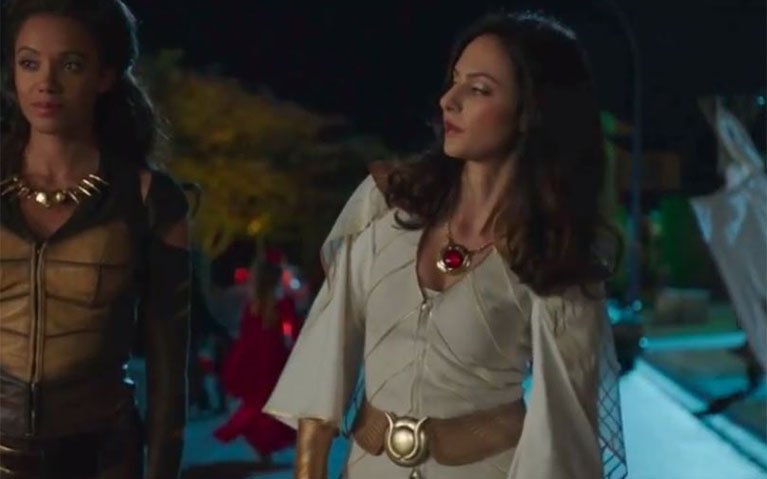
The character also appears in Legends of Tomorrow (first appearing in the episode "Zari", October 2017), but you'd be forgiven for not realizing it. Although she has the amulet, her name in this continuity is Zari Tomaz (though Adrianna is given as a middle name) and she doesn't transform or use the name Isis...but she does wear a much more modest version of the Isis costume as a Halloween costume in the episode "Phone Home" (October 2017).


So yeah, it seems like DC has to be very careful about how they use her, but they were still able to get into the comics universe, even for a brief time!

Friday, January 18, 2019

Flashback Friday: The Wonder Twins

Each Friday, I take one of the entries from my old Super Posts and expand it into its own featured article.

This week: the Wonder Twins!


Super Friends holds a very interesting place in DC Comics fandom. On one hand, it represents almost every comic book stereotype that the industry has fought for decades to avoid - simple, disconnected, sometimes preachy, and often nonsensical stories, told with flat characters and bad art, made only for children. The show is near-singlehandedly responsible for Aquaman's poor reputation, which he has only started to shake in the past few years (thanks, Jason Momoa!) On the other hand, it's also an iconic piece of fiction that nearly everybody watched growing up - for many, being the introduction to this world and these characters - so it's a touchstone that everyone can understand, and creators seemingly can't resist making reference to it when they get the chance.

I think this dilemma goes a long way to explain the odd contortions so many Super Friends characters go through when they finally make it onto the page. Sometimes they'll come in unscathed, like El Dorado, but more often than not, you'll get things like Wonder Dog, the man-eating demon, or Manitou Raven, what Apache Chief would be if he dressed like a voodoo priest. The Wonder Twins are somewhere in the middle.


The Wonder Twins first appeared in the first episode of The All-New Super Friends Hour (segment: "Joy Ride" (1977)).  They were a replacement for Wendy and Marvin, and an improvement; although they still provided the young characters for kids to relate to, they were also superheroes in their own right and could join in on the action.


As an aside, I want to talk about their powers for a second. They are often given as examples of characters with lame powers, but let's examine that. Zan can turn into any form of water. That's usually depicted - especially in parodies - as "a bucket of water" or "an ice slick", but that's also things like any form (and any amount!) of precipitation and ice in any shape. He could also theoretically turn into multiple forms of water at once, meaning he could scald you and freeze you at the same time. Here's Zan as an ice unicycle - if he can turn into complex machinery, he can turn into anything. It's loophole abuse of the highest caliber, but it still counts.


Jayna's EVEN MORE powerful. She can turn into any animal. Any. Animal. Real or mythological, native to Earth or alien, she can do it all. She can turn into a Kryptonian and suddenly have Superman's powers. That's canon.  (Pictured is a Kryptonian animal, but considering she turns into a human in her secret identity, nothing's stopping her from also turning into a Kryptonian person. Regardless, Kryptonian animals have Superman's powers too.)


I'll get off my soapbox now. Anyway, while appearing on the show, they also made appearances in the Super Friends tie-in comic book series, beginning in issue 7 (August 1977). There's some debate over whether Super Friends is part of continuity or not; usually tie-in comics are not, and it's published specifically as a "DC TV Comic". On the other hand, comics of the time were generally written so that they and Super Friends did not contradict each other. If that's the case, this article can pretty much end here.


If it's not the case, though, then they first turned up in comics for real in Extreme Justice #9 (August 1995). To support my earlier point, in this issue the Wonder Twins were the antagonists and the team had to stop them from destroying a town. It was probably a misunderstanding related to them being runaway slaves owned by an alien overlord. The team later emancipates them and they join in issue 16 (March 1996), although they also made a few appearances in between. In addition to their more serious backstory, they're also given more serious outfits - at least from a 1990s point of view.


They faded into obscurity after that series was cancelled, but later appeared in Young Justice #49-52 (September - December 2002) as part of a storyline that included nearly every teenage superhero active at the time. I note this because it gives them new costumes that appear closer to their animated versions, and confirms they are from Exor, just like in the cartoon.


They continued to show up here and there, including on Smallville, of all places...


...but the next important thing to note is their post-Rebirth SERIES that debuts next month (February 2019)! In the closest they've been to their original versions, the series will follow them as they navigate school and Earth life under the tutelage of Superman, while also working at the Hall of Justice.


Finally, I forgot to mention the brief detour they took on Justice League Unlimited as Downpour and Shifter, but you can read more about that here.