Subheader

A forever in-work compendium of Marvel and DC canon immigrants. What's a canon immigrant? Go here to find out!
Showing posts with label Captain America. Show all posts

Wednesday, August 14, 2019

Costume Spotlight: Captain America's Armory

In Captain America #12 (July 2019), we learn that Captain America has an armory of sorts. We've seen this with characters like Iron Man and Batman, but it's a first for good ol' Captain Rogers. In doing so, however, we're treated to a variety of costumes from throughout his history, including a few I wouldn't exactly expect to see.


On the far left is, naturally, the costume from his first appearance in Captain America Comics #1 (1939). But more intriguing is the one next to it. This one isn't from the comics at all, but instead, the 1979 tv movie, and its sequel, Captain America II: Death Too Soon (also 1979).

These movies featured a very different Captain America more inspired by Evel Knievel. There was still a tie to the 40s, though it was because Steve Rogers's father was a famous government agent of the time, also known as Captain America. And there was still a super-soldier serum, though it was more of a super-steroid derived called FLAG (Full Latent Ability Gain) from Steve's father's own physiology. Everything else about the story is different.


The suit after that is the Commander Rogers outfit from circa 2010, but the next two are VERY interesting. The first is Captain America's World War II uniform from The Ultimates #1 (January 2002)...


...and the next is his modern outfit from the same issue. Which means they're from Ultimate Marvel, an entirely different comics universe. What's going on here? Are they relics from the merging of Earth-1610 and Earth-616 in Secret Wars? Or is there some other explanation?


Finally, there's this one. I can't totally be sure it belongs on this site, but I'm including it to put it to the masses. It looks like it's probably from some animated project, but I can't figure out which one. So what say you? Is this suit from some tv or movie, maybe a toy line or Hostess ad? Is it from some comics alternate reality? Or is it just from some run-of-the-mill comics storyline and I simply don't recognize it?


Let me know if you know!

Wednesday, May 9, 2018

Character Spotlight: Captain America (Peggy Carter)

Recently, Marvel has brought back Exiles, a series about a team of superheroes from across the multiverse whose goal is to save the multiverse. This month (May 2018), an alternate Captain America joins the team - Peggy Carter!


This version of Captain America first debuted in Marvel Puzzle Quest in June 2016. Presuming the two characters have the same backstory, this Peggy was friends with Steve Rogers before he became Captain America and took his place in the Super-Soldier Program when he died prematurely.


And this might actually be a double immigrant, because her costume seems to be based on a mixture of the outfits in Captain America: The First Avenger (2011) and Avengers: Age of Ultron (2015), albeit with a dapper tie that Steve didn't have:


Wednesday, January 3, 2018

Item Spotlight: Infinity Stones

These are the Infinity Gems. They have a long history in Marvel Comics, beginning in Marvel Premiere #1 (February 1972), when the Soul Gem first appeared. The rest of them appeared during The Power of Warlock (1972) and were originally called Soul Gems as a group. In The Thanos Quest (1990), Thanos changes the name to Infinity Gems since only one of them controls the soul.


In the MCU, Infinity Stones (note they're not called gems) first confirmed to exist in Thor: The Dark World (2013). However, that's not the first time one appeared.


The Tesseract (aka the Cosmic Cube in the comics) was first mentioned in Iron Man 2 (2010), first appeared in the post-credits scene of Thor (2011), played a major role in Captain America: The First Avenger (2011), and then was first confirmed as an Infinity Stone in Thor: The Dark World (2013). At some point, probably in an interview, the Tesseract was confirmed to be the Space Stone.


The Aether first appeared in Thor: The Dark World (2013). At some point, it was revealed to be the Reality Stone.


The Orb first appeared in Guardians of the Galaxy (2014). It was confirmed to be the Power Stone.


The Mind Stone first appeared (sort of) as the Scepter in The Avengers (2012). The Mind Stone itself was first alluded to in Guardians of the Galaxy (2014), and then first appeared in Avengers: Age of Ultron (2015). As the gem that powers the Vision, it was combined with the Sunstone from the comics.


The Time Stone was first alluded to in Guardians of the Galaxy (2014), then first appeared as the center of the Eye of Agamotto in Doctor Strange (2016).


The Soul Stone (which is orange) has not appeared yet.

As you may have noticed, the colors of the Infinity Stones do not match the colors of the Infinity Gems. Keep that in mind below.

In the Marvel Universe, the universe was rewritten following Secret Wars. In practice, this doesn't mean much. No previous Marvel stories have been erased from existence. But it does allow them to change a few things going forward, and one of those changes is that Infinity Gems are now Infinity Stones. Other properties have changed as well.

They started reappearing in Marvel Legacy #1 (September 2017) with this blue stone.


The next one to appear was this giant purple stone in Guardians of the Galaxy #147 (November 2017). The writer says it's so big because of how much energy it has, but that it can be compressed.


Captain Marvel #126 (November 2017) debuted the next stone, a red one that was found in another reality.


The most recent one was also the first to be specifically named: the Time Stone. As you can see, it is now green. It showed up in Thanos #13 (December 2017). Interestingly, only a piece of it has been found so far, and it was found in the future.


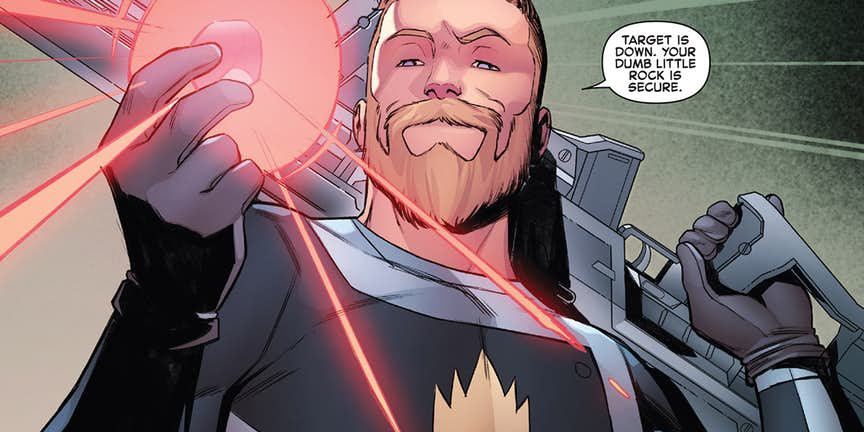
Infinity Countdown Prime #1 (February 2018) shows that Turk Barrett has the Mind Stone...


...and Magus has the Soul Stone, until it's taken by Ultron.


Wednesday, December 6, 2017

Appearance Spotlight: Hydra Logo

Hydra has been around in comics for a long time. In fact, their first appearance was in Strange Tales #135, all the way back in June 1965. And in that time, their organization's logo has pretty much been the same. Here are some examples:


The comics were still using this version of the logo in January 2011 when they published Captain America: Hail Hydra #1, and continued through all five issues of that miniseries:


When Hydra appeared in Captain America: The First Avenger (July 2011), they kept the symbol mostly the same, but they did make a few changes. The most noticeable is that it's red, both to tie in to the Red Skull - who leads it in this version - and to make the color scheme closer to the Nazi Party. The other change is that they made the negative space inside the tentacles resemble gears because this version of Hydra started as the Nazi science division. (There is an interview that confirms this but I can no longer find it. If anyone has a source for this information, please let me know.)


I don't have a definite date for its first appearance (although the earliest date I can find is 2013), but this symbol has become the standard in comics. Here are some examples of that:


As you can see, while all of the pre-2011 examples are green and yellow, the post-2011 examples have started using the red from the movie as well, in some cases.

Wednesday, September 20, 2017

Who Designed Captain America's Shield?

In the comics, Captain America's circular shield was designed by Myron Maclain. Surprisingly, we don't learn this until Avengers #66 (May 1969).


In Captain America: The First Avenger (2011), we learn that Howard Stark - Iron Man's father - was a key member of the Super Soldier Program and designed the shield himself.


In Captain America: White #3 (2015), however, Cap mentions he believes Howard Stark invented it.


This is an interesting canon immigrant because it's not concrete. We don't see Howard Stark working on it; it doesn't even say for sure that he did invent it. All we know is that Steve heard he invented it. This allows writers going forward to keep it Myron Maclain or change it to Howard Stark and pretty much be right either way.

Wednesday, March 22, 2017

Character Spotlight: Gail Richards

This is a minor one, but it's still neat.

In The Ultimates #1 (January 2002), we see that Captain America, aka Steve Rogers, is engaged to a girl named Gail.


In The Ultimates #3 (March 2002), paying close attention reveals that Gail's last name is Richards


So what does this all mean? In the serial Captain America (1944), Gail Richards is the secretary and love interest of Captain America, aka District Attorney Grant Gardner.


As you might guess, the serial was quite different from the comics of the time. But interestingly, the serial itself exists within Marvel Comics continuity, presumably because Captain America's identity was classified at the time it was made. Whether intentional or not, the existence of the serial in the comics may provide a good example of why Gail Richards or Grant Gardner have never appeared in the comics personally (excluding Ultimate Marvel, that is).

Wednesday, February 15, 2017

Country Spotlight: Sokovia

This one took me by surprise, though it probably shouldn't have since it's become such a turning point in the MCU.

In Avengers: Age of Ultron (May 2015), we're introduced to an Eastern European country called Sokovia. Sokovia is a major part of the story as that's where Baron Strucker's base is, that's where Scarlet Witch and Quicksilver live, and that's where Ultron decides to attack. It continues to be important in Captain America: Civil War (May 2016), because it's where Zemo's from and it's (obviously) a large part of the reason behind the Sokovia Accords.


Here's the weird part: I'm not entirely sure why they created Sokovia for the movie. In the comics, Scarlet Witch and Quicksilver are from the Eastern European country Transia, and that would've worked just as well.

Regardless, Sokovia is here, and it makes sense that the comics would eventually use it, which they did in Captain America: Steve Rogers #5 (September 2016):


Sokovia also appears in issue 7. Whether it'll become a staple of the Marvel Universe like Wakanda or Madripoor remains to be seen.


Wednesday, February 1, 2017

Group Spotlight: Strategic Scientific Reserve

The Strategic Scientific Reserve is one of the most interesting additions to the Marvel canon that the Marvel Cinematic Universe has made. Basically, what they did is use real history to fill in a story gap and create a connection to the present that wasn't there previously.

In the comics, you have Project Rebirth, which seems to be just an Army experiment, and then later on you have SHIELD. But the MCU said, "well, in real life the CIA was preceded during war time by the OSS? What if SHIELD was the same way?" Enter the SSR. This also allowed them to give the Howling Commandos ties to SHIELD despite not being led by Nick Fury in this continuity.


Which brings us to another alternate reality, but one in the comics this time: Spider-Gwen. Spider-Gwen is set on Earth-65, which is similar to the main Marvel universe on the surface, but with differences here and there. The differences generally fall into one of two categories - (1) characters are the opposite of what you'd expect; Peter Parker was the Lizard, Matt Murdock is the Kingpin, Frank Castle is a cop, or (2) women are put to the forefront; Gwen Stacy is Spider-Woman, Peggy Carter runs SHIELD, Captain America is named Samantha Wilson.

In Spider-Gwen #2 (November 2015), we get a lot of Captain America's backstory. The first part comes in a flashback, where we see the SSR in action:


But we don't learn it's the SSR until a text piece in the back, which gives a fuller history of the character:


It's not the 616 universe, which is a little disappointing, but I'm hoping this is the first step to learning the organization existed there in some capacity as well.