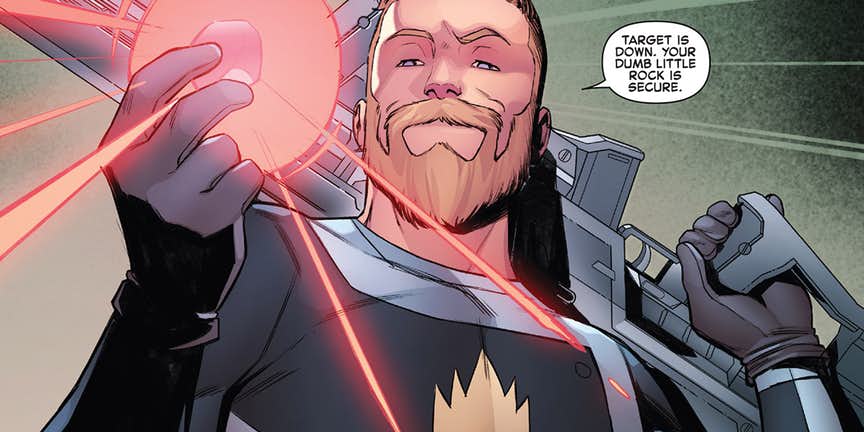
The current and most well-known version of the Guardians of the Galaxy team formed in the 2006 event, Annihilation. Eight years later, they received their own movie, 2014's Guardians of the Galaxy. In that time, they appeared in 75 issues across multiple titles. In the five years since then, they have appeared in over 200 issues. That is almost entirely due to the success they've had on film. So it's no surprise the comics have steadily changed to make them more like their movie counterparts, from character designs like Star-Lord and Nebula, to new concepts like the Milano and the Ravagers, to relationships like Nebula and Gamora. It's another Gamora relationship we'll talk about today, this time between her and Star-Lord.
In the comics, Gamora does have a romantic relationship with a fellow Guardian, but it's Nova, aka Richard Rider. This is first seen in Annihilation #1 (August 2006) and lasts until his death in the Cancerverse (Guardians of the Galaxy #20, June 2014).
In the films, however, Gamora has a relationship with Star-Lord. In the first film it's mostly flirting, but they're officially together during the second film.
But this all changed in the latest volume of Guardians of the Galaxy. Although it's been building since Infinity Wars, they officially get together in Guardians of the Galaxy #7 (July 2019).
Is this a temporary thing or will they go the distance? Only time will tell.
Subheader
A forever in-work compendium of Marvel and DC canon immigrants. What's a canon immigrant? Go here to find out!
Showing posts with label Guardians of the Galaxy. Show all posts
Wednesday, September 25, 2019
Wednesday, July 10, 2019
Nebula's Appearance
Sometimes, in comic book adaptations, a detail can be based on something that's already extant in the comics, but changed ever so slightly for the new medium. When it comes to designs, this usually means making the design more intricate. Of course, because canon immigration is essentially inescapable, then the more intricate design finds its way into the comics. This is what happened with Nebula.
Sometimes when this happens, it takes me a while to learn it happened. This is also what happened with Nebula.
When Nebula first appeared in The Avengers #257 (May 1985), she was a pirate who had seized control of Thanos's ship, the Sanctuary II, in a period when he was presumed dead. She claimed to be his granddaughter, and she looked like this:
In Silver Surfer #69 (June 1992), she's catatonic, so one of the people looking after her takes her to Dr. Mandibus to get her back to normal. In Silver Surfer #72 (July 1992), we see that Dr. Mandibus was able to restore her mental capacity, but turned her into a cyborg to do so.
She shows up again in Silver Surfer #110 (September 1995), and she mostly looks the same except she's grown her hair out again.
In Nova #1 (March 1999), however, she's back to her original look.
But in her next appearance, Annihilation: Ronan #1 (April 2006), she's back to being a bald cyborg. She continues to look this way through the rest of the Annihilation event.
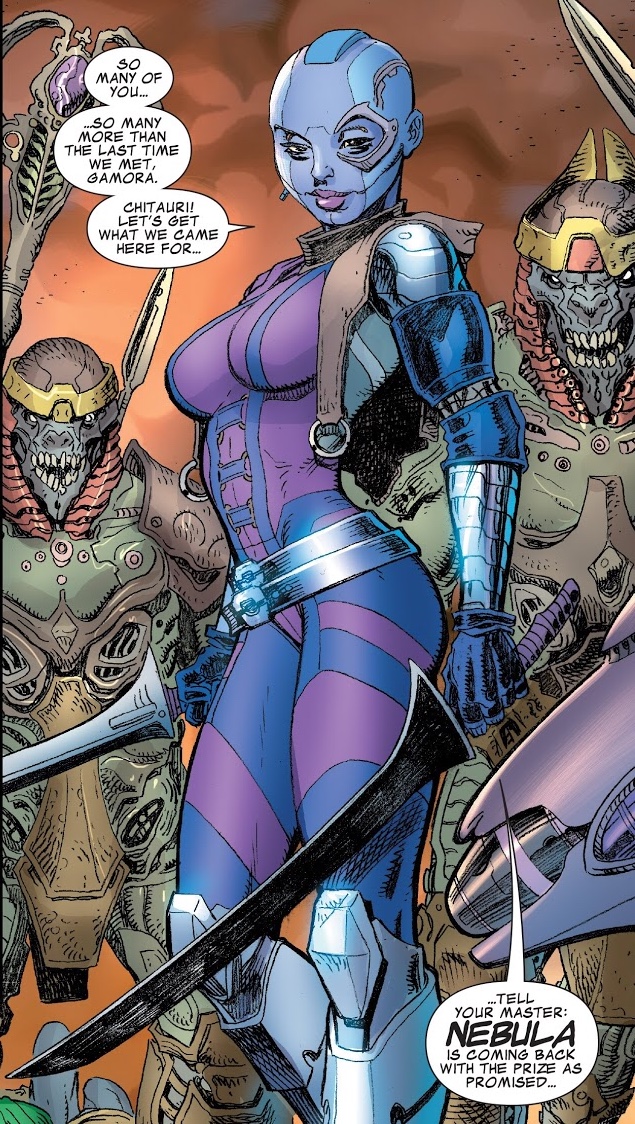
The modern Guardians of the Galaxy spun out of the Annihilation event, so it's no surprise that, when Guardians of the Galaxy was released in 2014, Nebula's look was based on how she appeared in Annihilation. Overall it's simply a more detailed version of the look above. The most major change is the stripe down the middle of her face, which I believe is meant to mimic the stripe down her chest that's present in most of the images above.
Guardians of the Galaxy was a huge hit, so it's no surprise that, when she appeared in Guardians Team-Up #1 (March 2015) - itself a book that wouldn't exist without the movie - she appeared as she does in the movie. Notably, she's flanked by Chitauri, another case of appearance canon immigration.
And she's appeared that way ever since!
That's not the only change to Nebula the movie made, but we'll get to that next week.
Sometimes when this happens, it takes me a while to learn it happened. This is also what happened with Nebula.
When Nebula first appeared in The Avengers #257 (May 1985), she was a pirate who had seized control of Thanos's ship, the Sanctuary II, in a period when he was presumed dead. She claimed to be his granddaughter, and she looked like this:
In Silver Surfer #69 (June 1992), she's catatonic, so one of the people looking after her takes her to Dr. Mandibus to get her back to normal. In Silver Surfer #72 (July 1992), we see that Dr. Mandibus was able to restore her mental capacity, but turned her into a cyborg to do so.
She shows up again in Silver Surfer #110 (September 1995), and she mostly looks the same except she's grown her hair out again.
In Nova #1 (March 1999), however, she's back to her original look.
But in her next appearance, Annihilation: Ronan #1 (April 2006), she's back to being a bald cyborg. She continues to look this way through the rest of the Annihilation event.
The modern Guardians of the Galaxy spun out of the Annihilation event, so it's no surprise that, when Guardians of the Galaxy was released in 2014, Nebula's look was based on how she appeared in Annihilation. Overall it's simply a more detailed version of the look above. The most major change is the stripe down the middle of her face, which I believe is meant to mimic the stripe down her chest that's present in most of the images above.
Guardians of the Galaxy was a huge hit, so it's no surprise that, when she appeared in Guardians Team-Up #1 (March 2015) - itself a book that wouldn't exist without the movie - she appeared as she does in the movie. Notably, she's flanked by Chitauri, another case of appearance canon immigration.
And she's appeared that way ever since!
That's not the only change to Nebula the movie made, but we'll get to that next week.
Wednesday, August 1, 2018
Vehicle Spotlight: The Milano
I've been waiting to feature this one for almost a year, but I could never find visual proof...until now.
Many people don't know this, but the film Guardians of the Galaxy (2014) took a lot of liberties with the property. Although the main cast matches the post-Annihilation version of the team, a good chunk - possibly a majority - of the rest of the movie is original to it, even including some of the main characters' personalities and backstories. One such example is the Milano, Star-Lord's personal Ravager ship.
In the comics, the Guardians used a much different ship. However, beginning in All-New Guardians of the Galaxy, the team was suddenly using the Milano - name and all, despite the fact that the name is pretty dependent on Quill's man-out-of-time-who-grew-up-in-the-80s persona that doesn't really jib with the backstory of the comics version. The ship first appeared in All-New Guardians of the Galaxy #1 (May 2017).
Its origin is given a couple days later in Free Comic Book Day: All-New Guardians of the Galaxy 2017 (May 2017), where we learn the Guardians' ship was impounded by the Nova Corps, and they went to steal it back but decided to take the Milano instead.
Many people don't know this, but the film Guardians of the Galaxy (2014) took a lot of liberties with the property. Although the main cast matches the post-Annihilation version of the team, a good chunk - possibly a majority - of the rest of the movie is original to it, even including some of the main characters' personalities and backstories. One such example is the Milano, Star-Lord's personal Ravager ship.
In the comics, the Guardians used a much different ship. However, beginning in All-New Guardians of the Galaxy, the team was suddenly using the Milano - name and all, despite the fact that the name is pretty dependent on Quill's man-out-of-time-who-grew-up-in-the-80s persona that doesn't really jib with the backstory of the comics version. The ship first appeared in All-New Guardians of the Galaxy #1 (May 2017).
Its origin is given a couple days later in Free Comic Book Day: All-New Guardians of the Galaxy 2017 (May 2017), where we learn the Guardians' ship was impounded by the Nova Corps, and they went to steal it back but decided to take the Milano instead.
Wednesday, January 3, 2018
Item Spotlight: Infinity Stones
These are the Infinity Gems. They have a long history in Marvel Comics, beginning in Marvel Premiere #1 (February 1972), when the Soul Gem first appeared. The rest of them appeared during The Power of Warlock (1972) and were originally called Soul Gems as a group. In The Thanos Quest (1990), Thanos changes the name to Infinity Gems since only one of them controls the soul.
In the MCU, Infinity Stones (note they're not called gems) first confirmed to exist in Thor: The Dark World (2013). However, that's not the first time one appeared.
The Tesseract (aka the Cosmic Cube in the comics) was first mentioned in Iron Man 2 (2010), first appeared in the post-credits scene of Thor (2011), played a major role in Captain America: The First Avenger (2011), and then was first confirmed as an Infinity Stone in Thor: The Dark World (2013). At some point, probably in an interview, the Tesseract was confirmed to be the Space Stone.
The Aether first appeared in Thor: The Dark World (2013). At some point, it was revealed to be the Reality Stone.
The Orb first appeared in Guardians of the Galaxy (2014). It was confirmed to be the Power Stone.
The Mind Stone first appeared (sort of) as the Scepter in The Avengers (2012). The Mind Stone itself was first alluded to in Guardians of the Galaxy (2014), and then first appeared in Avengers: Age of Ultron (2015). As the gem that powers the Vision, it was combined with the Sunstone from the comics.
The Time Stone was first alluded to in Guardians of the Galaxy (2014), then first appeared as the center of the Eye of Agamotto in Doctor Strange (2016).
The Soul Stone (which is orange) has not appeared yet.
As you may have noticed, the colors of the Infinity Stones do not match the colors of the Infinity Gems. Keep that in mind below.
In the Marvel Universe, the universe was rewritten following Secret Wars. In practice, this doesn't mean much. No previous Marvel stories have been erased from existence. But it does allow them to change a few things going forward, and one of those changes is that Infinity Gems are now Infinity Stones. Other properties have changed as well.
They started reappearing in Marvel Legacy #1 (September 2017) with this blue stone.
The next one to appear was this giant purple stone in Guardians of the Galaxy #147 (November 2017). The writer says it's so big because of how much energy it has, but that it can be compressed.
Captain Marvel #126 (November 2017) debuted the next stone, a red one that was found in another reality.
The most recent one was also the first to be specifically named: the Time Stone. As you can see, it is now green. It showed up in Thanos #13 (December 2017). Interestingly, only a piece of it has been found so far, and it was found in the future.
Infinity Countdown Prime #1 (February 2018) shows that Turk Barrett has the Mind Stone...
...and Magus has the Soul Stone, until it's taken by Ultron.
In the MCU, Infinity Stones (note they're not called gems) first confirmed to exist in Thor: The Dark World (2013). However, that's not the first time one appeared.
The Tesseract (aka the Cosmic Cube in the comics) was first mentioned in Iron Man 2 (2010), first appeared in the post-credits scene of Thor (2011), played a major role in Captain America: The First Avenger (2011), and then was first confirmed as an Infinity Stone in Thor: The Dark World (2013). At some point, probably in an interview, the Tesseract was confirmed to be the Space Stone.
The Aether first appeared in Thor: The Dark World (2013). At some point, it was revealed to be the Reality Stone.
The Orb first appeared in Guardians of the Galaxy (2014). It was confirmed to be the Power Stone.
The Mind Stone first appeared (sort of) as the Scepter in The Avengers (2012). The Mind Stone itself was first alluded to in Guardians of the Galaxy (2014), and then first appeared in Avengers: Age of Ultron (2015). As the gem that powers the Vision, it was combined with the Sunstone from the comics.
The Time Stone was first alluded to in Guardians of the Galaxy (2014), then first appeared as the center of the Eye of Agamotto in Doctor Strange (2016).
The Soul Stone (which is orange) has not appeared yet.
As you may have noticed, the colors of the Infinity Stones do not match the colors of the Infinity Gems. Keep that in mind below.
In the Marvel Universe, the universe was rewritten following Secret Wars. In practice, this doesn't mean much. No previous Marvel stories have been erased from existence. But it does allow them to change a few things going forward, and one of those changes is that Infinity Gems are now Infinity Stones. Other properties have changed as well.
They started reappearing in Marvel Legacy #1 (September 2017) with this blue stone.
The next one to appear was this giant purple stone in Guardians of the Galaxy #147 (November 2017). The writer says it's so big because of how much energy it has, but that it can be compressed.
Captain Marvel #126 (November 2017) debuted the next stone, a red one that was found in another reality.
The most recent one was also the first to be specifically named: the Time Stone. As you can see, it is now green. It showed up in Thanos #13 (December 2017). Interestingly, only a piece of it has been found so far, and it was found in the future.
Infinity Countdown Prime #1 (February 2018) shows that Turk Barrett has the Mind Stone...
...and Magus has the Soul Stone, until it's taken by Ultron.
Wednesday, May 3, 2017
Character Spotlight: Baby Groot
He is Groot.
Groot has been killed and regrown before, but in the past, it always happened as a proportionally smaller version of himself. (I believe this is from Guardians of the Galaxy #1 (May 2008), but I could be wrong. Definitely that run, anyway.)
In Guardians of the Galaxy (2014), and especially Guardians of the Galaxy vol. 2 (2017), the new Groot, aka "Baby Groot", has child-like proportions and is considered a new character.
This is also the case in the new series, I Am Groot, out this month.
Groot has been killed and regrown before, but in the past, it always happened as a proportionally smaller version of himself. (I believe this is from Guardians of the Galaxy #1 (May 2008), but I could be wrong. Definitely that run, anyway.)
In Guardians of the Galaxy (2014), and especially Guardians of the Galaxy vol. 2 (2017), the new Groot, aka "Baby Groot", has child-like proportions and is considered a new character.
This is also the case in the new series, I Am Groot, out this month.
Friday, January 29, 2016
Character/Team Spotlight: Yondu and the Ravagers
Although it's happened before, it's not often you see characters who already exist become canon immigrants as well thanks to some creative adaptations, but that's exactly what has happened here.
Yondu Udonta first appeared as a member of the Guardians of the Galaxy in Marvel Super-Heroes #18 (November 1968). As a Centaurian, he's a walking Native American stereotype, with loincloth, mohawk - headfin, excuse me, bow and arrow, and an empathic link to nature.
When Yondu appeared in the Guardians of the Galaxy movie (2014), he was...not that. He wasn't even a Guardian of the Galaxy, but instead the leader of a gang of space pirates called the Ravagers.
As you can see, he still has the mohawk, but it seems more like an implant than a natural part of him, and with the rest of his changes, it plays more to a biker persona than a Native American one. He also uses an arrow as a weapon, but divorced from the bow, it seems less stereotypical as well.
As the comics version of the Guardians of the Galaxy - at least the version hat Yondu is a member of - lives in an alternate future, this version was brought into comics as Yondu's ancestor (also named Yondu), the leader of a gang of space pirates called the Ravagers.
Yondu first appeared in Star-Lord #1 (November 2015), while the Ravagers first appeared in Star-Lord #2 (December 2015). As in the movie, Star-Lord joins their team for a while.
Yondu Udonta first appeared as a member of the Guardians of the Galaxy in Marvel Super-Heroes #18 (November 1968). As a Centaurian, he's a walking Native American stereotype, with loincloth, mohawk - headfin, excuse me, bow and arrow, and an empathic link to nature.
When Yondu appeared in the Guardians of the Galaxy movie (2014), he was...not that. He wasn't even a Guardian of the Galaxy, but instead the leader of a gang of space pirates called the Ravagers.
As you can see, he still has the mohawk, but it seems more like an implant than a natural part of him, and with the rest of his changes, it plays more to a biker persona than a Native American one. He also uses an arrow as a weapon, but divorced from the bow, it seems less stereotypical as well.
As the comics version of the Guardians of the Galaxy - at least the version hat Yondu is a member of - lives in an alternate future, this version was brought into comics as Yondu's ancestor (also named Yondu), the leader of a gang of space pirates called the Ravagers.
Yondu first appeared in Star-Lord #1 (November 2015), while the Ravagers first appeared in Star-Lord #2 (December 2015). As in the movie, Star-Lord joins their team for a while.
Tuesday, November 18, 2014
Appearance Spotlight: Star-Lord
Star-Lord has had a few different looks over the years. When he first appeared in Marvel Preview #4 (December 1975), he looked like this:
When he came back as part of "Annihilation", he looked like this:
And until around May of this year, he looked like this:
In the Guardians of the Galaxy movie, which was released August 2014, Star-Lord had a look inspired by his "Annihilation" look, but overall a pretty big departure:
Finally, in June 2014 (but cover dated August 2014), Guardians of the Galaxy #16 showed off Star-Lord's new look, which looks pretty familiar:
When he came back as part of "Annihilation", he looked like this:
And until around May of this year, he looked like this:
In the Guardians of the Galaxy movie, which was released August 2014, Star-Lord had a look inspired by his "Annihilation" look, but overall a pretty big departure:
Finally, in June 2014 (but cover dated August 2014), Guardians of the Galaxy #16 showed off Star-Lord's new look, which looks pretty familiar:
Subscribe to:
Posts (Atom)