The trouble with doing a blog like this is that sometimes things are so well known that you think you've covered it already, but you actually haven't! This happened to me last week when talking about Krypton's prison rings; I mentioned an example and went to link to it, only to discover I'd never written about it before. Luckily, I needed a post for this final week of the year, so it works out. And that example - which you already know if you've read the title - is Jor-El's hologram.
See, everyone knows that Jor-El sent a baby Superman to Earth in a rocket to save him from the exploding Krypton. And for a long time, that was the story. Superman eventually learned about Krypton through time travel, Phantom Zone criminals, and various things that fell to Earth, but it was something that happened over time.
That was not the case in Superman: The Movie (1976). This depiction that Clark come to Earth with a crystal that, when dropped into the Arctic Circle for whatever reason, formed the Fortress of Solitude. Inside the Fortress was a hologram of Jor-El that could tell Superman pretty much anything he wanted to know about Krypton or any other location in the 28 known galaxies.
Originally, this did not affect the comics at all. In fact, even when Superman's origin was updated in the 80s, it would've been impossible because Superman's ship was a "birthing matrix" that housed an unborn Kal-El. There was nothing that would hold a crystal or anything else. But when they updated his origin again in Superman: Birthright (2003 - 2004), we see that - perhaps because they reverted to the rocket of the classic origin - Jor-El packed a tablet in the rocket that acts as a Kryptonian encyclopedia. However, despite the tablet passing a very brief message from the adult Superman back to Jor-El and Lara, it does not allow for a Jor-El AI to act as a surrogate father figure, as in the movie and Smallville versions.
That all changed in Action Comics #844 (October 2006), around the same time the Fortress of Solitude came to resemble the one from the movies. Now Jor-El was a fully interactive hologram.
Thankfully it didn't stick. My personal belief is that Superman should have as little interaction with Jor-El as possible; my ideal version of Superman considers the Kents his real parents and has an alive Jonathan (and Martha) to talk to when he needs help. It seems a lot of people disagree with me on this point, however.
Subheader
A forever in-work compendium of Marvel and DC canon immigrants. What's a canon immigrant? Go here to find out!
Showing posts with label DC Other. Show all posts
Wednesday, December 25, 2019
Wednesday, December 18, 2019
Gadget Spotlight: Kryptonian Prison Rings
For some reason, people love Superman: The Movie. I don't get it, personally. Although Christopher Reeve is perfect as Clark Kent and Superman, nearly everything else about it falls flat for me. Especially the aesthetic, particularly the Kryptonian aesthetic. Still, people love it for some reason, so the aesthetic has crept into most modern adaptations, even when it doesn't make any sense. (Seriously, why would the Fortress of Solitude - which is meant to be Superman's home away from home - look like an ice cave instead of actually cozy and livable? It's silly. But I digress.)
With the comics, this happened for the first time - as far as I know - in 2006 when Geoff Johns took over writing Action Comics. Among other changes, suddenly the Fortress was crystal, Jor-El was a hologram, Ben Hubbard appeared, and Zod's crew (now Ursa and Non) dressed all in black. Also, the Kryptonian prison rings debuted.
In the movie (1976), we see Zod, Ursa, and Non imprisoned in spinning rings while they wait to be sent to the Phantom Zone.
In Action Comics #846 (December 2006), we get a hint to this technology when we see Phantom Zone criminals with rings around them.
Action Comics Annual #10 (January 2007) shows Zod, Ursa, and Non in a more standard depiction of the rings.
And Superman: World of New Krypton #5 (July 2009) shows the rings on the cover and throughout the book.
To my knowledge, they have not been seen since, and thank goodness for that.
Friday, November 15, 2019
Flashback Friday: Granville, Kansas
Each Friday, I take one of the entries from my old Super Posts and expand it into its own featured article.
This week: Granville, Kansas!
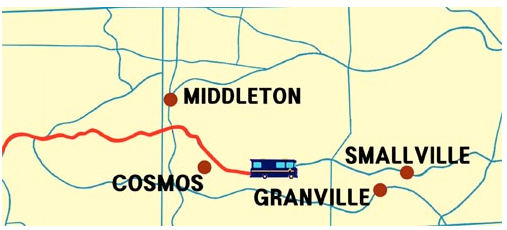
Granville first appeared in Smallville as a neighboring city of Smallville. In the episode "Accelerate" (May 2003), Clark tracks the father of a childhood friend of Lana's to the city. Granville continued to be mentioned or appear once a season until season 8. This is a good name because it plays off the size angle - Small vs Grand - but it's also a reference to Smallville's production. The show (and most genre television) was filmed in Vancouver, which was originally known as Granville.
It appeared in a similar capacity in Superman/Batman #13 (August 2004). It has appeared a few times since then, but details on the internet are scarce so I can't find another mention. I know I've seen it, though, and recently. If you have a lead, let me know!
For the sake of full disclosure, I should point out that Action Comics #791 (May 2002) mentions a "Grandville". This is possibly a case of parallel thinking, or - since the issue is a flashback to Clark's high school days published at the tail end of Smallville season one - possibly a use of information from the Smallville writers' room that hadn't made its way on screen yet. Either way, the spelling of the town's name is a canon immigrant even if the town itself might not be.
One final note: Granville was also seen on a map in Batman: The Brave and the Bold's "Aquaman's Outrageous Adventure!" (January 2010).
Wednesday, November 13, 2019
Smallville Crows
Minor details are often canon immigrants, but that can be tricky for me to prove because it's hard to say for sure I'm right without reading through every possible appearance. So I do my best to support my case; if you can evidence that proves me wrong, let me know!
Today we'll be talking about Smallville High's mascot. It seems like, for most of history, Smallville's mascot was whatever the creators wanted it to be at the time. In Superboy #121 (April 1965), it was the Tigers.
While they were the Smallville Giants in Adventures of Superman #474 (November 1990).
And Smallville had them as the Crows ("Pilot", 2001).
In Action Comics #791 (May 2002), which I should point out was published at the end of Smallville season one, the team is also called the Crows.
Superman/Batman Secret Files & Origins (September 2003) continues this trend during a story about Lex's time in high school...another thing Smallville re-established.
I can't find any evidence of the Smallville High team name after these appearances, so I have no idea if it's still the Crows or not. But, for a time at least, it was.
Friday, October 18, 2019
Flashback Friday: The Batcave
Each Friday, I take one of the entries from my old Super Posts and expand it into its own featured article.
This week: The Batcave!
Originally, the closest thing Batman had to a Batcave was an old barn he used for a hangar/garage, which he accessed via underground tunnel connected to Wayne Manor. You can see it here in Detective Comics #48 (December 1940).
In Batman #12 (June 1942), we see underground hangars as an extension of the above idea, but they're presented as man-made. Incidentally, Batman #12 is the first appearance of Batman's trophy room, which is housed in Wayne Manor and mainly exists as a way for Batman and Robin to talk about past cases.
In 1943, Batman received his first serial, also called Batman. In it, Batman was a government agent and his base was a cave called The Bat's Cave, which debuted in the chapter of the same name (July 1943). It didn't house much except a desk and some science equipment. Although it was thematically appropriate, the only reason for it was as a money-saving measure since the studio already had a cave set.
It was thematically appropriate, though, so the Batcave itself first appeared in Detective Comics #83 (November 1943). Note that the image is essentially the same as the one above, only now drawn so that it exists in a natural cave. Also note that they've moved the trophy room into the Batcave.
Interestingly, Detective Comics #205 (January 1954) shows that Bruce originally planned to use the barn as his base of operations, but he fell through the floor and discovered the cave. That's a neat way to smooth that history!...although you'll also notice this says Bruce bought Wayne Manor as an adult, which is its own continuity snafu.
The Batcave, of course, has become a major part of the Batman mythos, appearing in every film and tv adaptation since, even the "grounded" Christopher Nolan films. It also, of course, continued to appear in comics after the New 52 and Rebirth.
Friday, September 20, 2019
Flashback Friday: Hall of Justice
Each Friday, I take one of the entries from my old Super Posts and expand it into its own featured article.
This week: the Hall of Justice!
The Hall of Justice first appeared as the Justice League headquarters in first episode of the Super Friends animated series (September 1973). It quickly became a trademark of the series, especially during Challenge of the Super Friends when it was contrasted with the equally iconic Legion of Doom headquarters. Here's an interesting piece of trivia for you: the Hall was based on Cincinatti's Union Terminal:
The Hall of Justice first appeared in comics in Super Friends #1 (September 1976), but since DC TV comics are...complicated in terms of continuity, we'll keep going.
The designed was used in Kingdom Come (1996) as the United Nations headquarters...
...but the actual Hall of Justice debuted in Justice League of America #7 (March 2007) as one half of the JLA's new headquarters (the other half being the Satellite Watchtower).
Since then it has become a mainstay. It technically continued to exist in the New 52, although it was blown up in the first month, in Justice League International #1 (September 2011).
It was then rebuilt following the destruction of the Watchtower, and the new version debuted in Justice League #1 (June 2018).
It has also been featured as - or inspired the look of - headquarters in many adaptations. I won't list them all, but some examples include the Arrowverse...
...Young Justice...
...The Batman...
...and Batman: The Brave and the Bold.
This week: the Hall of Justice!
The Hall of Justice first appeared as the Justice League headquarters in first episode of the Super Friends animated series (September 1973). It quickly became a trademark of the series, especially during Challenge of the Super Friends when it was contrasted with the equally iconic Legion of Doom headquarters. Here's an interesting piece of trivia for you: the Hall was based on Cincinatti's Union Terminal:
The Hall of Justice first appeared in comics in Super Friends #1 (September 1976), but since DC TV comics are...complicated in terms of continuity, we'll keep going.
...but the actual Hall of Justice debuted in Justice League of America #7 (March 2007) as one half of the JLA's new headquarters (the other half being the Satellite Watchtower).
Since then it has become a mainstay. It technically continued to exist in the New 52, although it was blown up in the first month, in Justice League International #1 (September 2011).
It was then rebuilt following the destruction of the Watchtower, and the new version debuted in Justice League #1 (June 2018).
It has also been featured as - or inspired the look of - headquarters in many adaptations. I won't list them all, but some examples include the Arrowverse...
...Young Justice...
...The Batman...
...and Batman: The Brave and the Bold.
Friday, September 6, 2019
Flashback Friday: Kal-El's (and Kal-L's) Name
Each Friday, I take one of the entries from my old Super Posts and expand it into its own featured article.
This week: Kal-El's name (and Kal-L's)!
Everyone knows Superman debuted in Action Comics #1 (April 1938), and that's where his origin was told for the first time. What many people don't realize is how bare-bones the origin was at the time. A scientist on a dying planet sent his infant son into space, where he landed on Earth, grew up as Clark Kent, and used his superpowers as Superman.
All of that is still accurate today, but it's missing a lot of detail. Luckily, Superman became very popular very quickly, so in January 1939, a Superman comic strip started - which, incidentally, was Jerry Siegel and Joe Shuster's preferred format for Superman in the first place (the first Superman story was simply the first 38 strips they had produced when they were shopping the character around). This new strip allowed them a do-over, so it started with a more detailed origin, where we learn the baby's name is Kal-L in the first strip ("Superman Comes to Earth").
Over time, it was established that one of the differences between Earth-One and Earth-Two is Kryptonian naming conventions, with Earth-One using "-El" and Earth-Two using "-L". The name "Kal-L" would appear as the birthname of the Superman of Earth-Two in Action Comics #484 (April 1978).
In the New 52, the primary Earth's Superman is still called Kal-El, but Earth-2's Superman is also called Kal-El. However, the Pre-Crisis Earth-Two's Superman is still known as Kal-L when he appears (such as in Convergence: Action Comics #1, April 2015).
This week: Kal-El's name (and Kal-L's)!
Everyone knows Superman debuted in Action Comics #1 (April 1938), and that's where his origin was told for the first time. What many people don't realize is how bare-bones the origin was at the time. A scientist on a dying planet sent his infant son into space, where he landed on Earth, grew up as Clark Kent, and used his superpowers as Superman.
All of that is still accurate today, but it's missing a lot of detail. Luckily, Superman became very popular very quickly, so in January 1939, a Superman comic strip started - which, incidentally, was Jerry Siegel and Joe Shuster's preferred format for Superman in the first place (the first Superman story was simply the first 38 strips they had produced when they were shopping the character around). This new strip allowed them a do-over, so it started with a more detailed origin, where we learn the baby's name is Kal-L in the first strip ("Superman Comes to Earth").
Superman's origin was re-told again when he got his own series (Superman #1, April 1939), but it didn't include the baby's Kryptonian name.
Soon after, Superman got a radio adaptation and one of the radio show's writers, George Lowther, wrote a book called The Adventures of Superman (1942). In this re-telling of his origin, his name is spelled "Kal-el" for the first time. I couldn't find proof of that, but here is an image from the book of "Jor-el" being spelled the same way.
Surprisingly, the spelling "Kal-El" (with or without a capital) wouldn't appear in comics until Superman #113 (March 1957).
In the New 52, the primary Earth's Superman is still called Kal-El, but Earth-2's Superman is also called Kal-El. However, the Pre-Crisis Earth-Two's Superman is still known as Kal-L when he appears (such as in Convergence: Action Comics #1, April 2015).
Wednesday, August 21, 2019
Clayface's New Origin
Many people are unaware of this, but there have been several people who have gone by the name "Clayface" over the course of Batman's history. Arguably the two most important are the first and second ones. The original was an actor named Basil Karlo who, in his first appearance at least, wore the costume of a movie monster he played (Clayface) to attack people connected to a remake of one of his movies. The second, Matt Hagen, was a treasure hunter who touched some protoplasm and gained the powers to reshape his body, but the effects were temporary and he would continually have to return to the protoplasm to regain his powers.
These two characters were combined to create Batman: The Animated Series's version of Clayface, who first appeared in the two-part episode, "Feat of Clay" (September 1992). In this series, Matt Hagen was a famous actor until a car accident ruined his face. Since then, he has started working for Roland Daggett, who gives him a substance called Renuyu each month that allows Matt to reshape his face - and therefore also lets him look like other people. Daggett uses Matt's abilities for corporate espionage and asks him to try to kill Lucius Fox while disguised as Bruce Wayne to help facilitate a merger between Daggett's and Wayne's companies. The plan doesn't work, so Daggett cuts off Matt from Renuyu, and when Matt breaks into the factory to get some, Daggett's goons cover Matt with it and force him to drink liters of the stuff. This, of course, turns Matt into Clayface.
Matt Hagen is the only Clayface in the DC Animated Universe, but the comics are less picky. Prior to this series, there were four, which is not that surprising. There were also multiple Two-Faces and Mad Hatters, for instance, for reasons we won't really get into. But unlike these other characters, DC has continued to introduce new Clayfaces, for a total of nine as of this writing.
That being said, the comics likewise seem to have settled on Basil Karlo as the "main" Clayface, and to that end, featured a retelling of his origin in Detective Comics Annual 2018. Although it's not an exact retelling of "Feat of Clay", it does feature more beats from that than from Basil Karlo's original debut in Detective Comics #40 (April 1940). His face is disfigured in a car accident, and he fixes that using a chemical called Renu - no "yu" on the end in this version, since it's not meant to be a cosmetic...
...which is still made by Roland Daggett's company, spelled with one "t" in this version for reasons that aren't clear.
Similarly, being doused with loads of the Renu turns Karlo into a hulking mass of goo like the animated Clayface.
This, however, is NOT the first time The Animated Series has influenced Clayface's appearance. I've previously written about that. It's due for a Flashback Friday, but I don't know when I'll get around to it.
These two characters were combined to create Batman: The Animated Series's version of Clayface, who first appeared in the two-part episode, "Feat of Clay" (September 1992). In this series, Matt Hagen was a famous actor until a car accident ruined his face. Since then, he has started working for Roland Daggett, who gives him a substance called Renuyu each month that allows Matt to reshape his face - and therefore also lets him look like other people. Daggett uses Matt's abilities for corporate espionage and asks him to try to kill Lucius Fox while disguised as Bruce Wayne to help facilitate a merger between Daggett's and Wayne's companies. The plan doesn't work, so Daggett cuts off Matt from Renuyu, and when Matt breaks into the factory to get some, Daggett's goons cover Matt with it and force him to drink liters of the stuff. This, of course, turns Matt into Clayface.
That being said, the comics likewise seem to have settled on Basil Karlo as the "main" Clayface, and to that end, featured a retelling of his origin in Detective Comics Annual 2018. Although it's not an exact retelling of "Feat of Clay", it does feature more beats from that than from Basil Karlo's original debut in Detective Comics #40 (April 1940). His face is disfigured in a car accident, and he fixes that using a chemical called Renu - no "yu" on the end in this version, since it's not meant to be a cosmetic...
...which is still made by Roland Daggett's company, spelled with one "t" in this version for reasons that aren't clear.
Similarly, being doused with loads of the Renu turns Karlo into a hulking mass of goo like the animated Clayface.
Wednesday, August 7, 2019
Nickname Spotlight: The Last Son of Krypton
Superman has accumulated a lot of nicknames over the years. The Man of Steel, The Man of Tomorrow, The Metropolis Marvel, and one more are some of the most popular, and in fact, they were used to help create the personas of the four characters that appeared in the storyline "Reign of the Supermen" after Superman died fighting Doomsday.
It's that last one I want to talk about today.
"The Last Son of Krypton". The nickname was created by Elliot S. Maggin, and the story goes that he'd wanted to include it in the comics for a long time but editorial would never let him. He used other, similar nicknames, such as the Colossus of Krypton and the Last Survivor of Krypton (more of a description than a nickname, really), but never got to use that specific phrase, an epithet that is now so strongly tied to the character. And how did it become attached to the character in the first place?
Simple: Maggin wrote a book.
See, in 1978, Superman: The Movie came out, and they wanted a tie-in novel, so Maggin wrote this, a story that covers Superman's origin just like the movie does. I say "just like the movie does" because, despite being a movie tie-in - you can see Christopher Reeve's photo right on the cover - it doesn't really have anything to do with the movie. It diverges from the movie in many major ways, including spending time as Superboy and teaming up with Lex Luthor to fight aliens.
The important thing is that the novel had a different editor than the comics, so Maggin wasn't told no!
I can't find a comics appearance before Action Comics #687 (April 1993, above), but there must be one. If you find one, let me know!
Wednesday, July 31, 2019
Shazam's Animated Tie-In
A couple months ago, when I did my Flashback Friday on Isis, I talked briefly about how the 70s Shazam! comic was suddenly marketed as a DC TV comic even though it "isn't connected to the Shazam! animated series at all".
I was wrong.
Turns out, once the book became a DC TV comic, it was actually very strongly tied to the show. I'll explain.
See, when DC decided to launch a new Captain Marvel series in December 1972, they made it a continuation of his original series...which hadn't been published in 20 years. There are ways of doing that and having it work, but sales suggest whatever they did didn't work.
Luckily, a Shazam! tv series debuted in 1974 and it was a huge hit. Like many shows in the 70s, it involved Billy Batson travelling to a new town each episode and dealing with whatever trouble was there. Since he was still a minor, he was accompanied by an original character called Mentor, and they travelled together in a Captain Marvel-branded RV.
In Shazam! #25 (August 1976), Dr. Sivana threatens to attack a bunch of American cities. Billy doesn't know how he can protect all those cities since he has a job in New York, but luckily, his boss gets the idea to send Billy on a cross-country trip.
In Shazam! #26 (October 1976), several things of note happen. First, it's pointed out that Uncle Dudley grew a mustache and Billy's hair is getting longer, making them both look more like the leads in the show:
Second, the wizard Shazam tasks them with travelling across the country, and Shazam says Dudley needs to be like Mentor, the mythological character. (I find it interesting that Billy's boss had the idea to send him across the country but Shazam is carrying it out. Is Shazam secretly the manager of WHIZ?!)
Third, Shazam gives Billy a device called the Eterni-Phone to summon one of the people that make up the SHAZAM acronym (Solomon, Hercules, Achilles, Zeus, Atlas, and Mercury). This is based on a device in the show that performs the same function.
Finally, WHIZ-TV gives Billy an RV that strangely has the Captain Marvel lightning bolt on the front. (I'm telling you: Sterling Morris and Shazam are the same person.)
Interestingly, in the very same issue that moves the book to tie so closely to the tv show, there's also a reference to a recent team-up Captain Marvel had with the Justice League and Justice Society with a footnote to the relevant issues. More evidence to support my stance that DC TV comics are in continuity despite the title.
Subscribe to:
Posts (Atom)