Each Friday, I take one of the entries from my old Super Posts and expand it into its own featured article.
This week: J.A.R.V.I.S.!
Tony Stark's butler, Edwin Jarvis, who first appeared in Tales of Suspense #59 (September 1964)...
...was adapted for the Iron Man movie (2008) as an advanced AI that controlled the Stark Mansion (and the Iron Man suit later on) and was called J.A.R.V.I.S., which was explained in the movie novelization to stand for "Just A Rather Very Intelligent System".
J.A.R.V.I.S. later appears, which the same acronym explanation, in Invincible Iron Man #11 (March 2009), this time based on the personality of the real Jarvis and as the controller AI of Pepper Potts's "Rescue" armor.
As a side note, J.A.R.V.I.S.'s personality being based on a real Edwin Jarvis, who presumably helped raise Tony when he was young, was a common MCU fan theory. This was later confirmed when Agent Carter had Jarvis in a major supporting role across both seasons.
Subheader
A forever in-work compendium of Marvel and DC canon immigrants. What's a canon immigrant? Go here to find out!
Showing posts with label 2000s. Show all posts
Friday, December 13, 2019
Friday, November 22, 2019
Flashback Friday: Mystique's Movie Design
Each Friday, I take one of the entries from my old Super Posts and expand it into its own featured article.
This week: Mystique's movie design!
It can't be understated how big the first X-Men movie was in 2000. Avengers: Endgame becoming the top-grossing movie of all time can be traced directly back to the success of this movie. It was certainly the most important Marvel adaptation at the time, and Marvel - generally not one to have major canon immigrants at the time - bent over backwards to make the comics better reflect the movies.
As I'm sure you know, X-Men was much different from the comics of the time. The team was smaller and wore black leather. Xavier's was an actual school. The Brotherhood was made of some of the team's biggest villains (and Toad), and nearly all of them had a less human appearance than normal. The changes go on and on. Mystique in particular was naked with small spikes all over her skin. The rationale for her nakedness was that, if she morphed clothes, she'd be naked regardless (although let's be honest: they just wanted Rebecca Romijn to be naked); the textured skin was never explained.
But that's not how Mystique appeared in the comics. From her first appearance in Ms. Marvel #18 (April 1978), she's had more or less the same iconic look.
In 2001, Marvel started publishing a miniseries called X-Men Forever, ostensibly to build on the success of Avengers Forever. Like that series, this one would travel through the X-Men's history, but that's where the similarities end. While Avengers Forever's ultimate goal was to explain away some continuity bugs, the goal of X-Men Forever was simply to make the X-Men more like the comics. And that is how, in issue 6 (April 2001), Mystique came to look like this:
To say the change didn't last would be putting it lightly. It might as well have not happened at all. Her next published appearance that wasn't a flashback or morphed was a year later in Uncanny X-Men #404 (April 2002). She looks normal.
In fact, the only other appearance I can find of Mystique's movie form is in X-Treme X-Men #32 (October 2003), when a mutant named Revenant make Rogue think she's turning into Mystique.
And that's not even really Mystique. But that's for the best, because it's not a great design. I think the movies have realized that too, because over time, her skin has gotten smoother and smoother and she's started wearing clothes even when unmorphed.
This week: Mystique's movie design!
It can't be understated how big the first X-Men movie was in 2000. Avengers: Endgame becoming the top-grossing movie of all time can be traced directly back to the success of this movie. It was certainly the most important Marvel adaptation at the time, and Marvel - generally not one to have major canon immigrants at the time - bent over backwards to make the comics better reflect the movies.
As I'm sure you know, X-Men was much different from the comics of the time. The team was smaller and wore black leather. Xavier's was an actual school. The Brotherhood was made of some of the team's biggest villains (and Toad), and nearly all of them had a less human appearance than normal. The changes go on and on. Mystique in particular was naked with small spikes all over her skin. The rationale for her nakedness was that, if she morphed clothes, she'd be naked regardless (although let's be honest: they just wanted Rebecca Romijn to be naked); the textured skin was never explained.
But that's not how Mystique appeared in the comics. From her first appearance in Ms. Marvel #18 (April 1978), she's had more or less the same iconic look.
In 2001, Marvel started publishing a miniseries called X-Men Forever, ostensibly to build on the success of Avengers Forever. Like that series, this one would travel through the X-Men's history, but that's where the similarities end. While Avengers Forever's ultimate goal was to explain away some continuity bugs, the goal of X-Men Forever was simply to make the X-Men more like the comics. And that is how, in issue 6 (April 2001), Mystique came to look like this:
To say the change didn't last would be putting it lightly. It might as well have not happened at all. Her next published appearance that wasn't a flashback or morphed was a year later in Uncanny X-Men #404 (April 2002). She looks normal.
In fact, the only other appearance I can find of Mystique's movie form is in X-Treme X-Men #32 (October 2003), when a mutant named Revenant make Rogue think she's turning into Mystique.
And that's not even really Mystique. But that's for the best, because it's not a great design. I think the movies have realized that too, because over time, her skin has gotten smoother and smoother and she's started wearing clothes even when unmorphed.
Wednesday, November 20, 2019
The Maybe File: Smallville High's Coach Walt
Smallville arguably used more original characters than any other comic book adaptation. Especially early on, when we get characters like Coach Walt Arnold in "Hothead" (September 2001). Arnold is a football coach with a temper who gets anger-related fire powers after he uses meteor rocks - Kryptonite, for anyone who hasn't seen the show - in his sauna.
In Action Comics #791 (May 2002), a Coach Walt Andrews writes Clark to ask him to come to his Smallville class reunion.
I know. The name's not the same. But let's look at the evidence. Smallville debuts in September 2001 and becomes an instant success. Then Action Comics #791 comes out right in time for the Smallville season finale and features an extensive flashback to Superman's high school days, the essential premise of the show. The story definitely introduces the Smallville Crows to canon and possibly Granville. It's also the first appearance in comics of a Coach Walt A., and Smallville just so happens to have also introduced a Coach Walt A.
Is it meant to be the same character? If it is, did they change the name by accident or is it for legal reasons? I don't know the answers to these questions. I can't say for sure Coach Walt is a canon immigrant, but here's what I can say: if he is meant to be one, he's certainly not the one to have changed the most during the journey.
In Action Comics #791 (May 2002), a Coach Walt Andrews writes Clark to ask him to come to his Smallville class reunion.
I know. The name's not the same. But let's look at the evidence. Smallville debuts in September 2001 and becomes an instant success. Then Action Comics #791 comes out right in time for the Smallville season finale and features an extensive flashback to Superman's high school days, the essential premise of the show. The story definitely introduces the Smallville Crows to canon and possibly Granville. It's also the first appearance in comics of a Coach Walt A., and Smallville just so happens to have also introduced a Coach Walt A.
Is it meant to be the same character? If it is, did they change the name by accident or is it for legal reasons? I don't know the answers to these questions. I can't say for sure Coach Walt is a canon immigrant, but here's what I can say: if he is meant to be one, he's certainly not the one to have changed the most during the journey.
Friday, November 15, 2019
Flashback Friday: Granville, Kansas
Each Friday, I take one of the entries from my old Super Posts and expand it into its own featured article.
This week: Granville, Kansas!
Granville first appeared in Smallville as a neighboring city of Smallville. In the episode "Accelerate" (May 2003), Clark tracks the father of a childhood friend of Lana's to the city. Granville continued to be mentioned or appear once a season until season 8. This is a good name because it plays off the size angle - Small vs Grand - but it's also a reference to Smallville's production. The show (and most genre television) was filmed in Vancouver, which was originally known as Granville.
It appeared in a similar capacity in Superman/Batman #13 (August 2004). It has appeared a few times since then, but details on the internet are scarce so I can't find another mention. I know I've seen it, though, and recently. If you have a lead, let me know!
For the sake of full disclosure, I should point out that Action Comics #791 (May 2002) mentions a "Grandville". This is possibly a case of parallel thinking, or - since the issue is a flashback to Clark's high school days published at the tail end of Smallville season one - possibly a use of information from the Smallville writers' room that hadn't made its way on screen yet. Either way, the spelling of the town's name is a canon immigrant even if the town itself might not be.
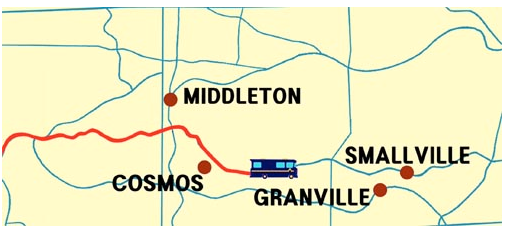
One final note: Granville was also seen on a map in Batman: The Brave and the Bold's "Aquaman's Outrageous Adventure!" (January 2010).
This week: Granville, Kansas!
Granville first appeared in Smallville as a neighboring city of Smallville. In the episode "Accelerate" (May 2003), Clark tracks the father of a childhood friend of Lana's to the city. Granville continued to be mentioned or appear once a season until season 8. This is a good name because it plays off the size angle - Small vs Grand - but it's also a reference to Smallville's production. The show (and most genre television) was filmed in Vancouver, which was originally known as Granville.
It appeared in a similar capacity in Superman/Batman #13 (August 2004). It has appeared a few times since then, but details on the internet are scarce so I can't find another mention. I know I've seen it, though, and recently. If you have a lead, let me know!
For the sake of full disclosure, I should point out that Action Comics #791 (May 2002) mentions a "Grandville". This is possibly a case of parallel thinking, or - since the issue is a flashback to Clark's high school days published at the tail end of Smallville season one - possibly a use of information from the Smallville writers' room that hadn't made its way on screen yet. Either way, the spelling of the town's name is a canon immigrant even if the town itself might not be.
One final note: Granville was also seen on a map in Batman: The Brave and the Bold's "Aquaman's Outrageous Adventure!" (January 2010).
Wednesday, November 13, 2019
Smallville Crows
Minor details are often canon immigrants, but that can be tricky for me to prove because it's hard to say for sure I'm right without reading through every possible appearance. So I do my best to support my case; if you can evidence that proves me wrong, let me know!
Today we'll be talking about Smallville High's mascot. It seems like, for most of history, Smallville's mascot was whatever the creators wanted it to be at the time. In Superboy #121 (April 1965), it was the Tigers.
While they were the Smallville Giants in Adventures of Superman #474 (November 1990).
And Smallville had them as the Crows ("Pilot", 2001).
In Action Comics #791 (May 2002), which I should point out was published at the end of Smallville season one, the team is also called the Crows.
Superman/Batman Secret Files & Origins (September 2003) continues this trend during a story about Lex's time in high school...another thing Smallville re-established.
I can't find any evidence of the Smallville High team name after these appearances, so I have no idea if it's still the Crows or not. But, for a time at least, it was.
Today we'll be talking about Smallville High's mascot. It seems like, for most of history, Smallville's mascot was whatever the creators wanted it to be at the time. In Superboy #121 (April 1965), it was the Tigers.
While they were the Smallville Giants in Adventures of Superman #474 (November 1990).
And Smallville had them as the Crows ("Pilot", 2001).
In Action Comics #791 (May 2002), which I should point out was published at the end of Smallville season one, the team is also called the Crows.
Superman/Batman Secret Files & Origins (September 2003) continues this trend during a story about Lex's time in high school...another thing Smallville re-established.
I can't find any evidence of the Smallville High team name after these appearances, so I have no idea if it's still the Crows or not. But, for a time at least, it was.
Friday, November 8, 2019
Flashback Friday: Mas y Menos
Each Friday, I take one of the entries from my old Super Posts and expand it into its own featured article.
This week: Mas y Menos!
Mas y Menos first appeared in the Teen Titans cartoon, beginning with the episode "Titans East, Part 1" (January 2005). They're speedsters who can only use their powers when they're touching, though this extends to touching something the other is also touching.
They first appear in comics in Teen Titans Go! #20 (June 2005), although this is a tie-in series to the show. They appeared in several issues of this series.
They debuted in the mainstream in Teen Titans #38 (July 2006), which established them as Titans during the 52/One Year Later gap year. This appearance would set the stage for all future appearances; they seem to only exist to cameo.
They appear on a screen in Teen Titans #66 (December 2008)...
Final Crisis #1 (April 2009) shows them in action for the first time, but only for two panels with no dialogue...
They're in Teen Titans #100 (August 2011), but only in a pinup after the main story...
And Multiversity: The Just #1 (October 2014) has them in a group shot at a pool party.
Not the most illustrious career, but at least they still exist in the post-Rebirth DC Universe (even if, right now, it's only on Earth-16).
This week: Mas y Menos!
Mas y Menos first appeared in the Teen Titans cartoon, beginning with the episode "Titans East, Part 1" (January 2005). They're speedsters who can only use their powers when they're touching, though this extends to touching something the other is also touching.
They first appear in comics in Teen Titans Go! #20 (June 2005), although this is a tie-in series to the show. They appeared in several issues of this series.
They debuted in the mainstream in Teen Titans #38 (July 2006), which established them as Titans during the 52/One Year Later gap year. This appearance would set the stage for all future appearances; they seem to only exist to cameo.
They appear on a screen in Teen Titans #66 (December 2008)...
Final Crisis #1 (April 2009) shows them in action for the first time, but only for two panels with no dialogue...
They're in Teen Titans #100 (August 2011), but only in a pinup after the main story...
And Multiversity: The Just #1 (October 2014) has them in a group shot at a pool party.
Not the most illustrious career, but at least they still exist in the post-Rebirth DC Universe (even if, right now, it's only on Earth-16).
Friday, October 11, 2019
Flashback Friday: Reptil
Each Friday, I take one of the entries from my old Super Posts and expand it into its own featured article.
This week: Reptil!
Reptil is one of the very rare cases of a character being created for a toyline and then transitioning into comics. The only time I can think of that happening outside of Teenage Mutant Ninja Turtles is DC's Nite-Lik. (Of course, there are other examples that didn't occur to me.) He was created for Marvel's "Super Hero Squad" line of figurines, but strangely, the only figurine of his I can find online is from 2010, well after all the other appearances I plan to mention. His earliest appearance that I can find is a tie-in comic book one-shot Marvel Super Hero Squad: Hero Up! #1 (January 2009).
He later appeared in The Super Hero Squad Show episode, "To Err is Superhuman" (September 2009), but in between those two appearances, he appeared in Avengers: The Initiative - Featuring Reptil #1 (March 2009).
This week: Reptil!
Reptil is one of the very rare cases of a character being created for a toyline and then transitioning into comics. The only time I can think of that happening outside of Teenage Mutant Ninja Turtles is DC's Nite-Lik. (Of course, there are other examples that didn't occur to me.) He was created for Marvel's "Super Hero Squad" line of figurines, but strangely, the only figurine of his I can find online is from 2010, well after all the other appearances I plan to mention. His earliest appearance that I can find is a tie-in comic book one-shot Marvel Super Hero Squad: Hero Up! #1 (January 2009).
He later appeared in The Super Hero Squad Show episode, "To Err is Superhuman" (September 2009), but in between those two appearances, he appeared in Avengers: The Initiative - Featuring Reptil #1 (March 2009).
Reptil's real name is Humberto Lopez and he possesses a magic medallion that allows him to turn any part of his body into any part of any dinosaur's body. He was a main character in Avengers Academy and has likewise appeared in other teen-hero-centric things like Avengers Arena.
Wednesday, October 2, 2019
Character Spotlight: Gyoji
Teenage Mutant Ninja Turtles can occasionally be tricky in terms of canon immigrants because there are TWO official continuities: there's the original Mirage Comics continuity that ran off and on between 1984 and 2009, and there's the IDW continuity that ran from 2011 to present. For the most part, it's not a big deal: while Mirage was mainly interested in doing its own thing, IDW seems to want to pull in as many details as possible from every other continuity to create a single unified Ninja Turtles story. Therefore, whenever TMNT canon immigrants appear on this blog, it's safe to assume they're appearing in the IDW version. Imagine my surprise, then, when I learned this one happened in the Mirage continuity.
I've covered the Battle Nexus before, but a brief recap: the Battle Nexus is a cross-dimensional tournament that first appeared in the 2003 animated series but then was introduced into both the Mirage and IDW continuities.
But we're not here to talk about the Battle Nexus (yet), we're here to talk about Gyoji. Gyoji is a masked being who first appeared in the 2003 series episode, "The Ultimate Ninja" (February 2004), to referee a fight between Leonardo and the titular "Ultimate Ninja", aka Ue-sama. There is an air of mystery around Gyoji and why he appeared, especially once its revealed Ue-sama is from another dimension and from the same species as Gyoji's master, a species that claims to have taught humans ninjutsu. Splinter seems to know more about all this than he lets on.
Of course, this is all a set up for the four-part season finale, "The Big Brawl" (May - October 2004), which introduces us to the Battle Nexus. It's then we learn that Gyoji is the Battle Nexus's referee.
When the Battle Nexus started appearing in TMNT: Teenage Mutant Ninja Turtles, Gyoji came with it, although now his name is spelled "Gyogi". He first appeared in issue 29 (February 2008).
I've covered the Battle Nexus before, but a brief recap: the Battle Nexus is a cross-dimensional tournament that first appeared in the 2003 animated series but then was introduced into both the Mirage and IDW continuities.
But we're not here to talk about the Battle Nexus (yet), we're here to talk about Gyoji. Gyoji is a masked being who first appeared in the 2003 series episode, "The Ultimate Ninja" (February 2004), to referee a fight between Leonardo and the titular "Ultimate Ninja", aka Ue-sama. There is an air of mystery around Gyoji and why he appeared, especially once its revealed Ue-sama is from another dimension and from the same species as Gyoji's master, a species that claims to have taught humans ninjutsu. Splinter seems to know more about all this than he lets on.
Of course, this is all a set up for the four-part season finale, "The Big Brawl" (May - October 2004), which introduces us to the Battle Nexus. It's then we learn that Gyoji is the Battle Nexus's referee.
When the Battle Nexus started appearing in TMNT: Teenage Mutant Ninja Turtles, Gyoji came with it, although now his name is spelled "Gyogi". He first appeared in issue 29 (February 2008).
Friday, August 30, 2019
Flashback Friday: Bullseye's Appearance
Each Friday, I take one of the entries from my old Super Posts and expand it into its own featured article.
This week: Bullseye's appearance!
Bullseye, the long-time Daredevil villain with perfect aim, has one of the best looks around, in my opinion.
But in the early 2000s, comic book adaptations had a strange relationship with comic book accuracy. Although they were looking to the comics for stories more than ever before, the character designs were generally more "realistic" and "down to Earth". That's why, in Daredevil (February 2003), Bullseye looks like this below. The strange thing is that he asks for a costume halfway through the movie, but still doesn't get one.
In the miniseries Daredevil/Bullseye: The Target #1 (September 2002), Bullseye starts wearing plainclothes to draw less attention to himself, but someone complains, so he draws a target on his forehead like so (below). Now I know what you're thinking: this came out almost half a year before the movie. What gives? Well, the movie design had been released by June 2002, so that gives plenty of time for both the fans and the comics creators to become familiar with it.
In Daredevil #48 (June 2003), we get an even more movie-accurate version. In the next issue, we learn it's a tattoo instead of a scar.
But then in Daredevil #49 (July 2003), Daredevil carves it into his head, meaning it will become a scar.
He was back in his classic outfit by Thunderbolts #110 (January 2007)...
...although interestingly, the ditching of his costume seemed to only happen in Daredevil. Whenever he appeared in miniseries during this time, such as Identity Disc (June 2004), Bullseye: Greatest Hits (September 2004), or Punisher vs. Bullseye (November 2005), he wore his classic outfit.
Presumably he still has the scar, but we never see it.
This week: Bullseye's appearance!
Bullseye, the long-time Daredevil villain with perfect aim, has one of the best looks around, in my opinion.
But in the early 2000s, comic book adaptations had a strange relationship with comic book accuracy. Although they were looking to the comics for stories more than ever before, the character designs were generally more "realistic" and "down to Earth". That's why, in Daredevil (February 2003), Bullseye looks like this below. The strange thing is that he asks for a costume halfway through the movie, but still doesn't get one.
In the miniseries Daredevil/Bullseye: The Target #1 (September 2002), Bullseye starts wearing plainclothes to draw less attention to himself, but someone complains, so he draws a target on his forehead like so (below). Now I know what you're thinking: this came out almost half a year before the movie. What gives? Well, the movie design had been released by June 2002, so that gives plenty of time for both the fans and the comics creators to become familiar with it.
In Daredevil #48 (June 2003), we get an even more movie-accurate version. In the next issue, we learn it's a tattoo instead of a scar.
But then in Daredevil #49 (July 2003), Daredevil carves it into his head, meaning it will become a scar.
He was back in his classic outfit by Thunderbolts #110 (January 2007)...
...although interestingly, the ditching of his costume seemed to only happen in Daredevil. Whenever he appeared in miniseries during this time, such as Identity Disc (June 2004), Bullseye: Greatest Hits (September 2004), or Punisher vs. Bullseye (November 2005), he wore his classic outfit.
Presumably he still has the scar, but we never see it.
Friday, August 23, 2019
Flashback Friday: Chloe Sullivan
Each Friday, I take one of the entries from my old Super Posts and expand it into its own featured article.
This week: Chloe Sullivan!
Chloe Sullivan first appeared in the Smallville pilot (2001) as one of Clark's friends and the editor of the Torch, the school newspaper. She was also into researching all the strange things that have happened in Smallville and chronicled them on her Wall of Weird. And she's Lois Lane's cousin. As she got older, she got into hacking, got a job at the Daily Planet, and started dating Jimmy Olsen.
Chloe - or rather, her name - made two cameo appearances in Superman: Secret Origin. In Secret Origin #1 (September 2009), her name appears on a cast...
...and in Secret Origin #4 (January 2010), Lois has a Post-It reminding her to call Chloe.
She made her first official appearance in DC Comics in the Jimmy Olsen back-up feature of Action Comics #893 (September 2010). The comics character combines Chloe's journalistic background of the early Smallville seasons with her relationship with Jimmy Olsen of the later seasons.
That's pretty much it for her, though she did get a mention on Supergirl, in the episode "Midvale" (November 2017). Kara mentions Clark has a friend named Chloe who's good at hacking and has a Wall of Weird.
She has not appeared in the New 52 or Rebirth, and I highly doubt she will. Chloe's actor, Allison Mack, has gotten into some pretty serious legal trouble lately, and while I won't get into the nature of her alleged crimes, suffice to say it's tainted her and the character pretty permanently, I suspect.
This week: Chloe Sullivan!
Chloe Sullivan first appeared in the Smallville pilot (2001) as one of Clark's friends and the editor of the Torch, the school newspaper. She was also into researching all the strange things that have happened in Smallville and chronicled them on her Wall of Weird. And she's Lois Lane's cousin. As she got older, she got into hacking, got a job at the Daily Planet, and started dating Jimmy Olsen.
Chloe - or rather, her name - made two cameo appearances in Superman: Secret Origin. In Secret Origin #1 (September 2009), her name appears on a cast...
...and in Secret Origin #4 (January 2010), Lois has a Post-It reminding her to call Chloe.
She made her first official appearance in DC Comics in the Jimmy Olsen back-up feature of Action Comics #893 (September 2010). The comics character combines Chloe's journalistic background of the early Smallville seasons with her relationship with Jimmy Olsen of the later seasons.
That's pretty much it for her, though she did get a mention on Supergirl, in the episode "Midvale" (November 2017). Kara mentions Clark has a friend named Chloe who's good at hacking and has a Wall of Weird.
She has not appeared in the New 52 or Rebirth, and I highly doubt she will. Chloe's actor, Allison Mack, has gotten into some pretty serious legal trouble lately, and while I won't get into the nature of her alleged crimes, suffice to say it's tainted her and the character pretty permanently, I suspect.
Friday, August 16, 2019
Flashback Friday: Gizmo
Each Friday, I take one of the entries from my old Super Posts and expand it into its own featured article.
This week: Gizmo!
Teen Titans was notorious for playing fast and loose with the designs of characters. So although Gizmo had already appeared in comics, beginning in The New Teen Titans #3 (November 1980)...
...when he appeared in the Teen Titans episode "Final Exam" (2003), it was in a greatly altered form.
Gizmo kept the same appearance in the comics until February 2004, when he appeared in Teen Titans #8:
When he next appeared in Outsiders #12-14 (May-July 2004), however, he had an appearance closer to his animated counterpart.
And then in DC Special: Cyborg #5 (September 2008), he suddenly looks A LOT like his animated counterpart.
In the next issue, we learn this is Gizmo II, the original Gizmo's son (October 2008).
Gizmo II only appeared in a couple issues and hasn't seemed to survive the New 52. Gizmo's new appearance did for a little while, but he has since changed it. never got the full beard back, though.
This week: Gizmo!
Teen Titans was notorious for playing fast and loose with the designs of characters. So although Gizmo had already appeared in comics, beginning in The New Teen Titans #3 (November 1980)...
...when he appeared in the Teen Titans episode "Final Exam" (2003), it was in a greatly altered form.
Gizmo kept the same appearance in the comics until February 2004, when he appeared in Teen Titans #8:
When he next appeared in Outsiders #12-14 (May-July 2004), however, he had an appearance closer to his animated counterpart.
And then in DC Special: Cyborg #5 (September 2008), he suddenly looks A LOT like his animated counterpart.
In the next issue, we learn this is Gizmo II, the original Gizmo's son (October 2008).
Gizmo II only appeared in a couple issues and hasn't seemed to survive the New 52. Gizmo's new appearance did for a little while, but he has since changed it. never got the full beard back, though.
Subscribe to:
Posts (Atom)