Each Friday, I take one of the entries from my old Super Posts and expand it into its own featured article.
This week: Livewire!
These days, comic book adapters realize that Marvel and DC have thousands of characters and one of them will probably fit whatever story they want to tell. That wasn't always the case. Until the mid-00s (and possibly later), tv shows based on comics mainly used original characters, and the DC Animated Universe was no different. That brings us to Livewire.
Like Roxy Rocket, Livewire's first appearance wasn't really on tv. She debuted in Superman Adventures #5 (January 1997) in a story that has her attacking men because they've run the world for so long. What's interesting to me is that the issue is written as if everyone already knows Livewire, which makes me wonder if her premiere episode was originally planned for season one and then pushed back.
Either way, Livewire first appeared in Superman: The Animated Series in an episode of the same name (1997). In the episode, Leslie Willis is a shock jock who was struck by lightning during an outside concert. The lightning gave her electric powers and changed her appearance, and she blamed Superman for it. So she became Livewire to get revenge. She became a recurring antagonist, also appearing in The New Batman Adventures, Justice League, and Justice League Unlimited.
She first began appearing in the main DC Universe in Action Comics #835 (January 2006). Her backstory is mostly the same as her animated counterpart, except that she was born with her electric powers. The lightning strike only enhanced them and changed her appearance. She continued to appear and even reformed by 2011, just in time for the New 52.
In the New 52, Livewire made her first appearance in Justice League #30 (May 2014) during Forever Evil as a member of the Secret Society of Super-Villains. In Batgirl #42 (July 2015), she receives a new origin - now she was a vlogger who was electrocuted during a prank where she tried to make the lights of Metropolis spell out a dirty word.
And if comics to tv to comics weren't enough, she also made it back to tv - twice, actually. The first was in Smallville ("Injustice", May 2009), although you'd be forgiven for not realizing it's the same character...
...and the second was in Supergirl ("Livewire", November 2015), where she has once again become a recurring character.
Subheader
A forever in-work compendium of Marvel and DC canon immigrants. What's a canon immigrant? Go here to find out!
Showing posts with label DCAU. Show all posts
Friday, November 29, 2019
Wednesday, November 27, 2019
Lois Lane's Violet Eyes
Usually canon immigrants are big things like characters and events. But sometimes they're details so tiny, most people don't even realize they're there. This is an example of the latter.
In Superman: The Animated Series (1996), Lois Lane had violet eyes to match her suit.
This had never been the case in comics before. When Lois debuted in Action Comics #1 (1938), eyes weren't given that level of definition at all...
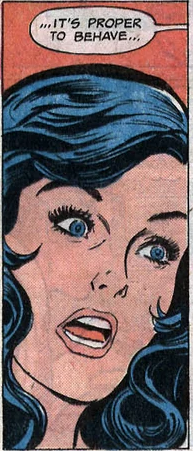
...and once they were, she was depicted with blue eyes.
After the animated series, however, she started appearing with violet eyes in the comics. In cases like this it's hard to determine the absolute first time it happened, but here's a smattering of examples released over fifteen years or so (the final one being a variant cover for Superman #13, July 2019).
I also can't guarantee her eyes are ALWAYS violet. Coloring is a tricky beast and there are often inconsistencies even when the colors of an object are set in stone.
Friday, October 25, 2019
Flashback Friday: Gray Ghost
Each Friday, I take one of the entries from my old Super Posts and expand it into its own featured article.
This week: Gray Ghost!
As most people know, Batman is inspired by earlier pulp heroes such as the Shadow and Zorro. In fact, "inspired" is putting it charitably, considering several of Batman's earliest stories were plagiarized Shadow stories. But the comics and other adaptations like to pay homage to this in various ways, with the main one becoming that the Waynes went to see a Zorro film on the day they died (which Zorro movie it was changes based on when the story takes place, but it's usually The Mark of Zorro).
Batman: The Animated Series, however, provided its own twist on this idea. In the episode "Beware the Gray Ghost" (1992), we learn of an old tv show that Bruce loved to watch as a kid. The Gray Ghost is very inspired by the Shadow, and Batman was, in turn, inspired by the Gray Ghost. In fact, Batman's Batcave is an exact replica of the Gray Ghost's base of operations. The episode involves the Simon Trent, the actor who played the Gray Ghost (voiced by Adam West), dressing as the Gray Ghost and teaming with Batman to help solve a series of bombings based on an episode of the series.
The first time the Grey Ghost was mentioned in comics was Batman: Gotham Adventures #3 (June 1998), when Scarecrow's fear formula made it seem like Batman was dressed as the character.
The Batman Adventures #14 (May 2004) featured Simon Trent as the Gray Ghost and the creation of a Gray Ghost movie.
But both of those are extensions of the DCAU. The first time the Gray Ghost was seen outside of that world was, surprisingly, the Grant Morrison Vertigo title, Joe the Barbarian #1 (January 2010). This series is about a boy who hallucinates a fantasy adventure involving his toys thanks to low blood sugar, and Gray Ghost - along with Batman - is one of the characters who appears.
When he finally appeared in mainstream DC comics, it was in a much different form. In Batgirl #15 (November 2010), the Grey Ghost appears as Clancy Johnson, Batgirl's self-proclaimed guardian angel. Incidentally, he's also the Mad Bomber (the villain of "Beware the Gray Ghost"). Clancy based his secret identity on the Grey Ghost tv show, which also now exists in DC Comics.
And then Simon Trent appeared as a theatre teacher in Gotham Academy, which I've previously discussed.
What I find most interesting about all of these appearances is that they keep the Gray Ghost a fictional entity. Writers could've easily made him a real hero, perhaps one active in the 30s. But they didn't. In some ways I prefer that.
The only (potential) example I can find otherwise is Batman Beyond 2.0 #40 (November 2014). I can't tell if this is Simon Trent taking up the mantle again or someone inspired by the Gray Ghost franchise. Either way, this series takes place on Earth-12, which is essentially the DCAU world in comics form.
This week: Gray Ghost!
As most people know, Batman is inspired by earlier pulp heroes such as the Shadow and Zorro. In fact, "inspired" is putting it charitably, considering several of Batman's earliest stories were plagiarized Shadow stories. But the comics and other adaptations like to pay homage to this in various ways, with the main one becoming that the Waynes went to see a Zorro film on the day they died (which Zorro movie it was changes based on when the story takes place, but it's usually The Mark of Zorro).
Batman: The Animated Series, however, provided its own twist on this idea. In the episode "Beware the Gray Ghost" (1992), we learn of an old tv show that Bruce loved to watch as a kid. The Gray Ghost is very inspired by the Shadow, and Batman was, in turn, inspired by the Gray Ghost. In fact, Batman's Batcave is an exact replica of the Gray Ghost's base of operations. The episode involves the Simon Trent, the actor who played the Gray Ghost (voiced by Adam West), dressing as the Gray Ghost and teaming with Batman to help solve a series of bombings based on an episode of the series.
The first time the Grey Ghost was mentioned in comics was Batman: Gotham Adventures #3 (June 1998), when Scarecrow's fear formula made it seem like Batman was dressed as the character.
But both of those are extensions of the DCAU. The first time the Gray Ghost was seen outside of that world was, surprisingly, the Grant Morrison Vertigo title, Joe the Barbarian #1 (January 2010). This series is about a boy who hallucinates a fantasy adventure involving his toys thanks to low blood sugar, and Gray Ghost - along with Batman - is one of the characters who appears.
When he finally appeared in mainstream DC comics, it was in a much different form. In Batgirl #15 (November 2010), the Grey Ghost appears as Clancy Johnson, Batgirl's self-proclaimed guardian angel. Incidentally, he's also the Mad Bomber (the villain of "Beware the Gray Ghost"). Clancy based his secret identity on the Grey Ghost tv show, which also now exists in DC Comics.
And then Simon Trent appeared as a theatre teacher in Gotham Academy, which I've previously discussed.
What I find most interesting about all of these appearances is that they keep the Gray Ghost a fictional entity. Writers could've easily made him a real hero, perhaps one active in the 30s. But they didn't. In some ways I prefer that.
The only (potential) example I can find otherwise is Batman Beyond 2.0 #40 (November 2014). I can't tell if this is Simon Trent taking up the mantle again or someone inspired by the Gray Ghost franchise. Either way, this series takes place on Earth-12, which is essentially the DCAU world in comics form.
Wednesday, August 21, 2019
Clayface's New Origin
Many people are unaware of this, but there have been several people who have gone by the name "Clayface" over the course of Batman's history. Arguably the two most important are the first and second ones. The original was an actor named Basil Karlo who, in his first appearance at least, wore the costume of a movie monster he played (Clayface) to attack people connected to a remake of one of his movies. The second, Matt Hagen, was a treasure hunter who touched some protoplasm and gained the powers to reshape his body, but the effects were temporary and he would continually have to return to the protoplasm to regain his powers.
These two characters were combined to create Batman: The Animated Series's version of Clayface, who first appeared in the two-part episode, "Feat of Clay" (September 1992). In this series, Matt Hagen was a famous actor until a car accident ruined his face. Since then, he has started working for Roland Daggett, who gives him a substance called Renuyu each month that allows Matt to reshape his face - and therefore also lets him look like other people. Daggett uses Matt's abilities for corporate espionage and asks him to try to kill Lucius Fox while disguised as Bruce Wayne to help facilitate a merger between Daggett's and Wayne's companies. The plan doesn't work, so Daggett cuts off Matt from Renuyu, and when Matt breaks into the factory to get some, Daggett's goons cover Matt with it and force him to drink liters of the stuff. This, of course, turns Matt into Clayface.
Matt Hagen is the only Clayface in the DC Animated Universe, but the comics are less picky. Prior to this series, there were four, which is not that surprising. There were also multiple Two-Faces and Mad Hatters, for instance, for reasons we won't really get into. But unlike these other characters, DC has continued to introduce new Clayfaces, for a total of nine as of this writing.
That being said, the comics likewise seem to have settled on Basil Karlo as the "main" Clayface, and to that end, featured a retelling of his origin in Detective Comics Annual 2018. Although it's not an exact retelling of "Feat of Clay", it does feature more beats from that than from Basil Karlo's original debut in Detective Comics #40 (April 1940). His face is disfigured in a car accident, and he fixes that using a chemical called Renu - no "yu" on the end in this version, since it's not meant to be a cosmetic...
...which is still made by Roland Daggett's company, spelled with one "t" in this version for reasons that aren't clear.
Similarly, being doused with loads of the Renu turns Karlo into a hulking mass of goo like the animated Clayface.
This, however, is NOT the first time The Animated Series has influenced Clayface's appearance. I've previously written about that. It's due for a Flashback Friday, but I don't know when I'll get around to it.
These two characters were combined to create Batman: The Animated Series's version of Clayface, who first appeared in the two-part episode, "Feat of Clay" (September 1992). In this series, Matt Hagen was a famous actor until a car accident ruined his face. Since then, he has started working for Roland Daggett, who gives him a substance called Renuyu each month that allows Matt to reshape his face - and therefore also lets him look like other people. Daggett uses Matt's abilities for corporate espionage and asks him to try to kill Lucius Fox while disguised as Bruce Wayne to help facilitate a merger between Daggett's and Wayne's companies. The plan doesn't work, so Daggett cuts off Matt from Renuyu, and when Matt breaks into the factory to get some, Daggett's goons cover Matt with it and force him to drink liters of the stuff. This, of course, turns Matt into Clayface.
That being said, the comics likewise seem to have settled on Basil Karlo as the "main" Clayface, and to that end, featured a retelling of his origin in Detective Comics Annual 2018. Although it's not an exact retelling of "Feat of Clay", it does feature more beats from that than from Basil Karlo's original debut in Detective Comics #40 (April 1940). His face is disfigured in a car accident, and he fixes that using a chemical called Renu - no "yu" on the end in this version, since it's not meant to be a cosmetic...
...which is still made by Roland Daggett's company, spelled with one "t" in this version for reasons that aren't clear.
Similarly, being doused with loads of the Renu turns Karlo into a hulking mass of goo like the animated Clayface.
Friday, July 26, 2019
Flashback Friday: Nora Fries
Each Friday, I take one of the entries from my old Super Posts and expand it into its own featured article.
This week: Nora Fries!
Nora Fries first appeared in the Batman: The Animated Series episode "Heart of Ice" (1992) as a part of Mr. Freeze's new origin.
Her first comics appearance was Batman: Mr. Freeze (1997), part of a series of prestige format comics that focused on the characters being featured in the Batman & Robin movie - Mr. Freeze, Bane, Batgirl, and Poison Ivy. Despite clearly existing to feed off the movie, they don't have anything to do with the movie. Mr. Freeze's issue takes the opportunity to bring the events of "Heart of Ice" into comics canon.
As part of an agreement, Nyssa al-Ghul allowed Mr. Freeze to put Nora Fries in a Lazarus Pit; however, her body was do damaged from cryogenesis that it turned her into Lazara (first appearance: Batgirl (vol. 2) #70 (January 2006)), a villain that can generate flame and revive the dead.
Nora did survive the New 52, but not unscathed. We get Mr. Freeze's origin in Batman Annual #1 (May 2012), and it's largely the same...until we learn that Nora is actually Nora Fields, a woman who was put into cryostasis in 1943 and Victor only deludedly believes she's his wife. I have no idea what the point of this change is. It adds nothing, and makes Mr. Freeze into simply another crazy Batman villain. But that's the New 52 for you: change for the sake of change, with little thought put into it.
As Mr. Freeze's new origin was so popular, a version of it tends to be used in any adaptation he appears. That means Nora usually appears also. That means she's appeared in a variety of movies, tv shows, and video games, including Batman and Robin (1997), Gotham (2007), the Arkham video game series (2011-2015), and Elseworlds (the 2018 CW crossover). She's also mentioned in The Batman (2004). In all these adaptations, she's presented as her classic self.
This week: Nora Fries!
Nora Fries first appeared in the Batman: The Animated Series episode "Heart of Ice" (1992) as a part of Mr. Freeze's new origin.
Her first comics appearance was Batman: Mr. Freeze (1997), part of a series of prestige format comics that focused on the characters being featured in the Batman & Robin movie - Mr. Freeze, Bane, Batgirl, and Poison Ivy. Despite clearly existing to feed off the movie, they don't have anything to do with the movie. Mr. Freeze's issue takes the opportunity to bring the events of "Heart of Ice" into comics canon.
As part of an agreement, Nyssa al-Ghul allowed Mr. Freeze to put Nora Fries in a Lazarus Pit; however, her body was do damaged from cryogenesis that it turned her into Lazara (first appearance: Batgirl (vol. 2) #70 (January 2006)), a villain that can generate flame and revive the dead.
Nora did survive the New 52, but not unscathed. We get Mr. Freeze's origin in Batman Annual #1 (May 2012), and it's largely the same...until we learn that Nora is actually Nora Fields, a woman who was put into cryostasis in 1943 and Victor only deludedly believes she's his wife. I have no idea what the point of this change is. It adds nothing, and makes Mr. Freeze into simply another crazy Batman villain. But that's the New 52 for you: change for the sake of change, with little thought put into it.
As Mr. Freeze's new origin was so popular, a version of it tends to be used in any adaptation he appears. That means Nora usually appears also. That means she's appeared in a variety of movies, tv shows, and video games, including Batman and Robin (1997), Gotham (2007), the Arkham video game series (2011-2015), and Elseworlds (the 2018 CW crossover). She's also mentioned in The Batman (2004). In all these adaptations, she's presented as her classic self.
Friday, May 31, 2019
Flashback Friday: Mercy Graves
Each Friday, I take one of the entries from my old Super Posts and expand it into its own featured article.
This week: Mercy Graves!
Mercy Graves first appeared in Superman: The Animated Series (Episode: "A Little Piece of Home", 1996) as Lex Luthor's valet/bodyguard. She appeared in the series often as she was basically the only person Lex trusted. In Justice League (2000), she becomes CEO of LexCorp while he's in prison. Their relationship sours over the course of the show and they eventually part ways, but she is seen working for him again in Justice League Unlimited.
Her first comics appearance ever was tie-in series Superman Adventures #1 (September 1996)...
...but her first in-continuity appearance wasn't for a few more years. Surprisingly, she didn't debut in a Superman book, but instead in Detective Comics #735 (June 1999) during the "No Man's Land" crossover event.
She was first identified by name in a character profile in Batman No Man's Land Secret Files and Origins #1 (October 1999), but in-story, it was Detective Comics #740 (November 1999). She also - as far as I know - wears her chauffeur's uniform for the first time in this story.
In the decade between her first appearance and the New 52, Mercy was allowed to grow beyond her animated origins, mainly by giving her new origins. In President Luthor Secret Files and Origins #1 (January 2001), she and fellow Luthor bodyguard Hope were implied by Circe to be Amazons. Prometheus confirmed this in Justice League: Cry for Justice #6 (January 2010).
Before I get into her New 52 version, let's talk about her adaptation appearances a bit. The most notable is probably Smallville's Tess Mercer, who's technically an original character, but who's actually a combination of Mercy Graves, Eve Teschmacher, and - spoiler alert - Lena Luthor.
She's also appeared in Young Justice, DC Universe Online, and Superman: Doomsday. More interesting is the version of her that appears in The Batman episode "The Batman/Superman Story" (2007), as they decided to make her Asian.
Batman v. Superman: Dawn of Justice (2016) followed suit, although I'm pretty sure they didn't take inspiration from The Batman. This version seems to be more of an assistant than a bodyguard.
In the New 52, Mercy is likewise Asian and definitely Lex's assistant. She first appeared in Justice League #31 (June 2014) and most certainly inspired the film version.
Now, was this version inspired by The Batman? I can't say, but I can't rule it out.
This week: Mercy Graves!
Mercy Graves first appeared in Superman: The Animated Series (Episode: "A Little Piece of Home", 1996) as Lex Luthor's valet/bodyguard. She appeared in the series often as she was basically the only person Lex trusted. In Justice League (2000), she becomes CEO of LexCorp while he's in prison. Their relationship sours over the course of the show and they eventually part ways, but she is seen working for him again in Justice League Unlimited.
Her first comics appearance ever was tie-in series Superman Adventures #1 (September 1996)...
...but her first in-continuity appearance wasn't for a few more years. Surprisingly, she didn't debut in a Superman book, but instead in Detective Comics #735 (June 1999) during the "No Man's Land" crossover event.
She was first identified by name in a character profile in Batman No Man's Land Secret Files and Origins #1 (October 1999), but in-story, it was Detective Comics #740 (November 1999). She also - as far as I know - wears her chauffeur's uniform for the first time in this story.
In the decade between her first appearance and the New 52, Mercy was allowed to grow beyond her animated origins, mainly by giving her new origins. In President Luthor Secret Files and Origins #1 (January 2001), she and fellow Luthor bodyguard Hope were implied by Circe to be Amazons. Prometheus confirmed this in Justice League: Cry for Justice #6 (January 2010).
Before I get into her New 52 version, let's talk about her adaptation appearances a bit. The most notable is probably Smallville's Tess Mercer, who's technically an original character, but who's actually a combination of Mercy Graves, Eve Teschmacher, and - spoiler alert - Lena Luthor.
She's also appeared in Young Justice, DC Universe Online, and Superman: Doomsday. More interesting is the version of her that appears in The Batman episode "The Batman/Superman Story" (2007), as they decided to make her Asian.
Batman v. Superman: Dawn of Justice (2016) followed suit, although I'm pretty sure they didn't take inspiration from The Batman. This version seems to be more of an assistant than a bodyguard.
In the New 52, Mercy is likewise Asian and definitely Lex's assistant. She first appeared in Justice League #31 (June 2014) and most certainly inspired the film version.
Now, was this version inspired by The Batman? I can't say, but I can't rule it out.
Friday, May 3, 2019
Flashback Friday: Renee Montoya
Each Friday, I take one of the entries from my old Super Posts and expand it into its own featured article.
This week: Renee Montoya!
Renee Montoya is an interesting case. She was created by the writing staff of Batman: The Animated Series to add diversity to the series, and first appeared in the episode "Pretty Poison" (September 1992). However, she first appeared in comics in March 1992 in Batman #475. This is due to production delays on the animated series.
Since her introduction, Montoya has become a very popular character. In 2002, she was the lead in the series Gotham Central, and during 52, she took over the role of The Question, and then shortly after that, received a back-up feature in the pages of Batwoman.
She was initially absent (essentially) from the New 52, appearing in one panel of Batwoman #1 (September 2011) and then again in one panel of Batwoman #0 (September 2012).
The implication was that she had died, but in Detective Comics #41 (), she is re-assigned as Harvey Bullock's partner and we learn that she has just been living in Bludhaven this whole time.
Surprisingly, she has not appeared in many adaptations. Beyond various entries in the DC Animated Universe, she has appeared on Gotham...
...as The Question in DC Universe Online...
...in Batman: The Telltale Series...
...and she'll be played by Rosie Perez in the (presumably upcoming, though you can never tell with DC movies) movie Birds of Prey (and the Fantabulous Emancipation of One Harley Quinn).
And that's it. But despite the lack of adaptations, she has managed to make herself an indelible part of the Batman world.
This week: Renee Montoya!
Renee Montoya is an interesting case. She was created by the writing staff of Batman: The Animated Series to add diversity to the series, and first appeared in the episode "Pretty Poison" (September 1992). However, she first appeared in comics in March 1992 in Batman #475. This is due to production delays on the animated series.
Since her introduction, Montoya has become a very popular character. In 2002, she was the lead in the series Gotham Central, and during 52, she took over the role of The Question, and then shortly after that, received a back-up feature in the pages of Batwoman.
She was initially absent (essentially) from the New 52, appearing in one panel of Batwoman #1 (September 2011) and then again in one panel of Batwoman #0 (September 2012).
The implication was that she had died, but in Detective Comics #41 (), she is re-assigned as Harvey Bullock's partner and we learn that she has just been living in Bludhaven this whole time.
Surprisingly, she has not appeared in many adaptations. Beyond various entries in the DC Animated Universe, she has appeared on Gotham...
...as The Question in DC Universe Online...
...in Batman: The Telltale Series...
...and she'll be played by Rosie Perez in the (presumably upcoming, though you can never tell with DC movies) movie Birds of Prey (and the Fantabulous Emancipation of One Harley Quinn).
And that's it. But despite the lack of adaptations, she has managed to make herself an indelible part of the Batman world.
Subscribe to:
Posts (Atom)