Subheader

A forever in-work compendium of Marvel and DC canon immigrants. What's a canon immigrant? Go here to find out!
Showing posts with label Television. Show all posts

Friday, December 6, 2019

Flashback Friday: Marsha, Queen of Diamonds

Each Friday, I take one of the entries from my old Super Posts and expand it into its own featured article.

This week: Marsha, Queen of Diamonds!


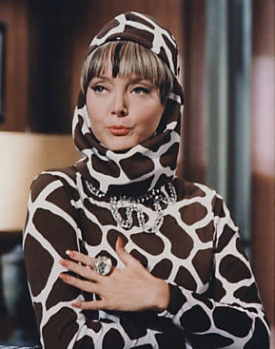
Marsha is a diamond thief who first appears in the episode of the same name (November 1966). She wants to get her hands on the Bat-Diamond, so she blackmails Batman into marrying her, which would have the added benefit of giving her access to the Batcave and his secret identity. Needless to say, Batman manages to find a way to escape and save Robin, Commissioner Gordon, and Chief O'Hara in the process.


Although this villain from the Batman tv series (1966-1968) hasn't yet made a real appearance in comics, she was mentioned by the Riddler in Secret Origins Special #1 (June 1989).  At the time, the rights to the 60s series were in a strange sort of limbo, which is why the tv-original characters were never used in the comics. But that's all sorted out now, so there's no telling when Marsha will appear for real!

Wednesday, November 20, 2019

The Maybe File: Smallville High's Coach Walt

Smallville arguably used more original characters than any other comic book adaptation. Especially early on, when we get characters like Coach Walt Arnold in "Hothead" (September 2001). Arnold is a football coach with a temper who gets anger-related fire powers after he uses meteor rocks - Kryptonite, for anyone who hasn't seen the show - in his sauna.


In Action Comics #791 (May 2002), a Coach Walt Andrews writes Clark to ask him to come to his Smallville class reunion.


I know. The name's not the same. But let's look at the evidence. Smallville debuts in September 2001 and becomes an instant success. Then Action Comics #791 comes out right in time for the Smallville season finale and features an extensive flashback to Superman's high school days, the essential premise of the show. The story definitely introduces the Smallville Crows to canon and possibly Granville. It's also the first appearance in comics of a Coach Walt A., and Smallville just so happens to have also introduced a Coach Walt A.

Is it meant to be the same character? If it is, did they change the name by accident or is it for legal reasons? I don't know the answers to these questions. I can't say for sure Coach Walt is a canon immigrant, but here's what I can say: if he is meant to be one, he's certainly not the one to have changed the most during the journey.

Friday, November 15, 2019

Flashback Friday: Granville, Kansas

Each Friday, I take one of the entries from my old Super Posts and expand it into its own featured article.

This week: Granville, Kansas!

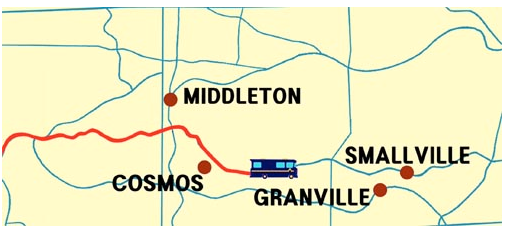
Granville first appeared in Smallville as a neighboring city of Smallville.  In the episode "Accelerate" (May 2003), Clark tracks the father of a childhood friend of Lana's to the city. Granville continued to be mentioned or appear once a season until season 8. This is a good name because it plays off the size angle - Small vs Grand - but it's also a reference to Smallville's production. The show (and most genre television) was filmed in Vancouver, which was originally known as Granville.


It appeared in a similar capacity in Superman/Batman #13 (August 2004). It has appeared a few times since then, but details on the internet are scarce so I can't find another mention. I know I've seen it, though, and recently. If you have a lead, let me know!


For the sake of full disclosure, I should point out that Action Comics #791 (May 2002) mentions a "Grandville". This is possibly a case of parallel thinking, or - since the issue is a flashback to Clark's high school days published at the tail end of Smallville season one - possibly a use of information from the Smallville writers' room that hadn't made its way on screen yet. Either way, the spelling of the town's name is a canon immigrant even if the town itself might not be.


One final note: Granville was also seen on a map in Batman: The Brave and the Bold's "Aquaman's Outrageous Adventure!" (January 2010).


Wednesday, November 13, 2019

Smallville Crows

Minor details are often canon immigrants, but that can be tricky for me to prove because it's hard to say for sure I'm right without reading through every possible appearance. So I do my best to support my case; if you can evidence that proves me wrong, let me know!

Today we'll be talking about Smallville High's mascot. It seems like, for most of history, Smallville's mascot was whatever the creators wanted it to be at the time. In Superboy #121 (April 1965), it was the Tigers.


While they were the Smallville Giants in Adventures of Superman #474 (November 1990).


And Smallville had them as the Crows ("Pilot", 2001).


In Action Comics #791 (May 2002), which I should point out was published at the end of Smallville season one, the team is also called the Crows.


Superman/Batman Secret Files & Origins (September 2003) continues this trend during a story about Lex's time in high school...another thing Smallville re-established.


I can't find any evidence of the Smallville High team name after these appearances, so I have no idea if it's still the Crows or not. But, for a time at least, it was.

Friday, November 8, 2019

Flashback Friday: Mas y Menos

Each Friday, I take one of the entries from my old Super Posts and expand it into its own featured article.

This week: Mas y Menos!

Mas y Menos first appeared in the Teen Titans cartoon, beginning with the episode "Titans East, Part 1" (January 2005). They're speedsters who can only use their powers when they're touching, though this extends to touching something the other is also touching.


They first appear in comics in Teen Titans Go! #20 (June 2005), although this is a tie-in series to the show. They appeared in several issues of this series.


They debuted in the mainstream in Teen Titans #38 (July 2006), which established them as Titans during the 52/One Year Later gap year. This appearance would set the stage for all future appearances; they seem to only exist to cameo.


They appear on a screen in Teen Titans #66 (December 2008)...


Final Crisis #1 (April 2009) shows them in action for the first time, but only for two panels with no dialogue...


They're in Teen Titans #100 (August 2011), but only in a pinup after the main story...


And Multiversity: The Just #1 (October 2014) has them in a group shot at a pool party.


Not the most illustrious career, but at least they still exist in the post-Rebirth DC Universe (even if, right now, it's only on Earth-16).

Wednesday, November 6, 2019

Character Spotlight: Hubert and Reba

Hubert and Reba are Jon Arbuckle's elderly neighbors in the Garfield comic strip. They debuted in Garfield's first television special, Here Comes Garfield, which aired on October 25, 1982. They play a major role in the plot, as Hubert calls the pound on Garfield and Odie for messing with his dog, Honey Bun. Garfield escapes but Odie is captured, leading to Garfield having to try to get Odie back.


Hubert first appeared in the comic strip on November 7, 1982. Reba is mentioned but doesn't appear.


Reba first appears on November 11, 1982, in a non-speaking role.


To my knowledge, Honey Bun has never appeared.


Wednesday, October 30, 2019

Character Spotlight: Cousin Ambrose

Cousin Ambrose is Sabrina the Teenage Witch's cousin. It's right there in the name. He's one of the lesser known Sabrina characters because he never appeared in the Sabrina the Teenage Witch TGIF series from the 90s, the version most people are familiar with.

That's somewhat ironic since he debuted on television. He first appeared in Filmation's Sabrina the Teenage Witch cartoon, in the second segment of the first episode, titled "Hiccups" (September 1969). He's a foppish gentleman with a mustache who Sabrina summons to help her cure her hiccups, which are causing her magic to malfunction.


He later appeared in Archie's TV Laugh-Out #1 (October 1969), which I've mentioned before. His comics version has a more modern style than his animated counterpart.


He's continually appeared in comics since then, including The Chilling Adventures of Sabrina. This series reinterpreted him as a young adult who has to live with the Spellmans as punishment for revealing himself to mortals.


He likewise appears in the Netflix series of the same name, as the same basic character. I assume this will be where most people know him from.


Friday, October 25, 2019

Flashback Friday: Gray Ghost

Each Friday, I take one of the entries from my old Super Posts and expand it into its own featured article.

This week: Gray Ghost!


As most people know, Batman is inspired by earlier pulp heroes such as the Shadow and Zorro. In fact, "inspired" is putting it charitably, considering several of Batman's earliest stories were plagiarized Shadow stories. But the comics and other adaptations like to pay homage to this in various ways, with the main one becoming that the Waynes went to see a Zorro film on the day they died (which Zorro movie it was changes based on when the story takes place, but it's usually The Mark of Zorro).


Batman: The Animated Series, however, provided its own twist on this idea. In the episode "Beware the Gray Ghost" (1992), we learn of an old tv show that Bruce loved to watch as a kid. The Gray Ghost is very inspired by the Shadow, and Batman was, in turn, inspired by the Gray Ghost. In fact, Batman's Batcave is an exact replica of the Gray Ghost's base of operations. The episode involves the Simon Trent, the actor who played the Gray Ghost (voiced by Adam West), dressing as the Gray Ghost and teaming with Batman to help solve a series of bombings based on an episode of the series.


The first time the Grey Ghost was mentioned in comics was Batman: Gotham Adventures #3 (June 1998), when Scarecrow's fear formula made it seem like Batman was dressed as the character.


The Batman Adventures #14 (May 2004) featured Simon Trent as the Gray Ghost and the creation of a Gray Ghost movie.


But both of those are extensions of the DCAU. The first time the Gray Ghost was seen outside of that world was, surprisingly, the Grant Morrison Vertigo title, Joe the Barbarian #1 (January 2010). This series is about a boy who hallucinates a fantasy adventure involving his toys thanks to low blood sugar, and Gray Ghost - along with Batman - is one of the characters who appears.


When he finally appeared in mainstream DC comics, it was in a much different form.  In Batgirl #15 (November 2010), the Grey Ghost appears as Clancy Johnson, Batgirl's self-proclaimed guardian angel. Incidentally, he's also the Mad Bomber (the villain of "Beware the Gray Ghost"). Clancy based his secret identity on the Grey Ghost tv show, which also now exists in DC Comics.


And then Simon Trent appeared as a theatre teacher in Gotham Academy, which I've previously discussed.

What I find most interesting about all of these appearances is that they keep the Gray Ghost a fictional entity. Writers could've easily made him a real hero, perhaps one active in the 30s. But they didn't. In some ways I prefer that.

The only (potential) example I can find otherwise is Batman Beyond 2.0 #40 (November 2014). I can't tell if this is Simon Trent taking up the mantle again or someone inspired by the Gray Ghost franchise. Either way, this series takes place on Earth-12, which is essentially the DCAU world in comics form.

Wednesday, October 23, 2019

Character Spotlight: Harvey Kinkle

Last week I showed you how Sabrina the Teenage Witch joined the Archie Universe, and today we'll continue along that path with the introduction of Sabrina's boyfriend, Harvey Kinkle!


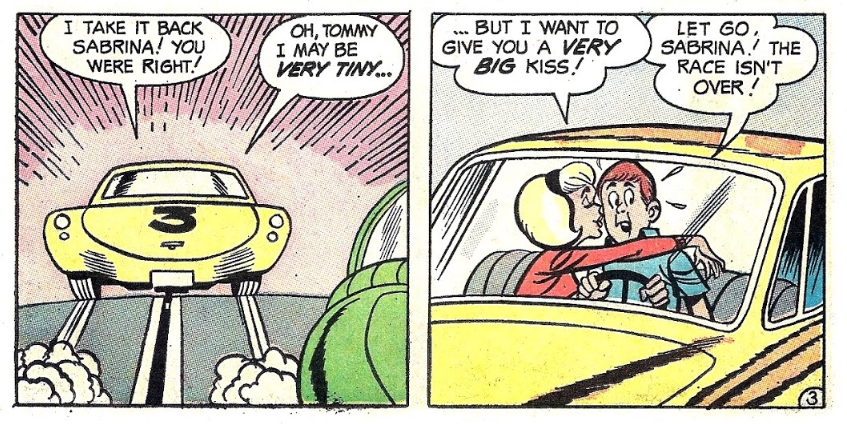
I should point out that Harvey was not the first boyfriend Sabrina had, which makes him all the more interesting. Information online is scant about Tommy Baker, but I know he at least appeared in Archie's Madhouse #55 and #59 (June and December 1967, respectively) and he was Sabrina's boyfriend in both appearances. He also knew about Sabrina's powers.


When the time came for Sabrina to have her own show, she needed a supporting cast. Filmation brought over Hilda, Zelda, and Salem from the comics, liberally used the existing Archie cast, and then also introduced Sabrina's best friend, Ophelia; Ophelia's crush, Spencer; and Sabrina's boyfriend, Harvey Kinkle. Why didn't they use the already existing Tommy Baker? I'm not sure, but Sabrina seemed to interact with people sporadically in her stories (usually only one or two per story, from what I've seen), so it's possible the writers didn't know he existed. Regardless, Harvey took his place and first appeared in the first episode, "The Fairy Godmother", in September 1969.


Notably, Harvey doesn't know Sabrina is a witch, because he's dumb as a brick and can't piece together obvious clues, like in this episode when he sees her in the window on the second floor and then she's instantly sitting in his car behind him.

Anyway, ComicVine says he first appeared in comics in Archie's TV Laugh-Out #1 (October 1969), the same comic that integrated Sabrina into Archie's world. Unfortunately, I could not find photographic proof of that, so here he is in Archie's TV Laugh-Out #3 (December 1969). He appears in nearly every Sabrina story in this issue, so they were really pushing him as a major member of the cast.

Since then, Harvey has become a mainstay of the Sabrina brand, appearing in everything from the TGIF series with Melissa Joan Hart to Sabrina The Animated Series and The Chilling Adventures of Sabrina.

Wednesday, October 16, 2019

Sabrina in the Archie Universe

I love when one of these surprises me, and this one certainly surprised me.

Sabrina the Teenage Witch is one of those characters that people know but don't necessarily know she's a comic book characters. I'd wager most people know her from her numerous adaptations, especially the 90s TGIF series starring Melissa Joan Hart (though I'm sure the numbers will quickly lean in favor of the current Netflix series, The Chilling Adventures of Sabrina). And I'm sure that many people who know she has comics don't necessarily know she's an Archie Comics character. I've pretty much always known that, but here's what I only just learned: although she's always been published by Archie Comics, she wasn't always part of their world. In fact, in her first appearance - Archie's Mad House #22 (August 1962) - she's watching Archie on tv!


This is especially strange because an Archie show - The Archie Show, in fact - wouldn't exist until 1968. And when it was created, it needed characters to play bit parts and Sabrina was pulled in. Although I can't find any definite screenshots from this first season, she did prominently appear (by name, even! Always helpful) in the video for "Sugar, Sugar", interacting with Betty. The video was released in May 1969.


Her appearances on this show led to her getting her own animated series - likewise called Sabrina the Teenage Witch - as part of The Archie Comedy Hour, which later became The Archie/Sabrina Hour. Over time, both The Archie Show and Sabrina the Teenage Witch would morph into other forms, with "Sabrina" becoming Sabrina and the Groovy Ghoulies and then Super Witch. As both series took place in Riverdale, characters and locations would also cross over frequently.


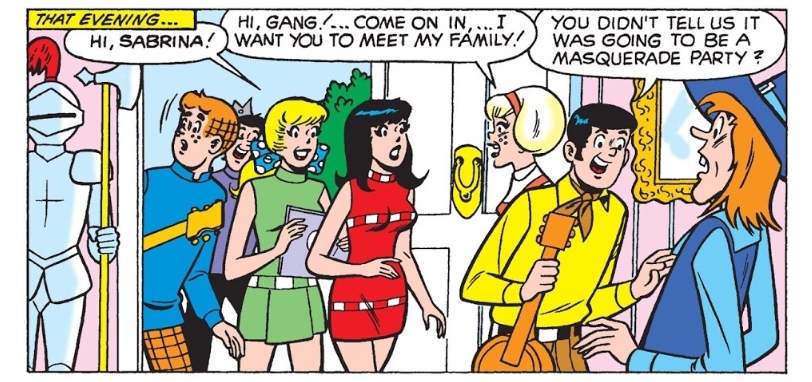
Sabrina was then integrated into Archie's comics world in Archie's TV Laugh-Out #1 (October 1969), in a story where Sabrina throws a party at home and the Archie gang attends.


She's been part of the universe ever since! She even almost appeared in Riverdale, although it didn't work out. But The Chilling Adventures of Sabrina still mentions Riverdale (and Riverdale likewise mentions Greendale), and the 1996 tv movie is set in Riverdale.

Wednesday, October 2, 2019

Character Spotlight: Gyoji

Teenage Mutant Ninja Turtles can occasionally be tricky in terms of canon immigrants because there are TWO official continuities: there's the original Mirage Comics continuity that ran off and on between 1984 and 2009, and there's the IDW continuity that ran from 2011 to present. For the most part, it's not a big deal: while Mirage was mainly interested in doing its own thing, IDW seems to want to pull in as many details as possible from every other continuity to create a single unified Ninja Turtles story. Therefore, whenever TMNT canon immigrants appear on this blog, it's safe to assume they're appearing in the IDW version. Imagine my surprise, then, when I learned this one happened in the Mirage continuity.

I've covered the Battle Nexus before, but a brief recap: the Battle Nexus is a cross-dimensional tournament that first appeared in the 2003 animated series but then was introduced into both the Mirage and IDW continuities.


But we're not here to talk about the Battle Nexus (yet), we're here to talk about Gyoji. Gyoji is a masked being who first appeared in the 2003 series episode, "The Ultimate Ninja" (February 2004), to referee a fight between Leonardo and the titular "Ultimate Ninja", aka Ue-sama. There is an air of mystery around Gyoji and why he appeared, especially once its revealed Ue-sama is from another dimension and from the same species as Gyoji's master, a species that claims to have taught humans ninjutsu. Splinter seems to know more about all this than he lets on.


Of course, this is all a set up for the four-part season finale, "The Big Brawl" (May - October 2004), which introduces us to the Battle Nexus. It's then we learn that Gyoji is the Battle Nexus's referee. 


When the Battle Nexus started appearing in TMNT: Teenage Mutant Ninja Turtles, Gyoji came with it, although now his name is spelled "Gyogi". He first appeared in issue 29 (February 2008).


Friday, September 20, 2019

Flashback Friday: Hall of Justice

Each Friday, I take one of the entries from my old Super Posts and expand it into its own featured article.

This week: the Hall of Justice!


The Hall of Justice first appeared as the Justice League headquarters in first episode of the Super Friends animated series (September 1973). It quickly became a trademark of the series, especially during Challenge of the Super Friends when it was contrasted with the equally iconic Legion of Doom headquarters. Here's an interesting piece of trivia for you: the Hall was based on Cincinatti's Union Terminal:


The Hall of Justice first appeared in comics in Super Friends #1 (September 1976), but since DC TV comics are...complicated in terms of continuity, we'll keep going.


The designed was used in Kingdom Come (1996) as the United Nations headquarters...


...but the actual Hall of Justice debuted in Justice League of America #7 (March 2007) as one half of the JLA's new headquarters (the other half being the Satellite Watchtower).


Since then it has become a mainstay. It technically continued to exist in the New 52, although it was blown up in the first month, in Justice League International #1 (September 2011).


It was then rebuilt following the destruction of the Watchtower, and the new version debuted in Justice League #1 (June 2018).


It has also been featured as - or inspired the look of - headquarters in many adaptations. I won't list them all, but some examples include the Arrowverse...


...Young Justice...


...The Batman...


...and Batman: The Brave and the Bold.