Subheader

A forever in-work compendium of Marvel and DC canon immigrants. What's a canon immigrant? Go here to find out!
Showing posts with label DC Appearances. Show all posts

Wednesday, November 27, 2019

Lois Lane's Violet Eyes

Usually canon immigrants are big things like characters and events. But sometimes they're details so tiny, most people don't even realize they're there. This is an example of the latter. 

In Superman: The Animated Series (1996), Lois Lane had violet eyes to match her suit.


This had never been the case in comics before. When Lois debuted in Action Comics #1 (1938), eyes weren't given that level of definition at all...


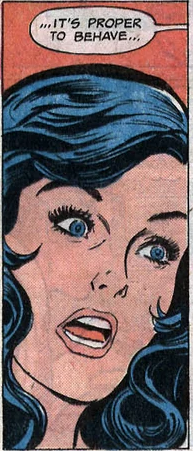
...and once they were, she was depicted with blue eyes. 


After the animated series, however, she started appearing with violet eyes in the comics. In cases like this it's hard to determine the absolute first time it happened, but here's a smattering of examples released over fifteen years or so (the final one being a variant cover for Superman #13, July 2019).


I also can't guarantee her eyes are ALWAYS violet. Coloring is a tricky beast and there are often inconsistencies even when the colors of an object are set in stone.

Friday, October 4, 2019

Flashback Friday: The Phantom Zone's Appearance

Each Friday, I take one of the entries from my old Super Posts and expand it into its own featured article.

This week: The Phantom Zone's appearance!


The Phantom Zone first appeared in Adventure Comics #283 (February 1961), where Superboy discovered it accidentally. In a crate of Kryptonian artifacts that landed on Earth, he came across the  Phantom Zone Projector, which incorporealized him. The Phantom Zone would later become a major part of the mythology, housing multiple Kryptonian criminals and being the method through which Mon-El winds up in the 30th century alongside the Legion of Super-Heroes.


In Superboy #185 (March 1972), the last appearance I can find prior to the movie, the Phantom Zone is still accessed via Phantom Zone Projector.


In Superman: The Movie (1978), the Phantom Zone is depicted very differently. In this, the Zone resembles a mirror pane that flies through space...seemingly controlled by Krypton, though it's unclear whether they created it or simply harnessed it. Criminals can see the world through the pane, and if it breaks, the criminals can escape.


The Phantom Zone mostly disappeared after Crisis on Infinite Earths, as its main role was housing Kryptonian criminals, and if Superman's the only surviving Kryptonian, there's no one to house. But it slowly creeped back into continuity, the way things usually do, to the point that Green Arrow's partner, Speedy, had a Phantom Zone Arrow in Teen Titans #32 (January 2006). When she used it on Superboy-Prime, the glass depiction of the Phantom Zone appeared in comics for the first time. This was a part of a larger trend of making the Superman books more like the movie at the time.


Although this never became the standard way to show the Phantom Zone, it did continue to appear from time to time. It even survived the New 52 and Rebirth, as seen in Superman #2 (June 2018).


This version of the Phantom Zone mainly appears in parodies and homages, but it does occasionally sneak into adaptations. Smallville, which likewise takes many visual and plot-related cues from the movie series, is one example.


You gotta admit: it's a good visual.

Friday, August 16, 2019

Flashback Friday: Gizmo

Each Friday, I take one of the entries from my old Super Posts and expand it into its own featured article.

This week: Gizmo!

Teen Titans was notorious for playing fast and loose with the designs of characters. So although Gizmo had already appeared in comics, beginning in The New Teen Titans #3 (November 1980)...


...when he appeared in the Teen Titans episode "Final Exam" (2003), it was in a greatly altered form. 


Gizmo kept the same appearance in the comics until February 2004, when he appeared in Teen Titans #8:


When he next appeared in Outsiders #12-14 (May-July 2004), however, he had an appearance closer to his animated counterpart.


And then in DC Special: Cyborg #5 (September 2008), he suddenly looks A LOT like his animated counterpart.


In the next issue, we learn this is Gizmo II, the original Gizmo's son (October 2008).

Gizmo II only appeared in a couple issues and hasn't seemed to survive the New 52. Gizmo's new appearance did for a little while, but he has since changed it. never got the full beard back, though.

Wednesday, July 31, 2019

Shazam's Animated Tie-In

A couple months ago, when I did my Flashback Friday on Isis, I talked briefly about how the 70s Shazam! comic was suddenly marketed as a DC TV comic even though it "isn't connected to the Shazam! animated series at all".

I was wrong.

Turns out, once the book became a DC TV comic, it was actually very strongly tied to the show. I'll explain.

See, when DC decided to launch a new Captain Marvel series in December 1972, they made it a continuation of his original series...which hadn't been published in 20 years. There are ways of doing that and having it work, but sales suggest whatever they did didn't work.


Luckily, a Shazam! tv series debuted in 1974 and it was a huge hit. Like many shows in the 70s, it involved Billy Batson travelling to a new town each episode and dealing with whatever trouble was there. Since he was still a minor, he was accompanied by an original character called Mentor, and they travelled together in a Captain Marvel-branded RV.


In Shazam! #25 (August 1976), Dr. Sivana threatens to attack a bunch of American cities. Billy doesn't know how he can protect all those cities since he has a job in New York, but luckily, his boss gets the idea to send Billy on a cross-country trip.


In Shazam! #26 (October 1976), several things of note happen. First, it's pointed out that Uncle Dudley grew a mustache and Billy's hair is getting longer, making them both look more like the leads in the show:


Second, the wizard Shazam tasks them with travelling across the country, and Shazam says Dudley needs to be like Mentor, the mythological character. (I find it interesting that Billy's boss had the idea to send him across the country but Shazam is carrying it out. Is Shazam secretly the manager of WHIZ?!)


Third, Shazam gives Billy a device called the Eterni-Phone to summon one of the people that make up the SHAZAM acronym (Solomon, Hercules, Achilles, Zeus, Atlas, and Mercury). This is based on a device in the show that performs the same function.


Finally, WHIZ-TV gives Billy an RV that strangely has the Captain Marvel lightning bolt on the front. (I'm telling you: Sterling Morris and Shazam are the same person.)


Interestingly, in the very same issue that moves the book to tie so closely to the tv show, there's also a reference to a recent team-up Captain Marvel had with the Justice League and Justice Society with a footnote to the relevant issues. More evidence to support my stance that DC TV comics are in continuity despite the title.

Friday, May 31, 2019

Flashback Friday: Mercy Graves

Each Friday, I take one of the entries from my old Super Posts and expand it into its own featured article.

This week: Mercy Graves!

Mercy Graves first appeared in Superman: The Animated Series (Episode: "A Little Piece of Home", 1996) as Lex Luthor's valet/bodyguard. She appeared in the series often as she was basically the only person Lex trusted. In Justice League (2000), she becomes CEO of LexCorp while he's in prison. Their relationship sours over the course of the show and they eventually part ways, but she is seen working for him again in Justice League Unlimited.


Her first comics appearance ever was tie-in series Superman Adventures #1 (September 1996)...


...but her first in-continuity appearance wasn't for a few more years. Surprisingly, she didn't debut in a Superman book, but instead in Detective Comics #735 (June 1999) during the "No Man's Land" crossover event.


She was first identified by name in a character profile in Batman No Man's Land Secret Files and Origins #1 (October 1999), but in-story, it was Detective Comics #740 (November 1999). She also - as far as I know - wears her chauffeur's uniform for the first time in this story.


In the decade between her first appearance and the New 52, Mercy was allowed to grow beyond her animated origins, mainly by giving her new origins. In President Luthor Secret Files and Origins #1 (January 2001), she and fellow Luthor bodyguard Hope were implied by Circe to be Amazons. Prometheus confirmed this in Justice League: Cry for Justice #6 (January 2010).


Before I get into her New 52 version, let's talk about her adaptation appearances a bit. The most notable is probably Smallville's Tess Mercer, who's technically an original character, but who's actually a combination of Mercy Graves, Eve Teschmacher, and - spoiler alert - Lena Luthor.


She's also appeared in Young Justice, DC Universe Online, and Superman: Doomsday. More interesting is the version of her that appears in The Batman episode "The Batman/Superman Story" (2007), as they decided to make her Asian.


Batman v. Superman: Dawn of Justice (2016) followed suit, although I'm pretty sure they didn't take inspiration from The Batman. This version seems to be more of an assistant than a bodyguard.


In the New 52, Mercy is likewise Asian and definitely Lex's assistant. She first appeared in Justice League #31 (June 2014) and most certainly inspired the film version.


Now, was this version inspired by The Batman? I can't say, but I can't rule it out.

Friday, May 17, 2019

Flashback Friday: Lionel Luthor

Each Friday, I take one of the entries from my old Super Posts and expand it into its own featured article.

This week: Lionel Luthor!

But before we get into Lionel Luthor, I should note that Lex Luthor's father does have a history in comics. So we should go over that first in order to better understand how depictions of Lionel Luthor differ.

Jules Thorul only made two appearances: one in Superman's Girlfriend, Lois Lane #23 (December 1960) and one in Superman #292 (August 1975). The story is that the Luthors were a comfortably middle class family in Smallville who disowned Lex when he turned to crime, then changed their names to "Thorul" just to complete the picture.

Fast forward to 2001, Lionel Luthor first appeared in the Smallville pilot. Lionel served two roles on the show: one, he filled the classic Lex Luthor role as the evil businessman, and two, he provided a contrast in parenting styles to the Kents. He was upgraded to the main cast in season 2, and stayed on more or less until the end, even transitioning over time into one of Clark's allies (in a storyline that never felt completely believable).


In 2004, DC released a re-telling of Superman's origin called Superman: Birthright. When first released, it was unclear whether it was a standalone story or if it were meant to replace Man of Steel as his official origin, although that is what eventually happened regardless. One of the changes it made, no doubt inspired by Smallville, was restoring Lex Luthor's past as growing up in Smallville and knowing Clark. In issue #8 (March 2004), we meet Lex's dad. He goes unnamed here, but his appearance is certainly inspired by John Glover and he appears to be wealthy, although we don't learn anything more about him than that.


The year after that, Teen Titans revealed that the human half of Superboy's DNA came, not from Cadmus director Paul Westfield like was once thought, but from Lex Luthor himself. In Teen Titans #26 (July 2005), we learn Lex was going to name Superboy "Lionel" after his father.


In Countdown #34 (July 2007), we get a short history of Lex Luthor. His background in Smallville is for real for real restored, and his father is once again a businessman with a passing resemblance to John Glover. He goes unnamed, but since Teen Titans previously established Lex's father's name is Lionel, we can assume it is here.


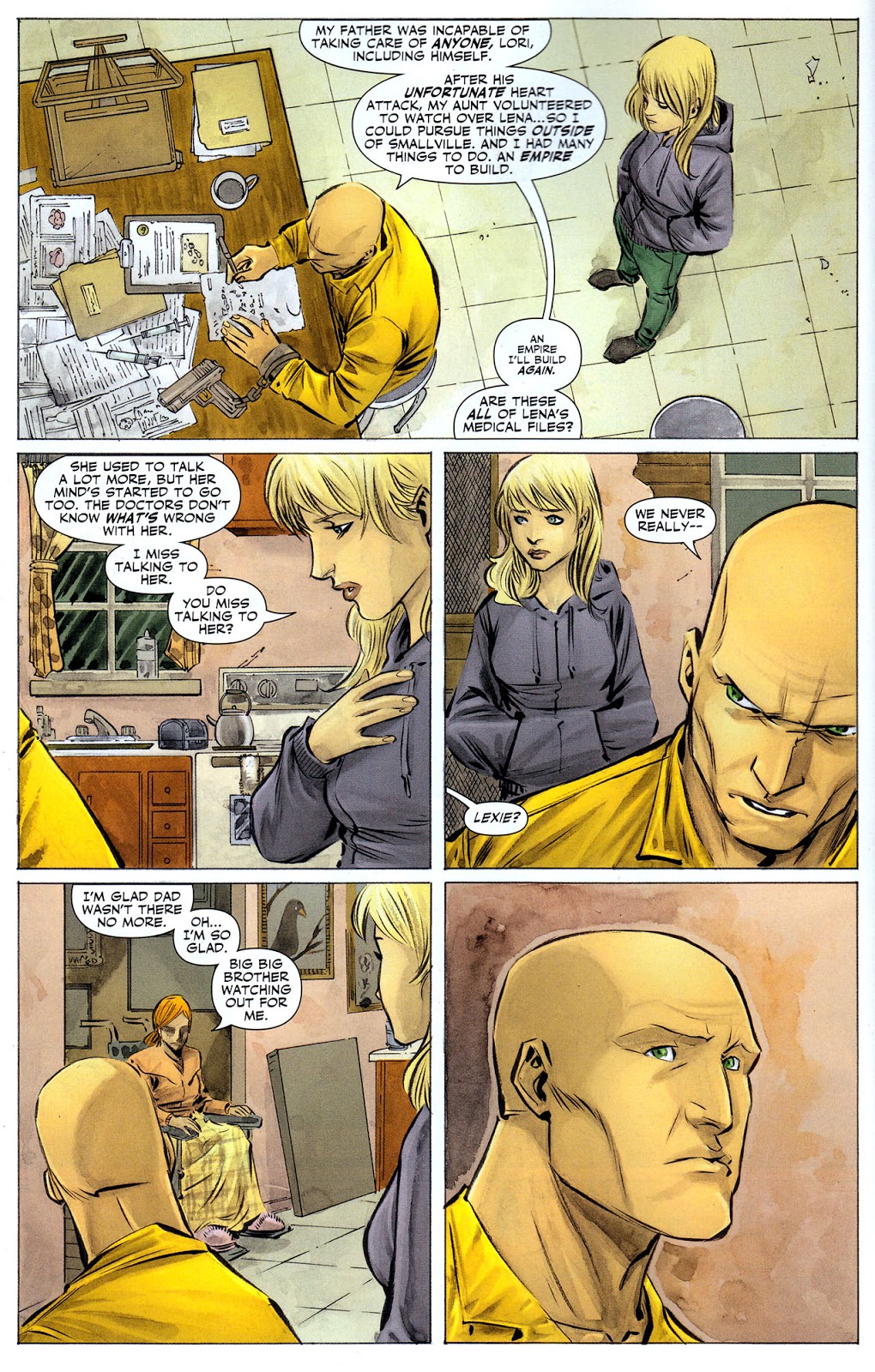
Here's where things get a little wonky. In Adventure Comics #6 (January 2010), we meet Lex's sister, Lena, and learn a little bit about their past. Here's the thing...suddenly he's not a wealthy businessman anymore. He's also not called Lionel here (although we can assume that's still his name). The Luthors are, at best, on the lower end of middle class. Since this issue was written by Geoff Johns, I'm sure it matches Superman: Secret Origin (2009), another re-telling of Superman's origin...and the most pointless, if I do say so myself.


It's pointless for several reasons. One, Birthright was only about five years old at this point. Two, it was mostly just a remix of previous origins. A little from Birthright, a little from Smallville, a little from Man of Steel, a little from various other things, and a LOT from Superman: The Movie. But mostly it was pointless because, only two years later, DC decided to reboot the whole universe. That gave us Flashpoint, and in the Flashpoint alternate reality, Lionel is at his most Smallville-esque. He debuts in Flashpoint: Project Superman #2 (July 2011).


After Flashpoint came the New 52, then DC Rebirth, and it seems like DC can't decide whether they want Lionel to be poor or wealthy, because Superwoman #6 (January 2017) fits what was pictured in Adventure Comics...


...but in Action Comics Special #1 (May 2018), he's a businessman again.


Then, Justice League #17 (February 2019) throws another wrench into the whole thing. Now, not only was Lionel a wealthy businessman, he was also studying aliens.


And Justice League #18 (March 2019) goes even farther to show him as a super-scientist who worked with Vandal Savage to harness the hidden power sources of the DC Universe, including the Still Force, the Ultraviolet part of the Emotional Spectrum, and the Tear of Extinction. I have no idea where they're going with this.


Surprisingly, this is all kind of still in line with Smallville's version of Lionel. See, beyond the "meteor rock" experiements LuthorCorp did, season seven revealed that Lionel Luthor was a member of a secret society called Veritas, which was interested in both alien life and strange artifacts on Earth, such as the Stones of Power and the Kawatche Caves. So while the comics take it quite a bit farther, it's not entirely out of left field.

One final note: Lex Luthor's father appears or is mentioned in many adaptations, but usually doesn't get named. He is, however, named Lionel when he appeared in Supergirl (2017).