Subheader

A forever in-work compendium of Marvel and DC canon immigrants. What's a canon immigrant? Go here to find out!
Showing posts with label Appearances. Show all posts

Wednesday, November 27, 2019

Lois Lane's Violet Eyes

Usually canon immigrants are big things like characters and events. But sometimes they're details so tiny, most people don't even realize they're there. This is an example of the latter. 

In Superman: The Animated Series (1996), Lois Lane had violet eyes to match her suit.


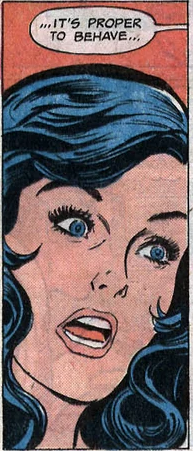
This had never been the case in comics before. When Lois debuted in Action Comics #1 (1938), eyes weren't given that level of definition at all...


...and once they were, she was depicted with blue eyes. 


After the animated series, however, she started appearing with violet eyes in the comics. In cases like this it's hard to determine the absolute first time it happened, but here's a smattering of examples released over fifteen years or so (the final one being a variant cover for Superman #13, July 2019).


I also can't guarantee her eyes are ALWAYS violet. Coloring is a tricky beast and there are often inconsistencies even when the colors of an object are set in stone.

Wednesday, October 9, 2019

Appearance Spotlight: Lady Octopus

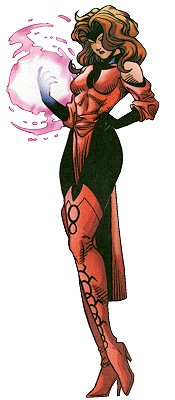
There's a strange phenomenon that happens as part of being a comics fan: the characters and concepts you're introduced to in your first couple years of reading comics become far more important in your mind than they are in the grand scheme of the universe. It's certainly true of me. It's why the Slingers are one of my favorite superteams, it's why I'm still disappointed Conduit never appeared in Smallville, and it's why my favorite Scarlet Witch outfit will always be this one. It's also why I'm glad Lady Octopus is having a resurgence.

Lady Octopus, or Doctor Octopus as she was originally called, was a former student of the original Doctor Octopus, who took over the role when he died. She first appeared in Amazing Spider-Man #406 (August 1995), and as that story is not only in the mid-90s, but in the Clone Saga as well, her story is needlessly complicated. I won't get into it all here, but suffice to say, it involves blending reality and virtual reality. Again, mid-90s.


After the original Doc Ock returned, she started going by Lady Octopus and only made sporadic appearances here and there. Recently she had a cameo in Amazing Spider-Man #17 (March 2019), though not wearing either her classic costume or her current one...


...which is strange, because in the next issue - Amazing Spider-Man #20 (April 2019) - she IS wearing an updated version of her classic outfit. Looking at the two, it seems like the one above is simply a coloring error, but I don't know that for sure.


A few months later, though, she appears in a brand new costume with the new Sinister Syndicate in Amazing Spider-Man #25 (July 2019).


What's the deal? Well, only a few months earlier - December 2018 - a movie called Spider-Man: Into the Spider-Verse was released. And one of the many villains who appeared in that movie was a female Doctor Octopus. To be clear, she is not Carolyn Trainer. She's Olivia Octavius, the CEO of Alchemax. She looks like this.


Clearly it's not an exact match. But side-by-side, it's easy to spot the similarities. The long, pulled-up brown hair instead of the short brown, black, or pink hair. The green, round goggles. The cream chestpiece. The green abdomen. The black arms and legs, and the lighter colored...thigh-highs, for lack of a better word.


One thing I wish they would've adapted was Olivia's clear, more lifelike tentacles, which would have made her more distinct from the original Doc Ock. But either way, it's nice to see a great movie like Into the Spider-Verse already impacting the comics!

Friday, October 4, 2019

Flashback Friday: The Phantom Zone's Appearance

Each Friday, I take one of the entries from my old Super Posts and expand it into its own featured article.

This week: The Phantom Zone's appearance!


The Phantom Zone first appeared in Adventure Comics #283 (February 1961), where Superboy discovered it accidentally. In a crate of Kryptonian artifacts that landed on Earth, he came across the  Phantom Zone Projector, which incorporealized him. The Phantom Zone would later become a major part of the mythology, housing multiple Kryptonian criminals and being the method through which Mon-El winds up in the 30th century alongside the Legion of Super-Heroes.


In Superboy #185 (March 1972), the last appearance I can find prior to the movie, the Phantom Zone is still accessed via Phantom Zone Projector.


In Superman: The Movie (1978), the Phantom Zone is depicted very differently. In this, the Zone resembles a mirror pane that flies through space...seemingly controlled by Krypton, though it's unclear whether they created it or simply harnessed it. Criminals can see the world through the pane, and if it breaks, the criminals can escape.


The Phantom Zone mostly disappeared after Crisis on Infinite Earths, as its main role was housing Kryptonian criminals, and if Superman's the only surviving Kryptonian, there's no one to house. But it slowly creeped back into continuity, the way things usually do, to the point that Green Arrow's partner, Speedy, had a Phantom Zone Arrow in Teen Titans #32 (January 2006). When she used it on Superboy-Prime, the glass depiction of the Phantom Zone appeared in comics for the first time. This was a part of a larger trend of making the Superman books more like the movie at the time.


Although this never became the standard way to show the Phantom Zone, it did continue to appear from time to time. It even survived the New 52 and Rebirth, as seen in Superman #2 (June 2018).


This version of the Phantom Zone mainly appears in parodies and homages, but it does occasionally sneak into adaptations. Smallville, which likewise takes many visual and plot-related cues from the movie series, is one example.


You gotta admit: it's a good visual.

Wednesday, September 11, 2019

Appearance Spotlight: Killmonger

Black Panther's Killmonger is easily among the best Marvel Cinematic Universe villains, due to a combination of a sympathetic backstory and goal and being played by the charismatic Michael B. Jordan.

In the comics, Killmonger's backstory is pretty much the same although his goal is exactly the opposite (making Wakanda even more isolationist rather than sharing its technology with the world), but another important difference is their appearance. While the movie's Killmonger where's a leopard-inspired take on  Black Panther's armor...


...the comics version of Killmonger goes for more a gladiator-esque look.


And that's still true today, for this Killmonger. But it's not true for another Killmonger. See, in Black Panther volume 7 by Ta-Nehisi Coates establishes an "Intergalactic Empire of Wakanda" that's some combination of in another reality and 2000 years in the future. I'm a little unclear based on what I could find online. Regardless, many of the people in this storyline share their names with Wakandans we know, including Emperor N'Jadaka, who's named after Killmonger. And his armor looks like this:


Note that it's not an exact recreation, and the MCU's Killmonger certainly doesn't have a cape made from a Symbiote, but it's still close enough that it's easy to tell what they were going for.

Wednesday, August 21, 2019

Clayface's New Origin

Many people are unaware of this, but there have been several people who have gone by the name "Clayface" over the course of Batman's history. Arguably the two most important are the first and second ones. The original was an actor named Basil Karlo who, in his first appearance at least, wore the costume of a movie monster he played (Clayface) to attack people connected to a remake of one of his movies. The second, Matt Hagen, was a treasure hunter who touched some protoplasm and gained the powers to reshape his body, but the effects were temporary and he would continually have to return to the protoplasm to regain his powers.


These two characters were combined to create Batman: The Animated Series's version of Clayface, who first appeared in the two-part episode, "Feat of Clay" (September 1992). In this series, Matt Hagen was a famous actor until a car accident ruined his face. Since then, he has started working for Roland Daggett, who gives him a substance called Renuyu each month that allows Matt to reshape his face - and therefore also lets him look like other people. Daggett uses Matt's abilities for corporate espionage and asks him to try to kill Lucius Fox while disguised as Bruce Wayne to help facilitate a merger between Daggett's and Wayne's companies. The plan doesn't work, so Daggett cuts off Matt from Renuyu, and when Matt breaks into the factory to get some, Daggett's goons cover Matt with it and force him to drink liters of the stuff. This, of course, turns Matt into Clayface.


Matt Hagen is the only Clayface in the DC Animated Universe, but the comics are less picky. Prior to this series, there were four, which is not that surprising. There were also multiple Two-Faces and Mad Hatters, for instance, for reasons we won't really get into. But unlike these other characters, DC has continued to introduce new Clayfaces, for a total of nine as of this writing.

That being said, the comics likewise seem to have settled on Basil Karlo as the "main" Clayface, and to that end, featured a retelling of his origin in Detective Comics Annual 2018. Although it's not an exact retelling of "Feat of Clay", it does feature more beats from that than from Basil Karlo's original debut in Detective Comics #40 (April 1940). His face is disfigured in a car accident, and he fixes that using a chemical called Renu - no "yu" on the end in this version, since it's not meant to be a cosmetic...


...which is still made by Roland Daggett's company, spelled with one "t" in this version for reasons that aren't clear.


Similarly, being doused with loads of the Renu turns Karlo into a hulking mass of goo like the animated Clayface.


This, however, is NOT the first time The Animated Series has influenced Clayface's appearance. I've previously written about that. It's due for a Flashback Friday, but I don't know when I'll get around to it.

Wednesday, August 14, 2019

Costume Spotlight: Captain America's Armory

In Captain America #12 (July 2019), we learn that Captain America has an armory of sorts. We've seen this with characters like Iron Man and Batman, but it's a first for good ol' Captain Rogers. In doing so, however, we're treated to a variety of costumes from throughout his history, including a few I wouldn't exactly expect to see.


On the far left is, naturally, the costume from his first appearance in Captain America Comics #1 (1939). But more intriguing is the one next to it. This one isn't from the comics at all, but instead, the 1979 tv movie, and its sequel, Captain America II: Death Too Soon (also 1979).

These movies featured a very different Captain America more inspired by Evel Knievel. There was still a tie to the 40s, though it was because Steve Rogers's father was a famous government agent of the time, also known as Captain America. And there was still a super-soldier serum, though it was more of a super-steroid derived called FLAG (Full Latent Ability Gain) from Steve's father's own physiology. Everything else about the story is different.


The suit after that is the Commander Rogers outfit from circa 2010, but the next two are VERY interesting. The first is Captain America's World War II uniform from The Ultimates #1 (January 2002)...


...and the next is his modern outfit from the same issue. Which means they're from Ultimate Marvel, an entirely different comics universe. What's going on here? Are they relics from the merging of Earth-1610 and Earth-616 in Secret Wars? Or is there some other explanation?


Finally, there's this one. I can't totally be sure it belongs on this site, but I'm including it to put it to the masses. It looks like it's probably from some animated project, but I can't figure out which one. So what say you? Is this suit from some tv or movie, maybe a toy line or Hostess ad? Is it from some comics alternate reality? Or is it just from some run-of-the-mill comics storyline and I simply don't recognize it?


Let me know if you know!

Wednesday, July 31, 2019

Shazam's Animated Tie-In

A couple months ago, when I did my Flashback Friday on Isis, I talked briefly about how the 70s Shazam! comic was suddenly marketed as a DC TV comic even though it "isn't connected to the Shazam! animated series at all".

I was wrong.

Turns out, once the book became a DC TV comic, it was actually very strongly tied to the show. I'll explain.

See, when DC decided to launch a new Captain Marvel series in December 1972, they made it a continuation of his original series...which hadn't been published in 20 years. There are ways of doing that and having it work, but sales suggest whatever they did didn't work.


Luckily, a Shazam! tv series debuted in 1974 and it was a huge hit. Like many shows in the 70s, it involved Billy Batson travelling to a new town each episode and dealing with whatever trouble was there. Since he was still a minor, he was accompanied by an original character called Mentor, and they travelled together in a Captain Marvel-branded RV.


In Shazam! #25 (August 1976), Dr. Sivana threatens to attack a bunch of American cities. Billy doesn't know how he can protect all those cities since he has a job in New York, but luckily, his boss gets the idea to send Billy on a cross-country trip.


In Shazam! #26 (October 1976), several things of note happen. First, it's pointed out that Uncle Dudley grew a mustache and Billy's hair is getting longer, making them both look more like the leads in the show:


Second, the wizard Shazam tasks them with travelling across the country, and Shazam says Dudley needs to be like Mentor, the mythological character. (I find it interesting that Billy's boss had the idea to send him across the country but Shazam is carrying it out. Is Shazam secretly the manager of WHIZ?!)


Third, Shazam gives Billy a device called the Eterni-Phone to summon one of the people that make up the SHAZAM acronym (Solomon, Hercules, Achilles, Zeus, Atlas, and Mercury). This is based on a device in the show that performs the same function.


Finally, WHIZ-TV gives Billy an RV that strangely has the Captain Marvel lightning bolt on the front. (I'm telling you: Sterling Morris and Shazam are the same person.)


Interestingly, in the very same issue that moves the book to tie so closely to the tv show, there's also a reference to a recent team-up Captain Marvel had with the Justice League and Justice Society with a footnote to the relevant issues. More evidence to support my stance that DC TV comics are in continuity despite the title.

Wednesday, July 10, 2019

Nebula's Appearance

Sometimes, in comic book adaptations, a detail can be based on something that's already extant in the comics, but changed ever so slightly for the new medium. When it comes to designs, this usually means making the design more intricate. Of course, because canon immigration is essentially inescapable, then the more intricate design finds its way into the comics. This is what happened with Nebula.

Sometimes when this happens, it takes me a while to learn it happened. This is also what happened with Nebula.

When Nebula first appeared in The Avengers #257 (May 1985), she was a pirate who had seized control of Thanos's ship, the Sanctuary II, in a period when he was presumed dead. She claimed to be his granddaughter, and she looked like this:


In Silver Surfer #69 (June 1992), she's catatonic, so one of the people looking after her takes her to Dr. Mandibus to get her back to normal. In Silver Surfer #72 (July 1992), we see that Dr. Mandibus was able to restore her mental capacity, but turned her into a cyborg to do so.


She shows up again in Silver Surfer #110 (September 1995), and she mostly looks the same except she's grown her hair out again.


In Nova #1 (March 1999), however, she's back to her original look.


But in her next appearance, Annihilation: Ronan #1 (April 2006), she's back to being a bald cyborg. She continues to look this way through the rest of the Annihilation event.


The modern Guardians of the Galaxy spun out of the Annihilation event, so it's no surprise that, when Guardians of the Galaxy was released in 2014, Nebula's look was based on how she appeared in Annihilation. Overall it's simply a more detailed version of the look above. The most major change is the stripe down the middle of her face, which I believe is meant to mimic the stripe down her chest that's present in most of the images above.


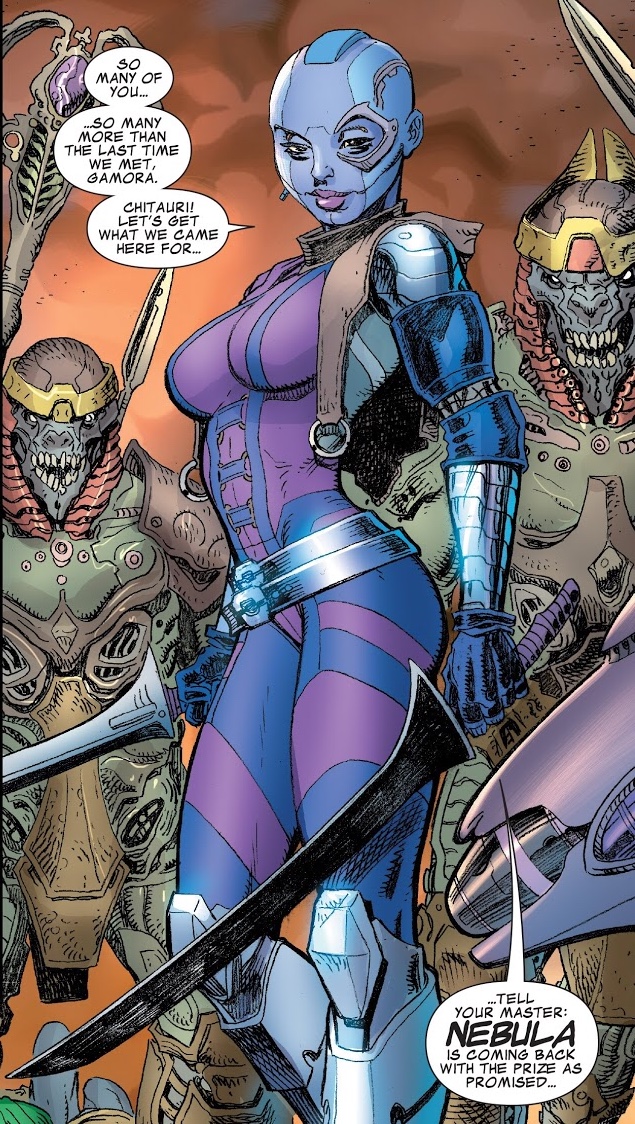
Guardians of the Galaxy was a huge hit, so it's no surprise that, when she appeared in Guardians Team-Up #1 (March 2015) - itself a book that wouldn't exist without the movie - she appeared as she does in the movie. Notably, she's flanked by Chitauri, another case of appearance canon immigration.


And she's appeared that way ever since!

That's not the only change to Nebula the movie made, but we'll get to that next week.