Each Friday, I take one of the entries from my old Super Posts and expand it into its own featured article.
This week: J.A.R.V.I.S.!
Tony Stark's butler, Edwin Jarvis, who first appeared in Tales of Suspense #59 (September 1964)...
...was adapted for the Iron Man movie (2008) as an advanced AI that controlled the Stark Mansion (and the Iron Man suit later on) and was called J.A.R.V.I.S., which was explained in the movie novelization to stand for "Just A Rather Very Intelligent System".
J.A.R.V.I.S. later appears, which the same acronym explanation, in Invincible Iron Man #11 (March 2009), this time based on the personality of the real Jarvis and as the controller AI of Pepper Potts's "Rescue" armor.
As a side note, J.A.R.V.I.S.'s personality being based on a real Edwin Jarvis, who presumably helped raise Tony when he was young, was a common MCU fan theory. This was later confirmed when Agent Carter had Jarvis in a major supporting role across both seasons.
Subheader
A forever in-work compendium of Marvel and DC canon immigrants. What's a canon immigrant? Go here to find out!
Showing posts with label Iron Man. Show all posts
Friday, December 13, 2019
Friday, June 14, 2019
Flashback Friday: Arc Reactor
Each Friday, I take one of the entries from my old Super Posts and expand it into its own featured article.
This week: the Arc Reactor!
The arc reactor first appeared in the film Iron Man (May 2008) as a portable power source that powered the magnet that kept a piece of shrapnel from entering Tony Stark's heart, as well as powering the Iron Man suit. It was a miniaturized version of a machine that Howard Stark built to create clean energy, a project that didn't go anywhere until Tony was able to miniaturize it. Side note: much evidence across the Marvel Cinematic Universe shows that the Arc Reactor is Howard Stark's attempt to create a man-made version of the Tesseract.
It later appeared in Invincible Iron Man #3 (July 2008), though instead called a Repulsor Technology Node. Pepper Potts was caught in an explosion that caused shrapnel to lodge into her body. Tony has a node implanted into her chest to keep the shrapnel from entering her heart. He also says he used one when the same thing happened to him in the Middle East, which essentially completely rewrites his origin to match the movie. Although the "Extremis" storyline from 2007 moved his origin to the Middle East, this is the first time it's been noted that he implanted something into his chest to help with his heart condition, rather than crating a whole chestplate to wear.
In Invincible Iron Man #21 (December 2009), Tony has to reboot the Extremis within his body to prevent Norman Osborn from gaining access to it. Doing so causes his body to shut down, so he has to get an RT Node implanted to restart it. Incidentally, this same issue seems to indicate he had both the RT Node and chestplate when he escaped Afghanistan.
The Arc Reactor/RT Node has continued to appear since then, although I'm not sure it's ever been vital to a storyline again. I'm also pretty sure neither Tony nor Pepper still have theirs; they're simply a way to power the suits these days.
This week: the Arc Reactor!
The arc reactor first appeared in the film Iron Man (May 2008) as a portable power source that powered the magnet that kept a piece of shrapnel from entering Tony Stark's heart, as well as powering the Iron Man suit. It was a miniaturized version of a machine that Howard Stark built to create clean energy, a project that didn't go anywhere until Tony was able to miniaturize it. Side note: much evidence across the Marvel Cinematic Universe shows that the Arc Reactor is Howard Stark's attempt to create a man-made version of the Tesseract.
It later appeared in Invincible Iron Man #3 (July 2008), though instead called a Repulsor Technology Node. Pepper Potts was caught in an explosion that caused shrapnel to lodge into her body. Tony has a node implanted into her chest to keep the shrapnel from entering her heart. He also says he used one when the same thing happened to him in the Middle East, which essentially completely rewrites his origin to match the movie. Although the "Extremis" storyline from 2007 moved his origin to the Middle East, this is the first time it's been noted that he implanted something into his chest to help with his heart condition, rather than crating a whole chestplate to wear.
In Invincible Iron Man #21 (December 2009), Tony has to reboot the Extremis within his body to prevent Norman Osborn from gaining access to it. Doing so causes his body to shut down, so he has to get an RT Node implanted to restart it. Incidentally, this same issue seems to indicate he had both the RT Node and chestplate when he escaped Afghanistan.
The Arc Reactor/RT Node has continued to appear since then, although I'm not sure it's ever been vital to a storyline again. I'm also pretty sure neither Tony nor Pepper still have theirs; they're simply a way to power the suits these days.
Saturday, December 29, 2018
Group Spotlight: Ten Rings
This is an important one! But CBR already wrote about it, so I’ll defer to them.
The gist is that the Ten Rings are a terrorist organization led by the Mandarin that debuted in Iron Man (May 2008), and Ironheart #1 (November 2018) has finally brought it into the comics ten years later. You can read about it in more detail at the following link:
https://www.cbr.com/mcu-ten-rings-iron-man-ironheart/
As you can see, the symbol isn’t completely the same, but it’s close enough.
Wednesday, November 29, 2017
James Rhodes as Iron Patriot
I don't know how I feel about including this one. It's common for comics to make changes around the time of a movie or tv show to make themselves more recognizable to people who decide to buy the comics because they like the movie/show. Sometimes this produces canon immigrants, such as new characters or costumes. Sometimes it doesn't, such as Spider-Man getting his black suit back in time for Spider-Man 3. But sometimes it produces a weird middle ground where none of the specific elements are new but the combination is. This one is an example of that. And generally I try to avoid these, but to be honest, I have a streak going and I want it to continue. So here we go.
Col. James "Rhodey" Rhodes took over as Iron Man following the death of Tony Stark, using a militarized version of the Iron Man armor, in Iron Man #284 (July 1992). The armor debuted three issues before. When Tony came back and took over as Iron Man again, Rhodey kept the suit and started going by War Machine in Avengers West Coast #94 (March 1993).
The Iron Patriot armor debuted in Dark Avengers #1 (January 2009), worn by Norman Osborn. It was purposefully designed by him to evoke both Iron Man and Captain America, I guess to give his team some legitimacy.
A few years later, Iron Patriot debuted in Iron Man 3 (2013) as Rhodey's new code name. The official reason was that the name "War Machine" didn't test well and they wanted something more positive in the wake of the Chitauri invasion.
So in Secret Avengers #6 (July 2013), only a couple months after Iron Man 3, Rhodey takes over as the new Iron Patriot and also controls some Iron Patriot drones.
Rhodey is no longer Iron Patriot, but he kept the role for about a year and a half. That longevity, definitely more than one story arc, is pretty much the only reason I'm comfortable at all posting this.
Col. James "Rhodey" Rhodes took over as Iron Man following the death of Tony Stark, using a militarized version of the Iron Man armor, in Iron Man #284 (July 1992). The armor debuted three issues before. When Tony came back and took over as Iron Man again, Rhodey kept the suit and started going by War Machine in Avengers West Coast #94 (March 1993).
The Iron Patriot armor debuted in Dark Avengers #1 (January 2009), worn by Norman Osborn. It was purposefully designed by him to evoke both Iron Man and Captain America, I guess to give his team some legitimacy.
A few years later, Iron Patriot debuted in Iron Man 3 (2013) as Rhodey's new code name. The official reason was that the name "War Machine" didn't test well and they wanted something more positive in the wake of the Chitauri invasion.
So in Secret Avengers #6 (July 2013), only a couple months after Iron Man 3, Rhodey takes over as the new Iron Patriot and also controls some Iron Patriot drones.
Rhodey is no longer Iron Patriot, but he kept the role for about a year and a half. That longevity, definitely more than one story arc, is pretty much the only reason I'm comfortable at all posting this.
Wednesday, August 2, 2017
Character Spotlight: Raza (plus bonus content related to Iron Man's origin)
I've been waiting for the chance to post this one for a long time. I've known about it since 2012, but I could never find any proof online, and I could never find the issue in person to verify it myself. Luckily, a friend of mine finally convinced me to get Marvel Unlimited and it was right there. Took me like two seconds to find.
In Iron Man (2008), Tony Stark is captured in Afghanistan by a terrorist cell called the Ten Rings. The leader of the cell is a man named Raza. Many people were disappointed that the Ten Rings wasn't led by the Mandarin, but Raza is conspicuously shown fiddling with a large ring on multiple occasions, and the Mandarin has been known to lend his rings to underlings on certain occasions.
Two years later, Invincible Iron Man Annual 2010 goes through the Mandarin's history, which includes a retelling of Iron Man's origin. This is the first time the Mandarin has been tied to this story in the comics, and more importantly, Raza shows up as his right hand man, looking just like he does in the movie.
On the next page, we see his name is indeed Raza:
As a bonus, here's how Tony's escape is depicted:
Although the movie's Mark I armor is very similar to the Mark I armor in the comics (way closer than I expected it to look), it has a much more segmented, jury-rigged appearance as is depicted here. The armor in Iron Man's first appearance also didn't have flamethrowers. For comparison, here's the original Mark I armor from the comics and the relevant scene from the movie.
In Iron Man (2008), Tony Stark is captured in Afghanistan by a terrorist cell called the Ten Rings. The leader of the cell is a man named Raza. Many people were disappointed that the Ten Rings wasn't led by the Mandarin, but Raza is conspicuously shown fiddling with a large ring on multiple occasions, and the Mandarin has been known to lend his rings to underlings on certain occasions.
Two years later, Invincible Iron Man Annual 2010 goes through the Mandarin's history, which includes a retelling of Iron Man's origin. This is the first time the Mandarin has been tied to this story in the comics, and more importantly, Raza shows up as his right hand man, looking just like he does in the movie.
On the next page, we see his name is indeed Raza:
As a bonus, here's how Tony's escape is depicted:
Although the movie's Mark I armor is very similar to the Mark I armor in the comics (way closer than I expected it to look), it has a much more segmented, jury-rigged appearance as is depicted here. The armor in Iron Man's first appearance also didn't have flamethrowers. For comparison, here's the original Mark I armor from the comics and the relevant scene from the movie.
Tales of Suspense #39 (1963)
Iron Man (2008)
Wednesday, January 25, 2017
Character Spotlight: Dr. Wu
This is an interesting one.
This is Dr. Wu. He appeared in Iron Man 3 (2013):
What's that? You don't remember him? That's because he only showed up in the Bern conference scene at the beginning and in the surgery scene at the end (where his face was covered)...for most audiences. In China, he had several other scenes. Several pro-China scenes specifically, that seem to have been requested by whatever Chinese production studio co-funded the movie.
Yet, somehow this character made the jump to comics anyway...in Amazing Spider-Man volume 4 #1 (October 2015), of all places. And he's a recurring character, the head of Parker Industries's bio-tech division.
And you're probably thinking what I did: the name's just a coincidence, right? But no:
This is Dr. Wu. He appeared in Iron Man 3 (2013):
What's that? You don't remember him? That's because he only showed up in the Bern conference scene at the beginning and in the surgery scene at the end (where his face was covered)...for most audiences. In China, he had several other scenes. Several pro-China scenes specifically, that seem to have been requested by whatever Chinese production studio co-funded the movie.
Yet, somehow this character made the jump to comics anyway...in Amazing Spider-Man volume 4 #1 (October 2015), of all places. And he's a recurring character, the head of Parker Industries's bio-tech division.
And you're probably thinking what I did: the name's just a coincidence, right? But no:
Wednesday, September 28, 2016
Gadget Spotlight: Iron Man HUD
I hate when I don't have a definitive first appearance, but I'm confident about this one, so here we go.
In the movie Iron Man (2008), we frequently cut to Tony's face inside the helmet, using a HUD that tells him power level, altitude, and lots of other information. I think it's pretty safe to say that this style of shot was created for the films as a way to get their lead actor on screen without having to take his mask off (although they do their fair share of that as well).
But I did some digging, and I was able to find one in Iron Man #1 (October 2012).
Now, I can't be certain without looking through every appearance of Iron Man from 2008 to 2012, but I'm willing to say this is the first appearance for a few reasons:
1) This would put it after The Avengers, which means there have been three movies to cement in the minds of the general audience that this is how Tony interacts with his armor.
2) This issue features him trying out an experimental armor, which is a good place to introduce a new feature such as this.
3) This issue is part of Marvel NOW!, which is also a good place to introduce new features like this.
4) This was the last panel of the first issue, which definitely says "hey! look at this new thing!" to me.
In the movie Iron Man (2008), we frequently cut to Tony's face inside the helmet, using a HUD that tells him power level, altitude, and lots of other information. I think it's pretty safe to say that this style of shot was created for the films as a way to get their lead actor on screen without having to take his mask off (although they do their fair share of that as well).
It doesn't really make sense visually - I'm sure he has a HUD, but I imagine it'd be localized to his eyeholes - but it's more of an "illusion of reality" type of thing. It gives you the information you need to know, but makes it more visually appealing for the audience.
Of course, being such an iconic visual, it made its way into the comics as well. I first noticed it in Invincible Iron Man #1 (October 2015), and thought it was an All-New, All-Different Marvel Now! change, like the quinjets.
But I did some digging, and I was able to find one in Iron Man #1 (October 2012).
Now, I can't be certain without looking through every appearance of Iron Man from 2008 to 2012, but I'm willing to say this is the first appearance for a few reasons:
1) This would put it after The Avengers, which means there have been three movies to cement in the minds of the general audience that this is how Tony interacts with his armor.
2) This issue features him trying out an experimental armor, which is a good place to introduce a new feature such as this.
3) This issue is part of Marvel NOW!, which is also a good place to introduce new features like this.
4) This was the last panel of the first issue, which definitely says "hey! look at this new thing!" to me.
Wednesday, January 14, 2015
Just A Small Little Thing: The Stark Industries Logo
Even though Stark Industries has existed in the comics since 1963, it never really had a logo. When the name did appear on a building or product (usually a building), the name has been written simply and inconsistently, like so:
This is true as recently as Avengers Vs. X-Men #1 (April 2012):
So when they made the movie Iron Man (2008), they had to create a logo for the company, and they came up with one that was simple, sleek, adaptable, and recognizable. That is to say, it's a pretty good one.
And I don't know if this is the absolute first appearance of it in comics, but it definitely appeared in this month's Ant-Man #1 (January 2015) when Scott Lang is looking for a new job.
UPDATE (6/28/16): I have found an earlier instance in Moon Knight #9 (November 2014). It's not the full logo, but it's obviously derived from it.
This is true as recently as Avengers Vs. X-Men #1 (April 2012):
So when they made the movie Iron Man (2008), they had to create a logo for the company, and they came up with one that was simple, sleek, adaptable, and recognizable. That is to say, it's a pretty good one.
And I don't know if this is the absolute first appearance of it in comics, but it definitely appeared in this month's Ant-Man #1 (January 2015) when Scott Lang is looking for a new job.
UPDATE (6/28/16): I have found an earlier instance in Moon Knight #9 (November 2014). It's not the full logo, but it's obviously derived from it.
Wednesday, April 25, 2012
Character Spotlight: Agent Phil Coulson
Comic Book Resources has just announced that Marvel will be bringing the fan-favorite Agent Coulson into the Marvel Universe proper in the upcoming Battle Scars #6 (June 2012). And that's not all: there will be a black Fury as well!
Battle Scars is a 2012 miniseries about an Army Ranger named Marcus Johnson, who is being fought over by several Marvel entities, including SHIELD, Captain America, and the Serpent Society, because they believe he's important for some reason. In issue 5, it's revealed that he's the son of Nick Fury (whose real name is Nick Fury Jr.), and according to the above image, he'll at least join SHIELD, and maybe even take the elder Fury's place. Whether this piece of obvious synergy is handled smartly or in a contrived way is yet to be seen, but I hope it's the former. (It'll probably be the latter, though, since Marcus has to lose an eye, shave his head, grow a goatee, and join SHIELD in the span of an issue.)
What's more important - to me, at least - is the addition of Coulson. Ever since he first appeared in Iron Man (2008), I've been counting down the days to his first comics appearance. But it never came. Even after showing up in other movies, being featured in a couple of shorts, becoming a major character in the Ultimate Spider-Man animated series, and getting his own poster for The Avengers film, it never came. I was even considering making a Canon Immigrant Wish List post that would've showcased several popular canon foreigners that never made the jump, but now the #1 pick would have to be removed. Thank goodness. Anyway, Coulson first appeared in Battle Scars #1 (January 2012) as Marcus's friend "Cheese", and was then revealed as Phil Coulson in Battle Scars #6 (June 2012).
Battle Scars is a 2012 miniseries about an Army Ranger named Marcus Johnson, who is being fought over by several Marvel entities, including SHIELD, Captain America, and the Serpent Society, because they believe he's important for some reason. In issue 5, it's revealed that he's the son of Nick Fury (whose real name is Nick Fury Jr.), and according to the above image, he'll at least join SHIELD, and maybe even take the elder Fury's place. Whether this piece of obvious synergy is handled smartly or in a contrived way is yet to be seen, but I hope it's the former. (It'll probably be the latter, though, since Marcus has to lose an eye, shave his head, grow a goatee, and join SHIELD in the span of an issue.)
What's more important - to me, at least - is the addition of Coulson. Ever since he first appeared in Iron Man (2008), I've been counting down the days to his first comics appearance. But it never came. Even after showing up in other movies, being featured in a couple of shorts, becoming a major character in the Ultimate Spider-Man animated series, and getting his own poster for The Avengers film, it never came. I was even considering making a Canon Immigrant Wish List post that would've showcased several popular canon foreigners that never made the jump, but now the #1 pick would have to be removed. Thank goodness. Anyway, Coulson first appeared in Battle Scars #1 (January 2012) as Marcus's friend "Cheese", and was then revealed as Phil Coulson in Battle Scars #6 (June 2012).
Wednesday, November 23, 2011
Marvel's Other Immigrants Super Post!
Every so often, a random change made in an adaptation will find its way into the original comics. They're not whole new characters, they're not a certain look, they're just...stuff. These are their stories.
Morph's name
A character named Changeling (Kevin Sidney) first appeared in Uncanny X-Men #35 (August 1967) as a member of the villainous Factor Three; he later secretly joined the X-Men but died the same issue. In the first episode of the X-Men animated series (1992), the creators wanted to show the seriousness of the series, so they made the character an X-Men member so they could kill him off; however, in the show, he was named "Morph". This would be the name he used when he appeared in the alternate reality "Age of Apocalypse" in X-Men Alpha (January 1995).
Spider-Man's organic web spinners
Until the Spider-Man movie (2002), Spider-Man's webs had always come from a device he invented. The creators of the movie thought it wouldn't make sense for a high school student to invent such a complex device, so they gave him organic web-spinners. The storyline Spider-Man: The Other (2005) gave him organic webshooters as well (among other new powers), but they have all disappeared after the Brand New Day storyline.
Rogue's real name
One of Rogue's defining traits was that she had no recollection of who she was. In the X-Men movie (2000), though, her name was Marie. After X-Treme X-Men #43 (April 2004) claimed her name was "Anna Raven" (alluding to actress Anna Paquin and using Mystique's first name as her last), the Rogue ongoing series followed in the footsteps of both in September 2004 by revealing her name is "Anna Marie", last name still unknown.
Arc Reactor
J.A.R.V.I.S. (Just Another Rather Very Intelligent System)
Mutant Response Division
The Mutant Response Division is a UN-affiliated office whose purpose is to deal with international mutant threats. They first appeared in the first episode of Wolverine and the X-Men (September 2008) and later made the jump to comics in X-Factor #204 (June 2010). They have since also been mentioned in The Avengers: Earth's Mightiest Heroes (episode: "The Man in the Ant Hill", September 2010).
Labels:
1990s,
2000s,
2010s,
Animated,
Film,
Iron Man,
Marvel Other,
Spider-Man,
X-Men
Tuesday, November 15, 2011
Marvel Characters Super Post!
Marvel isn't as crazy about canon immigrants as DC is. This means that there are fewer of them, but it also means that the characters that do immigrate generally become popular and are used in the long-term.
Dazzler
To be honest, I'm not entirely sure that Dazzler should be featured here. But I'm going to do it anyway for the sake of completeness, and also because the story's interesting. In the mid-1970s, Casablanca Records (the people behind KISS, the Village People, Parliament, and others) approached Marvel Comics with a cross-promotion idea that would feature a comic book character, a real-life singer, and a movie. The character was changed several times in preliminary stages - going through such names as the Disco Queen and the Disco Dazzler - before Casablanca backed out of the deal altogether. However, Marvel had already been promoting the character for several months and she had already premiered as The Dazzler in Uncanny X-Men #130 (February 1980), so Marvel decided to go ahead with their plans and released Dazzler #1 in March 1981.
HERBIE
Firestar
Ms. Lion
Videoman
Videoman first appeared in the Spider-Man and His Amazing Friends episode of the same name (1981) as a creation of Electro, and then later as an actual supervillain (1982), and later still as a superhero (1983). He made the jump to comics in Spider-Man Family Featuring Amazing Friends #1 (October 2006).
Orange Hulk
Orange Hulk first appeared as an unlockable character in the video game Marvel Vs. Capcom (1998). He later appeared as a member of the Black Legion in Uncanny X-Force #12 (July 2011).
The Spike
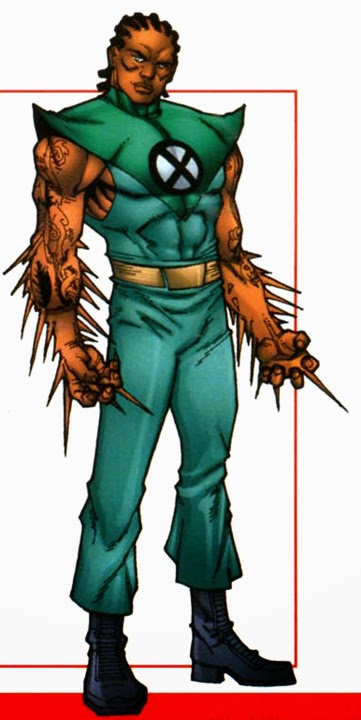
Spyke, aka Evan Daniels, first appeared in the X-Men: Evolution episode "Speed and The Spyke" (2000); he was a student at Xavier's school and Storm's nephew. He later made the transition to comics in the form of The Spike, aka Daran Elliot, a new member of X-Force (X-Force #121, December 2001).
X-23
Reptil
The Next Avengers
The Next Avengers first appeared in the direct-to-dvd movie Next Avengers: Heroes of Tomorrow (2008). They first appeared in comics in Avengers #1 (July 2010).
Whiplash (Anton Vanko)
This version of Whiplash was created for the movie Iron Man 2 (May 2010), where he is named Ivan Vanko, and is an amalgam of Whiplash and the first Crimson Dynamo (Anton Vanko). The character was brought over to the mainstream Marvel Universe in the Iron Man vs. Whiplash miniseries (December 2009-March 2010) in anticipation of the film's release, and because the movie character was dissimilar to any other version of Whiplash in the comics. You can see on the right that he even resembles Mickey Rourke. He has made several appearances since then, but sharing a name with Crimson Dynamo seems to be a coincidence in-universe.
Dazzler
To be honest, I'm not entirely sure that Dazzler should be featured here. But I'm going to do it anyway for the sake of completeness, and also because the story's interesting. In the mid-1970s, Casablanca Records (the people behind KISS, the Village People, Parliament, and others) approached Marvel Comics with a cross-promotion idea that would feature a comic book character, a real-life singer, and a movie. The character was changed several times in preliminary stages - going through such names as the Disco Queen and the Disco Dazzler - before Casablanca backed out of the deal altogether. However, Marvel had already been promoting the character for several months and she had already premiered as The Dazzler in Uncanny X-Men #130 (February 1980), so Marvel decided to go ahead with their plans and released Dazzler #1 in March 1981.
HERBIE
Firestar
Ms. Lion
Videoman
Videoman first appeared in the Spider-Man and His Amazing Friends episode of the same name (1981) as a creation of Electro, and then later as an actual supervillain (1982), and later still as a superhero (1983). He made the jump to comics in Spider-Man Family Featuring Amazing Friends #1 (October 2006).
Orange Hulk
Orange Hulk first appeared as an unlockable character in the video game Marvel Vs. Capcom (1998). He later appeared as a member of the Black Legion in Uncanny X-Force #12 (July 2011).
The Spike
Spyke, aka Evan Daniels, first appeared in the X-Men: Evolution episode "Speed and The Spyke" (2000); he was a student at Xavier's school and Storm's nephew. He later made the transition to comics in the form of The Spike, aka Daran Elliot, a new member of X-Force (X-Force #121, December 2001).
X-23
Reptil
The Next Avengers
The Next Avengers first appeared in the direct-to-dvd movie Next Avengers: Heroes of Tomorrow (2008). They first appeared in comics in Avengers #1 (July 2010).
Whiplash (Anton Vanko)
This version of Whiplash was created for the movie Iron Man 2 (May 2010), where he is named Ivan Vanko, and is an amalgam of Whiplash and the first Crimson Dynamo (Anton Vanko). The character was brought over to the mainstream Marvel Universe in the Iron Man vs. Whiplash miniseries (December 2009-March 2010) in anticipation of the film's release, and because the movie character was dissimilar to any other version of Whiplash in the comics. You can see on the right that he even resembles Mickey Rourke. He has made several appearances since then, but sharing a name with Crimson Dynamo seems to be a coincidence in-universe.
Labels:
1970s,
1980s,
1990s,
2000s,
2010s,
Animated,
Avengers,
Fantastic Four,
Hulk,
Iron Man,
Marvel Characters,
Spider-Man,
X-Men
Subscribe to:
Posts (Atom)


.jpg)


_from_Avengers_Vol_4_1_page_05.jpg)