Subheader

A forever in-work compendium of Marvel and DC canon immigrants. What's a canon immigrant? Go here to find out!

Sunday, June 5, 2016

Thirty Days of Turtles: Colors

Recently I decided that if I want to keep having new content on this blog, I'm going to have to branch out beyond Marvel and DC. They'll always bring in new content, and I'm sure I'll continue to find old ones I've missed, but it's time to move toward more unfamiliar territory. With that in mind, and because they have a new movie out, I thought I'd kick this new era off with Thirty Days of Turtles!

That's right: From June 3 to July 2, there'll be a post each day highlighting Teenage Mutant Ninja Turtles canon immigrants. Now, because TMNT canon is a little confusing, it can be hard to tell what counts as a canon immigrant and what doesn't. So for the purposes of this blog, a TMNT canon immigrant is anything (a) from the movies, cartoons, video games, toy lines, or tie-in comic series that later appeared in (b) TMNT volumes 1, 2, or 4 [because they're by the original creators] or TMNT volume 5 [because the original creators are involved, it's the new official continuity, and its goal is to use as much of the diverse TMNT lore as possible].

With that in mind, let's look at today's entry: The Turtles' Colors!

When the Turtles first debuted in Teenage Mutant Ninja Turtles #1 (May 1984), their masks didn't have any color at all, as it was a black-and-white comic. The only real way to tell the characters apart was by their weapons of choice.


The series seemed to moved to colored covers - the insides were still black-and-white - beginning with issue 5 (September 1984), but the Turtles all had the same color masks: red. By this point, you could begin to tell them apart by their personalities, but the main way was still by their weapons.


Things changed, however, in December 1987 with the premiere of the Teenage Mutant Ninja Turtles animated series. Whether it was to make the characters more marketable or simply to make it easier for children to tell them apart, each Turtle now had a unique color: Raphael stayed red, while Leonardo became blue, Michelangelo orange, and Donatello purple. They also had their initials on their belts for good measure. These changes would transfer to the toy line, which were otherwise - at least at first - based primarily on the comics.


The first non-red color to appear in comics showed up sooner than a lot of people think: issue #22 (May 1989) features a PURPLE mask. As this was a guest issue, it was probably an error made by someone influenced by the show. The masks remained all-red in every issue after that.


That remained the case all the way up to Teenage Mutant Ninja Turtles (vol. 5) #5 (December 2011). One of the goals of this volume is to bring together as much of the various TMNT lore into one coherent story. As such, the series begins with the Turtles in their red masks, but in issue 5, we learn that it was in "mourning" of sorts for Raphael, who had left the team. When he returns, Splinter gives the team individually colored masks, which match the gi colors of the Turtles' previous incarnations. (In this continuity, the Turtles were originally human ninjas in ancient Japan who have reincarnated.)


Of course, every single other version of the Turtles had been using these colors for 25 years at this point, so it was time for them to make their way to the comics. That's just how the general audience knows them. In fact, in the movie Teenage Mutant Ninja Turtles (2014), these colors were assigned to the characters at birth, and this continues to be the case in Teenage Mutant Ninja Turtles: Out of the Shadows (2016), in theatres now!

BONUS:

We've talked about several ways to tell the Turtles apart - weapons, personality, mask colors. But Playmates added a new one in 1988: skin color!


And while this became traditional for the toys, the only true adaptation to run with this is the animated series from the Oughts:


That is, until the IDW series. As far as I can tell, this is true from the first issue (August 2011), but it can be hard to tell at times because so many scenes happen at night. And, of course, the coloring is more subtle, but it's definitely there.


Saturday, June 4, 2016

Thirty Days of Turtles: Krang

Recently I decided that if I want to keep having new content on this blog, I'm going to have to branch out beyond Marvel and DC. They'll always bring in new content, and I'm sure I'll continue to find old ones I've missed, but it's time to move toward more unfamiliar territory. With that in mind, and because they have a new movie out, I thought I'd kick this new era off with Thirty Days of Turtles!

That's right: From June 3 to July 2, there'll be a post each day highlighting Teenage Mutant Ninja Turtles canon immigrants. Now, because TMNT canon is a little confusing, it can be hard to tell what counts as a canon immigrant and what doesn't. So for the purposes of this blog, a TMNT canon immigrant is anything (a) from the movies, cartoons, video games, toy lines, or tie-in comic series that later appeared in (b) TMNT volumes 1, 2, or 4 [because they're by the original creators] or TMNT volume 5 [because the original creators are involved, it's the new official continuity, and its goal is to use as much of the diverse TMNT lore as possible].

With that in mind, let's look at today's entry: Krang!


Krang is based on an alien race from the comics called the Utroms; the 2003 animated series, which heavily featured the Utroms, even had a member in one episode named Krang. Krang, however, is a being from Dimension X, same as the Neutrinos. (The 2012 animated series split the difference: it had an alien race from Dimension X called The Kraang.)

As with Bebop and Rocksteady, Krang is seen as an intrinsic part of the franchise at this point. The two are actually very tied together; they both first appeared in the same episode of the animated series (“Enter the Shredder”, December 1987), and if an adaptation includes one of them, they'll probably include the other.

Krang's comics appearances are also similar to Bebop and Rocksteady's. His first-ever comics appearance was Teenage Mutant Ninja Turtles Adventures #1 (August 1988), which doesn't count because it was a tie-in to the show. His first in-continuity appearance was Tales of the Teenage Mutant Ninja Turtles #58 (March 2009), which only sort of counts because it was as part of a multiverse.


It wasn't until IDW's Teenage Mutant Ninja Turtles #1 (August 2011) that he fully appeared in-continuity, this time as General Krang, working with Baxter Stockman to use mutagen to create soldiers. Of course, even then, we just got his name and saw a fist:


He wouldn't fully appear until Teenage Mutant Ninja Turtles #7 (February 2012):


Again, I don't know why a character so many people think of as essential to the brand took so long to make it to the comics. But people DO consider him essential, which is one of the reasons he was included in Teenage Mutant Ninja Turtles: Out of the Shadows, in theatres now!

Friday, June 3, 2016

Thirty Days of Turtles: Bebop and Rocksteady

Recently I decided that if I want to keep having new content on this blog, I'm going to have to branch out beyond Marvel and DC. They'll always bring in new content, and I'm sure I'll continue to find old ones I've missed, but it's time to move toward more unfamiliar territory. With that in mind, and because they have a new movie out, I thought I'd kick this new era off with Thirty Days of Turtles!

That's right: From June 3 to July 2, there'll be a post each day highlighting Teenage Mutant Ninja Turtles canon immigrants. Now, because TMNT canon is a little confusing, it can be hard to tell what counts as a canon immigrant and what doesn't. So for the purposes of this blog, a TMNT canon immigrant is anything (a) from the movies, cartoons, video games, toy lines, or tie-in comic series that later appeared in (b) TMNT volumes 1, 2, or 4 [because they're by the original creators] or TMNT volume 5 [because the original creators are involved, it's the new official continuity, and its goal is to use as much of the diverse TMNT lore as possible].

With that in mind, let's look at today's entry: Bebop and Rocksteady!


Bebop and Rocksteady are beloved villains that first appeared in the second-ever episode of the Teenage Mutant Ninja Turtles animated series, "Enter the Shredder" (December 1987). This duo started out as two gangsters who were mutated by Shredder into a warthog and a rhino, and they became so popular that, for many people, they're as essential to the franchise as Casey Jones or even April O'Neil.

They've appeared in the toy lines, in video games, in later cartoons...basically anywhere EXCEPT the comics. They even almost appeared in the second movie until they were replaced with Tokka and Rahzar. In fact, their struggle to break into the comics is almost as if they were purposefully being kept out.

Their first-ever appearance in comics was Teenage Mutant Ninja Turtles Adventures #1 (August 1988), but it was a spin-off of the cartoon so it doesn't really count. They didn't appear in an in-continuity story until twenty years later(!) in Tales of the Teenage Mutant Ninja Turtles #58 (March 2009), but THAT was a glimpse into the multiverse.


It wasn't until IDW's Teenage Mutant Ninja Turtles Micro-Series: Raphael #1 (December 2011) that they first truly appeared in comics continuity. Their first appearance in the series proper was Teenage Mutant Ninja Turtles #25 (August 2013).


I honestly don't know why it took so long; as I said above, they're an almost necessary part of the franchise at this point, which is one of the reasons they were included in Teenage Mutant Ninja Turtles: Out of the Shadows, in theatres now!

Wednesday, May 25, 2016

The Final 52 Shake-Up!

This is it: The New 52 is finally over! DC Rebirth #1 comes out today, which means DC's Five Years of Nonsense is officially at a close. Missing characters have returned, missing relationships have returned, missing teams have returned, and all of the characters look and feel like themselves again. I haven't decided yet whether I should replace the "52 Shake Up" tag with a "Reborn" one (although there's already one character - Jackson Hyde - that I could use it on), but that'll work itself out in time.

The point of this post is to close out the New 52 with a bookend of sorts. Two years ago, I created the first 52 Shake Up post to highlight all the canon immigrants that were kept around during the reboot. I've made several more posts since then, and in some cases the definition has expanded to include already existing characters that the New 52 changed radically enough to match adaptations that they basically became canon immigrants. But there are several more I missed, so I'll close out this era with an article dedicated to them.

The Riddler maintains his suit and bowler from the 60s show. Batman #23.2 (September 2013) is one example:


Killer Croc maintains his true reptilian-ness, instead of just having a skin condition. Batman and Robin #23.4 (September 2013) is one example:


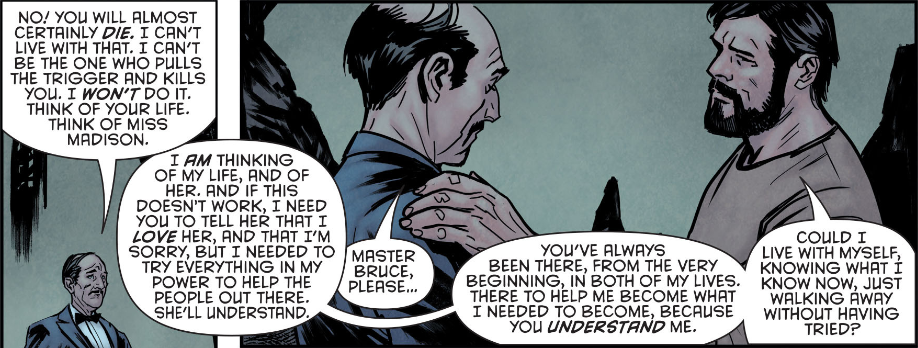
Alfred continues to have raised Bruce after the Waynes died. This example is taken from Batman #49 (February 2016):


The Hall of Justice appeared in Justice League International #1 (September 2011).


The Global Guardians were mentioned in Justice League International Annual #1 (August 2012). I'm not aware of their formation ever coming to pass.


Adrianna Tomaz appears in Justice League of America #7.4 (September 2013), which sets her up to become Isis. As far as I know, this never came to pass, either.


John Stewart still has a military background, as evidenced by this cover to Green Lantern Corps #25 (November 2013):


Tuesday, May 24, 2016

Costume Spotlight: The Flash's TV Look (With Bonus Reverse-Flash!)

Just in time for the season two finale, I present the time DC changed the Flash's costume to be more in line with the tv show...only to have the tv show make the change irrelevant only a few months later! Of course, this isn't the first time the Flash's outfit has reflected the small screen, as I've covered before.

When The New 52 happened, every character got a design overhaul. Some were major, some were minor, but all of them involved a bunch of extraneous lines. Fortunately, The Flash came off looking pretty good since extra lines means more places for lightning to flow from. Here's how he looked beginning in 2011:


Not bad!

Come 2014, The Flash gets his own series on The CW, with a pretty accurate costume...with some exceptions. The main one being that instead of a white circle behind the lightning bolt, it was red. I've never been able to figure out why this is, since the pilot shows a picture of a future Flash that has the white circle, but that's the choice they made. (The other one being that he doesn't have yellow boots, which has never occurred to me before but now that I've noticed it, it's going to bug me big time).


So in The Flash #41 (June 2015), the Flash in the comics gets a new costume that looks very similar. Even the extraneous lines have been moved to more accurately reflect the extraneous lines on his tv costume. And this was definitely to tie into the show, because this storyline also introduces the Reverse Flash to the New 52, and he was the primary antagonist of The Flash season 1.


So yay, he looks more like the tv show! ...except that season two of The Flash changed the circle to white only three months later. Of course, now that DC Rebirth is happening, I have no idea how the two costumes will compare.

But hey, speaking of Reverse Flash! Here's what he looked like prior to the New 52:


Simple, clean, efficient. I dig it. Here he is in The Flash season one (2014-2015):


Pretty good. A little too much black for my taste, but it gets the job done. So, of course, when he's introduced in the New 52 an issue before Barry's new costume (May 2015)...


...there's the black! Arguably not as much as the tv version, and they changed the shape of his symbol to a diamond for some reason, but it's still clearly based on the tv version.

Tuesday, May 17, 2016

Spotlight/52 Shake-Up: Miracle Monday

Sometimes other sites get to things before me. It doesn't happen often, but when it does, I don't feel comfortable repeating that information on this site as if I didn't just learn it. So instead, I link to it.

Today's link is about Miracle Monday, which was originally featured in a Superman novel of the same name (1981).


Now, I honestly don't know how this escaped me. I'm familiar with the story, because I've previously featured a character from it on this blog - Kristin Wells. But somehow I either never thought to look if the holiday made the transition as well, or I did and just forgot to ever post about it.

Either way, the great people at ComicsAlliance made an in-depth post about it yesterday, so you can read all about it there. Enjoy: A Celebration Of Freedom: Miracle Monday Through The Years

Wednesday, May 11, 2016

Character Spotlight: Grant Ward

It took some time, but Marvel has finally been getting around to introducing its MCU SHIELD characters. It started with Coulson back in 2012, before Agents of SHIELD existed. Then, after a couple years, we got a team including Coulson, May, FitzSimmons, and Quake, Daisy's nickname "Skye", Mockingbird and Lance Hunter's relationship, Quake's mother Jiaying, Coulson's car Lola, and Raina, all in fairly quick succession. But there's one major character missing from that list.

Grant Ward.

(The reason why is spoilers, so if you haven't yet watched past the first half-season of Agents of SHIELD but plan to, come back later.)

For those of you who don't know, Grant Ward was an operative on Coulson's special team in the first season of Agents of SHIELD, but after the events of Captain America: Winter Soldier (March 2014), he was revealed to be a HYDRA mole. So by the time they started introducing the characters into the comics, he was no longer part of the team.

This is reflected in his sort-of-first appearance in Secret Wars Hail HYDRA #1 (July 2015):


It's also reflected in his first ACTUAL appearance, in Agents of SHIELD #5 (May 2016).


I can't explain the Iron Man armor, even though that's totally something the show's Ward would do if they had the budget. But there you have it - the set is finally complete! Well...not counting Mike Peterson or Joey Guttierez or a few others. (For what it's worth, Mike Peterson is represented by a Deathlok in the Agents of SHIELD book, but that Deathlok's name is Henry Hayes.)