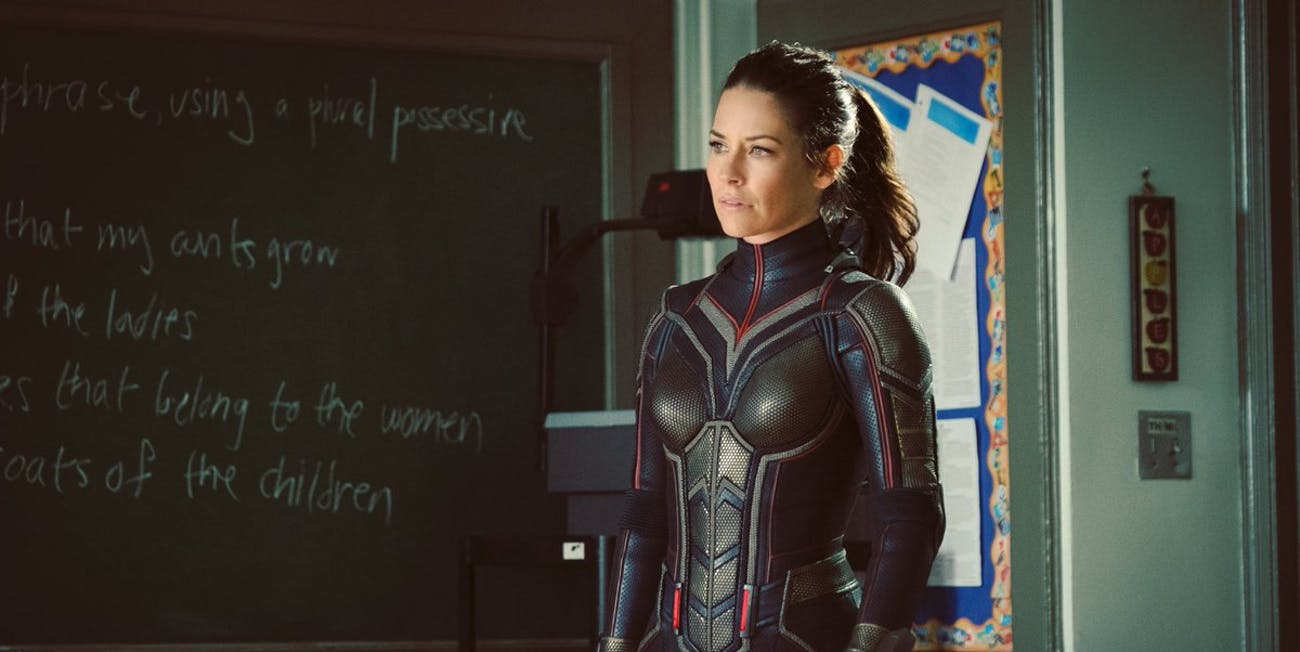
Each Friday, I take one of the entries from my old Super Posts and expand it into its own featured article.
This week: J.A.R.V.I.S.!
Tony Stark's butler, Edwin Jarvis, who first appeared in Tales of Suspense #59 (September 1964)...
...was adapted for the Iron Man movie (2008) as an advanced AI that controlled the Stark Mansion (and the Iron Man suit later on) and was called J.A.R.V.I.S., which was explained in the movie novelization to stand for "Just A Rather Very Intelligent System".
J.A.R.V.I.S. later appears, which the same acronym explanation, in Invincible Iron Man #11 (March 2009), this time based on the personality of the real Jarvis and as the controller AI of Pepper Potts's "Rescue" armor.
As a side note, J.A.R.V.I.S.'s personality being based on a real Edwin Jarvis, who presumably helped raise Tony when he was young, was a common MCU fan theory. This was later confirmed when Agent Carter had Jarvis in a major supporting role across both seasons.
Subheader
A forever in-work compendium of Marvel and DC canon immigrants. What's a canon immigrant? Go here to find out!
Showing posts with label MCU. Show all posts
Friday, December 13, 2019
Wednesday, September 25, 2019
Star-Lord's and Gamora's Relationship
The current and most well-known version of the Guardians of the Galaxy team formed in the 2006 event, Annihilation. Eight years later, they received their own movie, 2014's Guardians of the Galaxy. In that time, they appeared in 75 issues across multiple titles. In the five years since then, they have appeared in over 200 issues. That is almost entirely due to the success they've had on film. So it's no surprise the comics have steadily changed to make them more like their movie counterparts, from character designs like Star-Lord and Nebula, to new concepts like the Milano and the Ravagers, to relationships like Nebula and Gamora. It's another Gamora relationship we'll talk about today, this time between her and Star-Lord.
In the comics, Gamora does have a romantic relationship with a fellow Guardian, but it's Nova, aka Richard Rider. This is first seen in Annihilation #1 (August 2006) and lasts until his death in the Cancerverse (Guardians of the Galaxy #20, June 2014).
In the films, however, Gamora has a relationship with Star-Lord. In the first film it's mostly flirting, but they're officially together during the second film.
But this all changed in the latest volume of Guardians of the Galaxy. Although it's been building since Infinity Wars, they officially get together in Guardians of the Galaxy #7 (July 2019).
Is this a temporary thing or will they go the distance? Only time will tell.
In the comics, Gamora does have a romantic relationship with a fellow Guardian, but it's Nova, aka Richard Rider. This is first seen in Annihilation #1 (August 2006) and lasts until his death in the Cancerverse (Guardians of the Galaxy #20, June 2014).
In the films, however, Gamora has a relationship with Star-Lord. In the first film it's mostly flirting, but they're officially together during the second film.
But this all changed in the latest volume of Guardians of the Galaxy. Although it's been building since Infinity Wars, they officially get together in Guardians of the Galaxy #7 (July 2019).
Is this a temporary thing or will they go the distance? Only time will tell.
Wednesday, September 11, 2019
Appearance Spotlight: Killmonger
Black Panther's Killmonger is easily among the best Marvel Cinematic Universe villains, due to a combination of a sympathetic backstory and goal and being played by the charismatic Michael B. Jordan.
In the comics, Killmonger's backstory is pretty much the same although his goal is exactly the opposite (making Wakanda even more isolationist rather than sharing its technology with the world), but another important difference is their appearance. While the movie's Killmonger where's a leopard-inspired take on Black Panther's armor...
...the comics version of Killmonger goes for more a gladiator-esque look.
And that's still true today, for this Killmonger. But it's not true for another Killmonger. See, in Black Panther volume 7 by Ta-Nehisi Coates establishes an "Intergalactic Empire of Wakanda" that's some combination of in another reality and 2000 years in the future. I'm a little unclear based on what I could find online. Regardless, many of the people in this storyline share their names with Wakandans we know, including Emperor N'Jadaka, who's named after Killmonger. And his armor looks like this:
Note that it's not an exact recreation, and the MCU's Killmonger certainly doesn't have a cape made from a Symbiote, but it's still close enough that it's easy to tell what they were going for.
In the comics, Killmonger's backstory is pretty much the same although his goal is exactly the opposite (making Wakanda even more isolationist rather than sharing its technology with the world), but another important difference is their appearance. While the movie's Killmonger where's a leopard-inspired take on Black Panther's armor...
...the comics version of Killmonger goes for more a gladiator-esque look.
And that's still true today, for this Killmonger. But it's not true for another Killmonger. See, in Black Panther volume 7 by Ta-Nehisi Coates establishes an "Intergalactic Empire of Wakanda" that's some combination of in another reality and 2000 years in the future. I'm a little unclear based on what I could find online. Regardless, many of the people in this storyline share their names with Wakandans we know, including Emperor N'Jadaka, who's named after Killmonger. And his armor looks like this:
Note that it's not an exact recreation, and the MCU's Killmonger certainly doesn't have a cape made from a Symbiote, but it's still close enough that it's easy to tell what they were going for.
Wednesday, July 24, 2019
Character Spotlight: Howard the Duck on Film (a 2-for-1!)
In SHIELD #10 (September 2015), guest star Howard the Duck has to deal with a cosmic entity called The Liverer, whose goal is to eat a cosmic pate made from the livers of one million Howard the Ducks. His torso has a portal through which you can see alternate worlds, and Howard the Duck enters it, causing him to see alternate Howard the Ducks.
Among the many versions of himself he sees, including Howard the Human, Spider-Howard, and Indiana Howard, he sees the two film versions of himself!
The scruffy-looking one is the MCU version of Howard. He first appeared in Guardians of the Galaxy (2014), and then later, Guardians of the Galaxy vol. 2 (2017) and Avengers: Endgame (2019).
The one with the guitar is the Howard that starred in Howard the Duck (1986), Marvel's first theatrical film.
I admit these aren't true examples because they are still presented as alternate realities, but if Spider-Verse counts, so do these!
Among the many versions of himself he sees, including Howard the Human, Spider-Howard, and Indiana Howard, he sees the two film versions of himself!
The scruffy-looking one is the MCU version of Howard. He first appeared in Guardians of the Galaxy (2014), and then later, Guardians of the Galaxy vol. 2 (2017) and Avengers: Endgame (2019).
The one with the guitar is the Howard that starred in Howard the Duck (1986), Marvel's first theatrical film.
I admit these aren't true examples because they are still presented as alternate realities, but if Spider-Verse counts, so do these!
Wednesday, July 17, 2019
Nebula's Relationship with Gamora
One of the things the movie Guardians of the Galaxy (2014) and its sequel did really well was take a lot of disparate cosmic Marvel characters and form them into a cohesive whole. Credit where credit's due, the process was started by the 2006 event Annihilation, which the movies take a lot of inspiration from, but the movies really ran with it. One example of this is the relationship between Gamora and Nebula.
Gamora, aka The Deadliest Woman in the Whole Galaxy, first appeared in Strange Tales #180 (April 1975) as a bounty hunter looking for Adam Warlock. Only a few months later in Warlock #10 (October 1975), we learn that she was rescued by Thanos as a little girl and raised as his daughter to kill an evil version of Adam Warlock called The Magus.
Meanwhile, Nebula is introduced in Avengers #257 (May 1985) as a pirate who has taken over Thano's ship, the Sanctuary II. We learn there's more to the story in #260 (August 1985), however, when she reveals that she's Thanos's granddaughter.
In Infinity Gauntlet #1 (May 1991), Thanos calls the legitimacy of this claim into question, but accepts her as his granddaughter anyway.
For the next two decades, Gamora and Nebula only appear in a handful of issues together. In fact, they don't interact until Annihilation: Ronan #2 (May 2006), and don't show any sign of familiarity. In Annihilation: Ronan #4 (July 2006), Nebula has joined Gamora's team, the Graces, but they still don't seem to have any level of relationship beyond that.
Guardians of the Galaxy (2014) changes this drastically. In the Marvel Cinematic Universe, Gamora and Nebula are both Children of Thanos, and they have an intense rivalry as he constantly pits them against each other in combat. The reason Nebula is a cyborg in this universe is that, every time Nebula lost a fight against Gamora, Thanos would upgrade her to make her better. By this point, she's mostly machine. However, once they each turn on Thanos for their own reasons, they grow closer together and treat each other like sisters.
In Thanos Annual #1 (May 2014), Nebula is referred to as a daughter of Thanos for the first time. As it came out a few months before Guardians of the Galaxy was released, I don't know if it was planned to be roughly in time with the movie, or if it's just a coincidence. Either way, the Nebula discussed in this issue is from an alternate reality, so it doesn't really count one way or the other.
Guardians Team-Up #2 (March 2015) complicates things. Nebula and Gamora interact more than ever before, and it seems like they have personal history. Nebula in particular says she has many things she could blame Gamora for. That being said, the person who has hired Nebula to capture Gamora doesn't like Gamora because she's the daughter of Thanos, which implies Nebula is NOT a daughter of Thanos.
Guardians of the Galaxy: Best Story Ever #1 (April 2015) doesn't clear up anything. On one page, it re-affirms that Nebula is a granddaughter of Thanos, yet later Gamora refers to Nebula as her "sister" (quotes hers). Either way, there's clearly an animosity between them.
I thought Gamora #1 (December 2016) settled the issue. In it, Gamora and Nebula consider each other sisters and act as if they were raised together. But I don't actually know if it's continuity. The writer says it's set in the MCU, but nothing in the comic itself claims that (not to mention that Gamora and Thanos use their comics designs, not their movie ones). To make it worse, the genocide of Gamora's people, as depicted, doesn't match the movies OR the comics. So we'll just disregard the whole thing.
Unfortunately, that means this entry won't end with the smoking gun I thought it would. But I feel that the two Guardians stories from 2015, and the recent Asgardians of the Galaxy #3 (November 2018) that shows Nebula has a clear rivalry with Gamora, add up to make essentially the same point.
Gamora, aka The Deadliest Woman in the Whole Galaxy, first appeared in Strange Tales #180 (April 1975) as a bounty hunter looking for Adam Warlock. Only a few months later in Warlock #10 (October 1975), we learn that she was rescued by Thanos as a little girl and raised as his daughter to kill an evil version of Adam Warlock called The Magus.
Meanwhile, Nebula is introduced in Avengers #257 (May 1985) as a pirate who has taken over Thano's ship, the Sanctuary II. We learn there's more to the story in #260 (August 1985), however, when she reveals that she's Thanos's granddaughter.
In Infinity Gauntlet #1 (May 1991), Thanos calls the legitimacy of this claim into question, but accepts her as his granddaughter anyway.
For the next two decades, Gamora and Nebula only appear in a handful of issues together. In fact, they don't interact until Annihilation: Ronan #2 (May 2006), and don't show any sign of familiarity. In Annihilation: Ronan #4 (July 2006), Nebula has joined Gamora's team, the Graces, but they still don't seem to have any level of relationship beyond that.
Guardians of the Galaxy (2014) changes this drastically. In the Marvel Cinematic Universe, Gamora and Nebula are both Children of Thanos, and they have an intense rivalry as he constantly pits them against each other in combat. The reason Nebula is a cyborg in this universe is that, every time Nebula lost a fight against Gamora, Thanos would upgrade her to make her better. By this point, she's mostly machine. However, once they each turn on Thanos for their own reasons, they grow closer together and treat each other like sisters.
In Thanos Annual #1 (May 2014), Nebula is referred to as a daughter of Thanos for the first time. As it came out a few months before Guardians of the Galaxy was released, I don't know if it was planned to be roughly in time with the movie, or if it's just a coincidence. Either way, the Nebula discussed in this issue is from an alternate reality, so it doesn't really count one way or the other.
Guardians Team-Up #2 (March 2015) complicates things. Nebula and Gamora interact more than ever before, and it seems like they have personal history. Nebula in particular says she has many things she could blame Gamora for. That being said, the person who has hired Nebula to capture Gamora doesn't like Gamora because she's the daughter of Thanos, which implies Nebula is NOT a daughter of Thanos.
Guardians of the Galaxy: Best Story Ever #1 (April 2015) doesn't clear up anything. On one page, it re-affirms that Nebula is a granddaughter of Thanos, yet later Gamora refers to Nebula as her "sister" (quotes hers). Either way, there's clearly an animosity between them.
I thought Gamora #1 (December 2016) settled the issue. In it, Gamora and Nebula consider each other sisters and act as if they were raised together. But I don't actually know if it's continuity. The writer says it's set in the MCU, but nothing in the comic itself claims that (not to mention that Gamora and Thanos use their comics designs, not their movie ones). To make it worse, the genocide of Gamora's people, as depicted, doesn't match the movies OR the comics. So we'll just disregard the whole thing.
Unfortunately, that means this entry won't end with the smoking gun I thought it would. But I feel that the two Guardians stories from 2015, and the recent Asgardians of the Galaxy #3 (November 2018) that shows Nebula has a clear rivalry with Gamora, add up to make essentially the same point.
Wednesday, July 10, 2019
Nebula's Appearance
Sometimes, in comic book adaptations, a detail can be based on something that's already extant in the comics, but changed ever so slightly for the new medium. When it comes to designs, this usually means making the design more intricate. Of course, because canon immigration is essentially inescapable, then the more intricate design finds its way into the comics. This is what happened with Nebula.
Sometimes when this happens, it takes me a while to learn it happened. This is also what happened with Nebula.
When Nebula first appeared in The Avengers #257 (May 1985), she was a pirate who had seized control of Thanos's ship, the Sanctuary II, in a period when he was presumed dead. She claimed to be his granddaughter, and she looked like this:
In Silver Surfer #69 (June 1992), she's catatonic, so one of the people looking after her takes her to Dr. Mandibus to get her back to normal. In Silver Surfer #72 (July 1992), we see that Dr. Mandibus was able to restore her mental capacity, but turned her into a cyborg to do so.
She shows up again in Silver Surfer #110 (September 1995), and she mostly looks the same except she's grown her hair out again.
In Nova #1 (March 1999), however, she's back to her original look.
But in her next appearance, Annihilation: Ronan #1 (April 2006), she's back to being a bald cyborg. She continues to look this way through the rest of the Annihilation event.
The modern Guardians of the Galaxy spun out of the Annihilation event, so it's no surprise that, when Guardians of the Galaxy was released in 2014, Nebula's look was based on how she appeared in Annihilation. Overall it's simply a more detailed version of the look above. The most major change is the stripe down the middle of her face, which I believe is meant to mimic the stripe down her chest that's present in most of the images above.
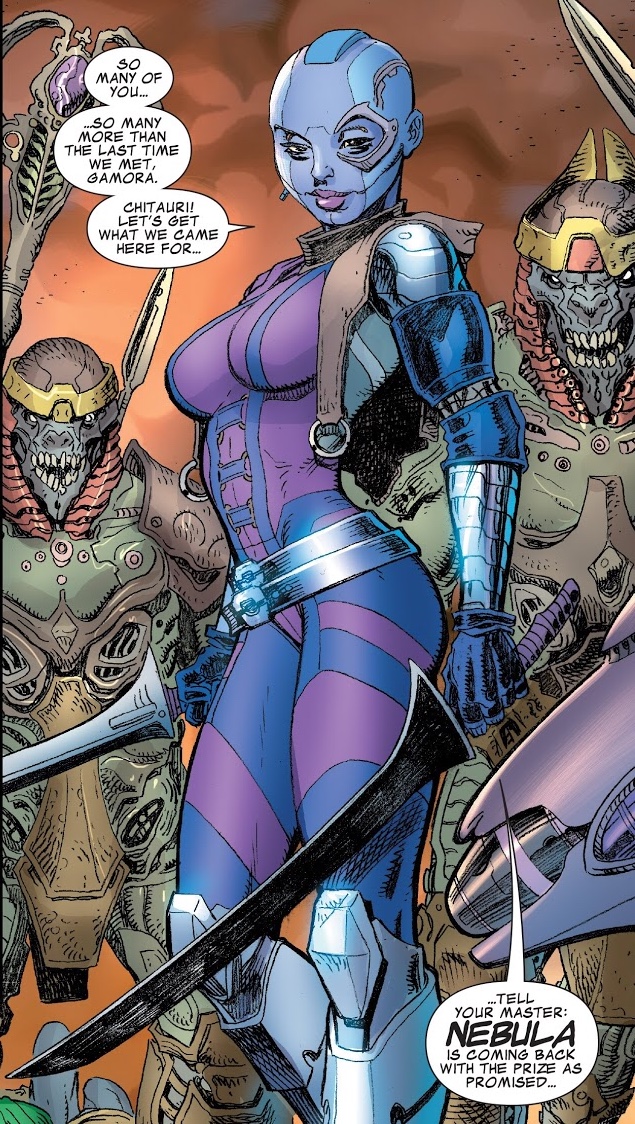
Guardians of the Galaxy was a huge hit, so it's no surprise that, when she appeared in Guardians Team-Up #1 (March 2015) - itself a book that wouldn't exist without the movie - she appeared as she does in the movie. Notably, she's flanked by Chitauri, another case of appearance canon immigration.
And she's appeared that way ever since!
That's not the only change to Nebula the movie made, but we'll get to that next week.
Sometimes when this happens, it takes me a while to learn it happened. This is also what happened with Nebula.
When Nebula first appeared in The Avengers #257 (May 1985), she was a pirate who had seized control of Thanos's ship, the Sanctuary II, in a period when he was presumed dead. She claimed to be his granddaughter, and she looked like this:
In Silver Surfer #69 (June 1992), she's catatonic, so one of the people looking after her takes her to Dr. Mandibus to get her back to normal. In Silver Surfer #72 (July 1992), we see that Dr. Mandibus was able to restore her mental capacity, but turned her into a cyborg to do so.
She shows up again in Silver Surfer #110 (September 1995), and she mostly looks the same except she's grown her hair out again.
In Nova #1 (March 1999), however, she's back to her original look.
But in her next appearance, Annihilation: Ronan #1 (April 2006), she's back to being a bald cyborg. She continues to look this way through the rest of the Annihilation event.
The modern Guardians of the Galaxy spun out of the Annihilation event, so it's no surprise that, when Guardians of the Galaxy was released in 2014, Nebula's look was based on how she appeared in Annihilation. Overall it's simply a more detailed version of the look above. The most major change is the stripe down the middle of her face, which I believe is meant to mimic the stripe down her chest that's present in most of the images above.
Guardians of the Galaxy was a huge hit, so it's no surprise that, when she appeared in Guardians Team-Up #1 (March 2015) - itself a book that wouldn't exist without the movie - she appeared as she does in the movie. Notably, she's flanked by Chitauri, another case of appearance canon immigration.
And she's appeared that way ever since!
That's not the only change to Nebula the movie made, but we'll get to that next week.
Friday, June 14, 2019
Flashback Friday: Arc Reactor
Each Friday, I take one of the entries from my old Super Posts and expand it into its own featured article.
This week: the Arc Reactor!
The arc reactor first appeared in the film Iron Man (May 2008) as a portable power source that powered the magnet that kept a piece of shrapnel from entering Tony Stark's heart, as well as powering the Iron Man suit. It was a miniaturized version of a machine that Howard Stark built to create clean energy, a project that didn't go anywhere until Tony was able to miniaturize it. Side note: much evidence across the Marvel Cinematic Universe shows that the Arc Reactor is Howard Stark's attempt to create a man-made version of the Tesseract.
It later appeared in Invincible Iron Man #3 (July 2008), though instead called a Repulsor Technology Node. Pepper Potts was caught in an explosion that caused shrapnel to lodge into her body. Tony has a node implanted into her chest to keep the shrapnel from entering her heart. He also says he used one when the same thing happened to him in the Middle East, which essentially completely rewrites his origin to match the movie. Although the "Extremis" storyline from 2007 moved his origin to the Middle East, this is the first time it's been noted that he implanted something into his chest to help with his heart condition, rather than crating a whole chestplate to wear.
In Invincible Iron Man #21 (December 2009), Tony has to reboot the Extremis within his body to prevent Norman Osborn from gaining access to it. Doing so causes his body to shut down, so he has to get an RT Node implanted to restart it. Incidentally, this same issue seems to indicate he had both the RT Node and chestplate when he escaped Afghanistan.
The Arc Reactor/RT Node has continued to appear since then, although I'm not sure it's ever been vital to a storyline again. I'm also pretty sure neither Tony nor Pepper still have theirs; they're simply a way to power the suits these days.
This week: the Arc Reactor!
The arc reactor first appeared in the film Iron Man (May 2008) as a portable power source that powered the magnet that kept a piece of shrapnel from entering Tony Stark's heart, as well as powering the Iron Man suit. It was a miniaturized version of a machine that Howard Stark built to create clean energy, a project that didn't go anywhere until Tony was able to miniaturize it. Side note: much evidence across the Marvel Cinematic Universe shows that the Arc Reactor is Howard Stark's attempt to create a man-made version of the Tesseract.
It later appeared in Invincible Iron Man #3 (July 2008), though instead called a Repulsor Technology Node. Pepper Potts was caught in an explosion that caused shrapnel to lodge into her body. Tony has a node implanted into her chest to keep the shrapnel from entering her heart. He also says he used one when the same thing happened to him in the Middle East, which essentially completely rewrites his origin to match the movie. Although the "Extremis" storyline from 2007 moved his origin to the Middle East, this is the first time it's been noted that he implanted something into his chest to help with his heart condition, rather than crating a whole chestplate to wear.
In Invincible Iron Man #21 (December 2009), Tony has to reboot the Extremis within his body to prevent Norman Osborn from gaining access to it. Doing so causes his body to shut down, so he has to get an RT Node implanted to restart it. Incidentally, this same issue seems to indicate he had both the RT Node and chestplate when he escaped Afghanistan.
The Arc Reactor/RT Node has continued to appear since then, although I'm not sure it's ever been vital to a storyline again. I'm also pretty sure neither Tony nor Pepper still have theirs; they're simply a way to power the suits these days.
Wednesday, May 29, 2019
Character Spotlight: Luis
I feel a little uneasy about this one, but I think there's enough evidence for it to count. (And, if we're being honest, I have a gap to fill and I'll take what I can get.)
2015's Ant-Man was a surprise hit for the Marvel Cinematic Universe. Although all their movies do well, people weren't expecting much from this one, and on top of that, there was a lot of controversy surrounding the movie thanks to Edgar Wright's departure.
I'm going to get on my soapbox for a second to say that I'm completely on Marvel's side for this one. I respect his decision to leave if he was being asked to make changes to his script he didn't want to make, but also...come on, dude. He knew what he was getting into when he signed up for it back in 2006. And if he didn't then, he certainly knew by the time they started production if he had paid attention to the 11 other movies (and multiple shows) made in the meantime. Marvel allowed him to delay Ant-Man until he was ready to make it - almost ten years, if you're keeping track - and agreed to his request to cut all references to the Ant-Man franchise until the movie was released, yet he still couldn't bring himself to play ball. But that's ok; by all accounts, we received a better movie for it.
Anyway, one of the most breakout parts of the movie was Luis, Scott Lang's cellmate/friend/literal partner-in-crime. Played by Michael Pena, he elevated the fun energy of a movie that already had quite a bit of it, and his storytelling became a trademark that people still talk about today.
Thanks to the movie, Ant-Man received a new comic called The Astonishing Ant-Man, which premiered in October 2015 (three months after the movie came out). The series finds Scott back in prison, with the first arc an extended flashback to how he got there. And his cellmate, true to form, is Luis.
Here's the thing, though: he's never called Luis. He never speaks so I don't know his personality. In fact, I can't even tell you if the person I've pictured is, in fact, Scott's cellmate because his face is never shown when they're in the cell. But this character, who looks a lot like Luis, is seen near Scott twice.
Normally, that wouldn't be enough for me. Even if the internet has decided this is Luis, I usually need some hard proof. If not actual in-comic evidence, then a quote from the writer or something. However, taking the rest of the book into account, I'm willing to go ahead with this one. After all, the series is meant to benefit from the heat of the movie. It uses the movie's logo. It puts Scott back in prison (just like the movie), has Cross Technologies as the villain (just like the movie), and focuses on Scott's relationship with Cassie (just like the movie). So I think it's safe to say that, just like the movie, Scott's cellmate is Luis.
2015's Ant-Man was a surprise hit for the Marvel Cinematic Universe. Although all their movies do well, people weren't expecting much from this one, and on top of that, there was a lot of controversy surrounding the movie thanks to Edgar Wright's departure.
I'm going to get on my soapbox for a second to say that I'm completely on Marvel's side for this one. I respect his decision to leave if he was being asked to make changes to his script he didn't want to make, but also...come on, dude. He knew what he was getting into when he signed up for it back in 2006. And if he didn't then, he certainly knew by the time they started production if he had paid attention to the 11 other movies (and multiple shows) made in the meantime. Marvel allowed him to delay Ant-Man until he was ready to make it - almost ten years, if you're keeping track - and agreed to his request to cut all references to the Ant-Man franchise until the movie was released, yet he still couldn't bring himself to play ball. But that's ok; by all accounts, we received a better movie for it.
Anyway, one of the most breakout parts of the movie was Luis, Scott Lang's cellmate/friend/literal partner-in-crime. Played by Michael Pena, he elevated the fun energy of a movie that already had quite a bit of it, and his storytelling became a trademark that people still talk about today.
Thanks to the movie, Ant-Man received a new comic called The Astonishing Ant-Man, which premiered in October 2015 (three months after the movie came out). The series finds Scott back in prison, with the first arc an extended flashback to how he got there. And his cellmate, true to form, is Luis.
Here's the thing, though: he's never called Luis. He never speaks so I don't know his personality. In fact, I can't even tell you if the person I've pictured is, in fact, Scott's cellmate because his face is never shown when they're in the cell. But this character, who looks a lot like Luis, is seen near Scott twice.
Normally, that wouldn't be enough for me. Even if the internet has decided this is Luis, I usually need some hard proof. If not actual in-comic evidence, then a quote from the writer or something. However, taking the rest of the book into account, I'm willing to go ahead with this one. After all, the series is meant to benefit from the heat of the movie. It uses the movie's logo. It puts Scott back in prison (just like the movie), has Cross Technologies as the villain (just like the movie), and focuses on Scott's relationship with Cassie (just like the movie). So I think it's safe to say that, just like the movie, Scott's cellmate is Luis.
Wednesday, March 13, 2019
Group Spotlight: Dogs of Hell
Five years ago, almost to the day (March 11, 2014), Agents of SHIELD aired the episode "Yes Men". The episode is notable for a full-on guest appearance by Sif - not just a cameo like with Nick Fury - and for being an early hint that Ward is a bad guy, but it's also notable for introducing the Dogs of Hell to the Marvel Cinematic Universe.
The Dogs of Hell are a motorcycle gang the the villain of the episode, Lorelei, is able to take control of through the hypnotic powers of her voice. This was their only appearance in Agents of SHIELD, but not their final appearance in the MCU. A different branch of the club played a major part in Daredevil season 2 (March 2016) as one of the three participants in the gang war that season revolves around. They later had brief appearances or mentions in The Punisher (November 2017) and both seasons of Iron Fist (March 2017 and September 2018).
Here's where it gets fuzzy. The Marvel Wikia claims that their first appearance in comics is in Civil War II: Kingpin #2 (August 2016). This would make sense, being only a few months after they were so prominently in Daredevil. And a biker gang DOES appear in that issue, but I can find no indication that they're actually the Dogs of Hell. If anyone can corroborate that information, let me know.
But that's all right, because they definitely do appear by name in The Immortal Hulk #1 (June 2018).
This is honestly my favorite kind of canon immigrant. It's not there to promote anything, it's not driven by any kind of nostalgia, it's just the comics realizing an adaptation filled a gap in some way and continuing to use it because it makes sense. Marvel never had a reoccurring motorcycle gang before. Now they do. And if they want, they can get a lot of mileage out of that.
The Dogs of Hell are a motorcycle gang the the villain of the episode, Lorelei, is able to take control of through the hypnotic powers of her voice. This was their only appearance in Agents of SHIELD, but not their final appearance in the MCU. A different branch of the club played a major part in Daredevil season 2 (March 2016) as one of the three participants in the gang war that season revolves around. They later had brief appearances or mentions in The Punisher (November 2017) and both seasons of Iron Fist (March 2017 and September 2018).
Here's where it gets fuzzy. The Marvel Wikia claims that their first appearance in comics is in Civil War II: Kingpin #2 (August 2016). This would make sense, being only a few months after they were so prominently in Daredevil. And a biker gang DOES appear in that issue, but I can find no indication that they're actually the Dogs of Hell. If anyone can corroborate that information, let me know.
But that's all right, because they definitely do appear by name in The Immortal Hulk #1 (June 2018).
This is honestly my favorite kind of canon immigrant. It's not there to promote anything, it's not driven by any kind of nostalgia, it's just the comics realizing an adaptation filled a gap in some way and continuing to use it because it makes sense. Marvel never had a reoccurring motorcycle gang before. Now they do. And if they want, they can get a lot of mileage out of that.
Wednesday, January 2, 2019
Appearance Spotlight: Killmonger’s Scars
I don't know if you've heard, but Black Panther - which came out all the way back in February 2018, almost a year ago - is a pretty big deal. It's the most successful MCU domestically, even beating all the Avengers films; it's the ninth most successful movie of all time worldwide (it doesn't beat the Avengers movies there); it's appearing on every "top 10 movies of 2018" list; it was nominated for a Best Picture Golden Globe; and most importantly, it was a cultural revolution.
So, of course, it elevated the status of all characters associated with it, turning them into household names. Not least among these was Killmonger, a character many call Marvel's best. It's no surprise, then, that Killmonger received a miniseries last month to delve into his origins, and it's even less of a surprise that this new story is influenced a bit by Black Panther.
When Killmonger first appeared in Jungle Action #6 (July 1973), he had a look similar to Kraven's in that it's like a tribal warrior look filtered through superhero comics.
He keeps that basic look throughout his history, though it becomes more involved and gains a mask.
But this style didn't carry through to the Black Panther movie. That movie got him looking straight like Vegeta. But it added a new detail, too: in keeping with the afro-futuristic design sense the movie went for, the Earth-199999 version of Killmonger had ritual scarring, one bump for each person he's killed.
On the first page of Killmonger #1 (December 2018), we see him with the same scarring:
The rest of the series is a flashback, so this is the only time we've seen it so far. But with three issues still to come, I imagine we'll see him get them at some point.
So, of course, it elevated the status of all characters associated with it, turning them into household names. Not least among these was Killmonger, a character many call Marvel's best. It's no surprise, then, that Killmonger received a miniseries last month to delve into his origins, and it's even less of a surprise that this new story is influenced a bit by Black Panther.
When Killmonger first appeared in Jungle Action #6 (July 1973), he had a look similar to Kraven's in that it's like a tribal warrior look filtered through superhero comics.
He keeps that basic look throughout his history, though it becomes more involved and gains a mask.
But this style didn't carry through to the Black Panther movie. That movie got him looking straight like Vegeta. But it added a new detail, too: in keeping with the afro-futuristic design sense the movie went for, the Earth-199999 version of Killmonger had ritual scarring, one bump for each person he's killed.
On the first page of Killmonger #1 (December 2018), we see him with the same scarring:
The rest of the series is a flashback, so this is the only time we've seen it so far. But with three issues still to come, I imagine we'll see him get them at some point.
Saturday, December 29, 2018
Group Spotlight: Ten Rings
This is an important one! But CBR already wrote about it, so I’ll defer to them.
The gist is that the Ten Rings are a terrorist organization led by the Mandarin that debuted in Iron Man (May 2008), and Ironheart #1 (November 2018) has finally brought it into the comics ten years later. You can read about it in more detail at the following link:
https://www.cbr.com/mcu-ten-rings-iron-man-ironheart/
As you can see, the symbol isn’t completely the same, but it’s close enough.
Wednesday, December 5, 2018
Character Spotlight: Nadia Van Dyne (Sorta)
I've known about this one for a while, but I brushed it off. I figured people were making guesses without knowing the whole story and that I knew better. But I recently found evidence that I was wrong, so here we are.
Our story starts all the way back in 1998. A very popular issue of What If...? - a series that genreally told alternate outcomes of various Marvel stories - featured a story about Peter Parker's baby if she hadn't disappeared, and she grew up to become Spider-Girl. The issue was SO popular that Marvel soon launched a whole imprint called MC2, short for "Marvel Comics 2", about a new generation of superheroes. Ironically, although set about 15 years in the future, the comics themselves were very old-fashioned in a good way. Mostly one-and-done stories that appealed to all ages and were easily accessible, but also had overarching stories to bring the reader back for more.
After a cameo in A-Next #7 (February 1999), A-Next #12 (July 1999) introduced a character called the Red Queen and her team, the Revengers. The Red Queen, aka Hope Pym, was the leader of the team and the biggest believer in their goal of destroying the Avengers. She and Big Man were the children of Hank Pym and Janet Van Dyne.
Almost two decades later in 2015, Ant-Man received his own movie, and a major subplot dealt with Hank Pym's strained relationship with his daughter, Hope Van Dyne. This version of Hope uses her missing mother's name to honor her, and to also distance herself from her father. Hope is upset at Hank for many reasons, one of them being that she has the skills and experience to use the Ant-Man suit but Hank got Scott Lang to use it instead. But instead of going out on her own and becoming Red Queen like the comics version, she becomes the Wasp and got to co-headline the 2018 sequel, Ant-Man and the Wasp.
In Free Comic Book Day Civil War II (May 2016), we're introduced to the new Wasp, who is named Nadia Pym. She's Hank's daughter from his first marriage, and she was raised in a Russian secret spy-training organization called the Red Room. She escaped, however, and became the Wasp to honor her stepmother.
At the time she was announced, people made a big deal of her being the Marvel Comics version of Hope Van Dyne. They even pointed out that "Nadia" means "Hope" in Russian. This never felt right to me. For one thing, Hope already has a comics version...Hope. And Nadia is one of the most common Russian names in Western fiction. It's like Natasha, then Boris, then Nadia. Ivan's in there somewhere. But again, IF the name was chosen because it means hope, how do we know it wasn't referring to the Red Queen? After all, only a couple months before in Astonishing Ant-Man #6 (March 2016), Cassie started using her previously-MC2-exclusive identity of Stinger.
So I never featured it. But last week I learned that Mark Waid is on the record as saying that Nadia is inspired by the movie's Hope, so that closes the book on that.
Subscribe to:
Posts (Atom)