Subheader

A forever in-work compendium of Marvel and DC canon immigrants. What's a canon immigrant? Go here to find out!
Showing posts with label Live Action. Show all posts

Wednesday, December 25, 2019

Gadget Spotlight: Jor-El's Hologram

The trouble with doing a blog like this is that sometimes things are so well known that you think you've covered it already, but you actually haven't! This happened to me last week when talking about Krypton's prison rings; I mentioned an example and went to link to it, only to discover I'd never written about it before. Luckily, I needed a post for this final week of the year, so it works out. And that example - which you already know if you've read the title - is Jor-El's hologram.


See, everyone knows that Jor-El sent a baby Superman to Earth in a rocket to save him from the exploding Krypton. And for a long time, that was the story. Superman eventually learned about Krypton through time travel, Phantom Zone criminals, and various things that fell to Earth, but it was something that happened over time.

That was not the case in Superman: The Movie (1976). This depiction that Clark come to Earth with a crystal that, when dropped into the Arctic Circle for whatever reason, formed the Fortress of Solitude. Inside the Fortress was a hologram of Jor-El that could tell Superman pretty much anything he wanted to know about Krypton or any other location in the 28 known galaxies.


Originally, this did not affect the comics at all. In fact, even when Superman's origin was updated in the 80s, it would've been impossible because Superman's ship was a "birthing matrix" that housed an unborn Kal-El. There was nothing that would hold a crystal or anything else. But when they updated his origin again in Superman: Birthright (2003 - 2004), we see that - perhaps because they reverted to the rocket of the classic origin - Jor-El packed a tablet in the rocket that acts as a Kryptonian encyclopedia. However, despite the tablet passing a very brief message from the adult Superman back to Jor-El and Lara, it does not allow for a Jor-El AI to act as a surrogate father figure, as in the movie and Smallville versions.


That all changed in Action Comics #844 (October 2006), around the same time the Fortress of Solitude came to resemble the one from the movies. Now Jor-El was a fully interactive hologram.


Thankfully it didn't stick. My personal belief is that Superman should have as little interaction with Jor-El as possible; my ideal version of Superman considers the Kents his real parents and has an alive Jonathan (and Martha) to talk to when he needs help. It seems a lot of people disagree with me on this point, however.

Friday, December 20, 2019

Flashback Friday: Perry White

Each Friday, I take one of the entries from my old Super Posts and expand it into its own featured article.

This week: Perry White!


Perry White is fascinating because most people don't realize he originated outside of comics. When Superman debuted in Action Comics #1 (April 1938), his editor didn't have a name. In Superman #2 (August 1939), we learn his name is George Taylor.


Around this same time, Superman gained his first adaptation, the Adventures of Superman radio show. In the second episode, "Clark Kent, Reporter" (February 1940), we meet Clark's editor, here named Perry White. This is not that out of the ordinary; adaptations trying to stay as faithful as possible to the comic books they're adapting is only a fairly recent phenomenon, and the farther back you go, the less they care. (For a particularly extreme example, check out the Captain America serial where he's a district attorney named Grant Gardner.) Of course, I should also mention that continuity was much less of a thing in comics in the early days, so basic details about characters could change on a whim from issue to issue.

Later that year, Perry White arrived in comics as the editor of the Daily Planet in Superman #7 (September 1940). There was no story about how or why he replaced George Taylor; he just did.


In the comics, George Taylor would not be forgotten, appearing on Earth-2 as that Superman's editor (at the Daily Star) and on the main earth as the Daily Planet's editor before Perry White and/or the editor of the Daily Star, the Planet's rival newspaper. As far as adaptations are concerned, however, Perry White is the only editor that matters. He has become a mainstay of Superman stories and has appeared in all adaptations (except for the Superboy tv show, though his son WAS in it).

Wednesday, December 18, 2019

Gadget Spotlight: Kryptonian Prison Rings

For some reason, people love Superman: The Movie. I don't get it, personally. Although Christopher Reeve is perfect as Clark Kent and Superman, nearly everything else about it falls flat for me. Especially the aesthetic, particularly the Kryptonian aesthetic. Still, people love it for some reason, so the aesthetic has crept into most modern adaptations, even when it doesn't make any sense. (Seriously, why would the Fortress of Solitude - which is meant to be Superman's home away from home - look like an ice cave instead of actually cozy and livable? It's silly. But I digress.)

With the comics, this happened for the first time - as far as I know - in 2006 when Geoff Johns took over writing Action Comics. Among other changes, suddenly the Fortress was crystal, Jor-El was a hologram, Ben Hubbard appeared, and Zod's crew (now Ursa and Non) dressed all in black. Also, the Kryptonian prison rings debuted.

In the movie (1976), we see Zod, Ursa, and Non imprisoned in spinning rings while they wait to be sent to the Phantom Zone.


In Action Comics #846 (December 2006), we get a hint to this technology when we see Phantom Zone criminals with rings around them.


Action Comics Annual #10 (January 2007) shows Zod, Ursa, and Non in a more standard depiction of the rings.


And Superman: World of New Krypton #5 (July 2009) shows the rings on the cover and throughout the book.


To my knowledge, they have not been seen since, and thank goodness for that.

Friday, December 13, 2019

Flashback Friday: JARVIS

Each Friday, I take one of the entries from my old Super Posts and expand it into its own featured article.

This week: J.A.R.V.I.S.!

Tony Stark's butler, Edwin Jarvis, who first appeared in Tales of Suspense #59 (September 1964)...


...was adapted for the Iron Man movie (2008) as an advanced AI that controlled the Stark Mansion (and the Iron Man suit later on) and was called J.A.R.V.I.S., which was explained in the movie novelization to stand for "Just A Rather Very Intelligent System".   


J.A.R.V.I.S. later appears, which the same acronym explanation, in Invincible Iron Man #11 (March 2009), this time based on the personality of the real Jarvis and as the controller AI of Pepper Potts's "Rescue" armor.


As a side note, J.A.R.V.I.S.'s personality being based on a real Edwin Jarvis, who presumably helped raise Tony when he was young, was a common MCU fan theory. This was later confirmed when Agent Carter had Jarvis in a major supporting role across both seasons.


Wednesday, December 4, 2019

Character Spotlight: Dr. Chase Meridian

It's funny how standards slip as deadlines loom. Normally I don't include immigrants until they've been in a mainstream universe, but I didn't want the last couple weeks of this year to not have new content (even though I started doing Flashback Friday for just such an occasion), so here we are.

Batman Forever (1995) wanted to be a serious look into the psychology of Batman. You probably wouldn't recognize that from the final product, which had most of that particular plotline excised, but one artifact that remains is Dr. Chase Meridian, Bruce Wayne's love interest for the movie and a psychiatrist who is obsessed with Batman. Her name is a pun because she was supposed to help Bruce find a balance between his two personas; ie, "chase" the "meridian".


Despite being played by Nicole Kidman at her Nicole Kidmanest in a very successful movie (second highest-grossing movie of 1995 and highest-grossing opening weekend, which it held until 1997), Chase Meridian never made an impact on the comics. Even when she finally crossed over, it was only in an out-of-continuity digital comic. Specifically, it was Legends of the Dark Knight #77-79 (November 2013), which was later collected in Legends of the Dark Knight 100-Page Spectacular #4 (September 2014). Notably, she has a completely different look than the movie.


Personally, I think Dr. Meridian could fill a hole in the Batman universe. You'd think a series with an asylum as a major set piece would have a recurring psychologist/psychiatrist character. In fact, it has two, but they're both villains: Harley Quinn and Hugo Strange. It would be very beneficial, I think, to have Chase as a supervillain expert who also doesn't play their games.


Friday, November 22, 2019

Flashback Friday: Mystique's Movie Design

Each Friday, I take one of the entries from my old Super Posts and expand it into its own featured article.

This week: Mystique's movie design!


It can't be understated how big the first X-Men movie was in 2000. Avengers: Endgame becoming the top-grossing movie of all time can be traced directly back to the success of this movie. It was certainly the most important Marvel adaptation at the time, and Marvel - generally not one to have major canon immigrants at the time - bent over backwards to make the comics better reflect the movies.

As I'm sure you know, X-Men was much different from the comics of the time. The team was smaller and wore black leather. Xavier's was an actual school. The Brotherhood was made of some of the team's biggest villains (and Toad), and nearly all of them had a less human appearance than normal. The changes go on and on. Mystique in particular was naked with small spikes all over her skin. The rationale for her nakedness was that, if she morphed clothes, she'd be naked regardless (although let's be honest: they just wanted Rebecca Romijn to be naked); the textured skin was never explained.

But that's not how Mystique appeared in the comics. From her first appearance in Ms. Marvel #18 (April 1978), she's had more or less the same iconic look.


In 2001, Marvel started publishing a miniseries called X-Men Forever, ostensibly to build on the success of Avengers Forever. Like that series, this one would travel through the X-Men's history, but that's where the similarities end. While Avengers Forever's ultimate goal was to explain away some continuity bugs, the goal of X-Men Forever was simply to make the X-Men more like the comics. And that is how, in issue 6 (April 2001), Mystique came to look like this:


To say the change didn't last would be putting it lightly. It might as well have not happened at all. Her next published appearance that wasn't a flashback or morphed was a year later in Uncanny X-Men #404 (April 2002). She looks normal.


In fact, the only other appearance I can find of Mystique's movie form is in X-Treme X-Men #32 (October 2003), when a mutant named Revenant make Rogue think she's turning into Mystique.


And that's not even really Mystique. But that's for the best, because it's not a great design. I think the movies have realized that too, because over time, her skin has gotten smoother and smoother and she's started wearing clothes even when unmorphed.

Wednesday, November 20, 2019

The Maybe File: Smallville High's Coach Walt

Smallville arguably used more original characters than any other comic book adaptation. Especially early on, when we get characters like Coach Walt Arnold in "Hothead" (September 2001). Arnold is a football coach with a temper who gets anger-related fire powers after he uses meteor rocks - Kryptonite, for anyone who hasn't seen the show - in his sauna.


In Action Comics #791 (May 2002), a Coach Walt Andrews writes Clark to ask him to come to his Smallville class reunion.


I know. The name's not the same. But let's look at the evidence. Smallville debuts in September 2001 and becomes an instant success. Then Action Comics #791 comes out right in time for the Smallville season finale and features an extensive flashback to Superman's high school days, the essential premise of the show. The story definitely introduces the Smallville Crows to canon and possibly Granville. It's also the first appearance in comics of a Coach Walt A., and Smallville just so happens to have also introduced a Coach Walt A.

Is it meant to be the same character? If it is, did they change the name by accident or is it for legal reasons? I don't know the answers to these questions. I can't say for sure Coach Walt is a canon immigrant, but here's what I can say: if he is meant to be one, he's certainly not the one to have changed the most during the journey.

Friday, November 15, 2019

Flashback Friday: Granville, Kansas

Each Friday, I take one of the entries from my old Super Posts and expand it into its own featured article.

This week: Granville, Kansas!

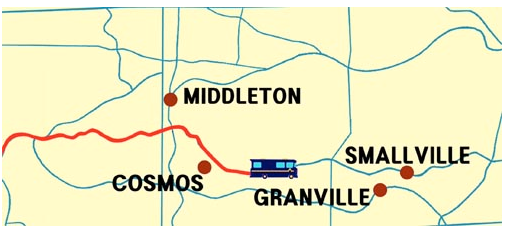
Granville first appeared in Smallville as a neighboring city of Smallville.  In the episode "Accelerate" (May 2003), Clark tracks the father of a childhood friend of Lana's to the city. Granville continued to be mentioned or appear once a season until season 8. This is a good name because it plays off the size angle - Small vs Grand - but it's also a reference to Smallville's production. The show (and most genre television) was filmed in Vancouver, which was originally known as Granville.


It appeared in a similar capacity in Superman/Batman #13 (August 2004). It has appeared a few times since then, but details on the internet are scarce so I can't find another mention. I know I've seen it, though, and recently. If you have a lead, let me know!


For the sake of full disclosure, I should point out that Action Comics #791 (May 2002) mentions a "Grandville". This is possibly a case of parallel thinking, or - since the issue is a flashback to Clark's high school days published at the tail end of Smallville season one - possibly a use of information from the Smallville writers' room that hadn't made its way on screen yet. Either way, the spelling of the town's name is a canon immigrant even if the town itself might not be.


One final note: Granville was also seen on a map in Batman: The Brave and the Bold's "Aquaman's Outrageous Adventure!" (January 2010).


Wednesday, November 13, 2019

Smallville Crows

Minor details are often canon immigrants, but that can be tricky for me to prove because it's hard to say for sure I'm right without reading through every possible appearance. So I do my best to support my case; if you can evidence that proves me wrong, let me know!

Today we'll be talking about Smallville High's mascot. It seems like, for most of history, Smallville's mascot was whatever the creators wanted it to be at the time. In Superboy #121 (April 1965), it was the Tigers.


While they were the Smallville Giants in Adventures of Superman #474 (November 1990).


And Smallville had them as the Crows ("Pilot", 2001).


In Action Comics #791 (May 2002), which I should point out was published at the end of Smallville season one, the team is also called the Crows.


Superman/Batman Secret Files & Origins (September 2003) continues this trend during a story about Lex's time in high school...another thing Smallville re-established.


I can't find any evidence of the Smallville High team name after these appearances, so I have no idea if it's still the Crows or not. But, for a time at least, it was.

Friday, November 1, 2019

Flashback Friday: Inspector Henderson

Each Friday, I take one of the entries from my old Super Posts and expand it into its own featured article.

This week: Inspector Henderson!


Inspector Henderson first appeared in the The Adventures of Superman radio show during the 1940s, although I can't find a specific first episode. I can confirm, however, that he appeared by 1945, as he is included in the 15-part episode, "The Atom Man", which has been published in book form.  His role was mainly to provide exposition for the story.

The radio show was very popular and had great influence on the comics, but Henderson wasn't one of them...yet. He did, however, appear in The Adventures of Superman tv show, as a way to keep Superman off-screen as long as possible (thanks to a limited budget).


His next appearance was also not in comics. It was in Filmation's "New Adventures of Superman" series. I can't confirm, but internet chatter leads me to believe he played a minor role in the episode, "Rain of Iron" (1968).


He finally made his first comics appearance in Action Comics #440 (August 1974) and became a minor recurring character until the New 52. He played a bigger part, however, in Black Lightning, which also took place in Metropolis.


He continued to be part of the Post-Crisis universe and made his first appearance there in Adventures of Superman #424 (November 1986).


Despite having a minor role in the comics nowadays, he has been a favorite of Superman adaptations, also appearing in Lois and Clark: The New Adventures of SupermanSuperman: The Animated Series, and Smallville. Most recently, he is a major supporting character in the CW's Black Lightning.


I should also probably note that Supergirl introduced an Inspector Mike Henderson in 2009, after Bill Henderson had been promoted to commissioner, but I don't know if that's coincidence.

Friday, October 4, 2019

Flashback Friday: The Phantom Zone's Appearance

Each Friday, I take one of the entries from my old Super Posts and expand it into its own featured article.

This week: The Phantom Zone's appearance!


The Phantom Zone first appeared in Adventure Comics #283 (February 1961), where Superboy discovered it accidentally. In a crate of Kryptonian artifacts that landed on Earth, he came across the  Phantom Zone Projector, which incorporealized him. The Phantom Zone would later become a major part of the mythology, housing multiple Kryptonian criminals and being the method through which Mon-El winds up in the 30th century alongside the Legion of Super-Heroes.


In Superboy #185 (March 1972), the last appearance I can find prior to the movie, the Phantom Zone is still accessed via Phantom Zone Projector.


In Superman: The Movie (1978), the Phantom Zone is depicted very differently. In this, the Zone resembles a mirror pane that flies through space...seemingly controlled by Krypton, though it's unclear whether they created it or simply harnessed it. Criminals can see the world through the pane, and if it breaks, the criminals can escape.


The Phantom Zone mostly disappeared after Crisis on Infinite Earths, as its main role was housing Kryptonian criminals, and if Superman's the only surviving Kryptonian, there's no one to house. But it slowly creeped back into continuity, the way things usually do, to the point that Green Arrow's partner, Speedy, had a Phantom Zone Arrow in Teen Titans #32 (January 2006). When she used it on Superboy-Prime, the glass depiction of the Phantom Zone appeared in comics for the first time. This was a part of a larger trend of making the Superman books more like the movie at the time.


Although this never became the standard way to show the Phantom Zone, it did continue to appear from time to time. It even survived the New 52 and Rebirth, as seen in Superman #2 (June 2018).


This version of the Phantom Zone mainly appears in parodies and homages, but it does occasionally sneak into adaptations. Smallville, which likewise takes many visual and plot-related cues from the movie series, is one example.


You gotta admit: it's a good visual.

Wednesday, September 25, 2019

Star-Lord's and Gamora's Relationship

The current and most well-known version of the Guardians of the Galaxy team formed in the 2006 event, Annihilation. Eight years later, they received their own movie, 2014's Guardians of the Galaxy. In that time, they appeared in 75 issues across multiple titles. In the five years since then, they have appeared in over 200 issues. That is almost entirely due to the success they've had on film. So it's no surprise the comics have steadily changed to make them more like their movie counterparts, from character designs like Star-Lord and Nebula, to new concepts like the Milano and the Ravagers, to relationships like Nebula and Gamora. It's another Gamora relationship we'll talk about today, this time between her and Star-Lord.

In the comics, Gamora does have a romantic relationship with a fellow Guardian, but it's Nova, aka Richard Rider. This is first seen in Annihilation #1 (August 2006) and lasts until his death in the Cancerverse (Guardians of the Galaxy #20, June 2014).


In the films, however, Gamora has a relationship with Star-Lord. In the first film it's mostly flirting, but they're officially together during the second film.


But this all changed in the latest volume of Guardians of the Galaxy. Although it's been building since Infinity Wars, they officially get together in Guardians of the Galaxy #7 (July 2019).


Is this a temporary thing or will they go the distance? Only time will tell.