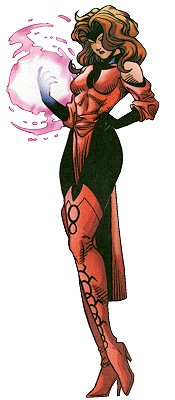
There's a strange phenomenon that happens as part of being a comics fan: the characters and concepts you're introduced to in your first couple years of reading comics become far more important in your mind than they are in the grand scheme of the universe. It's certainly true of me. It's why the Slingers are one of my favorite superteams, it's why I'm still disappointed Conduit never appeared in Smallville, and it's why my favorite Scarlet Witch outfit will always be this one. It's also why I'm glad Lady Octopus is having a resurgence.
Lady Octopus, or Doctor Octopus as she was originally called, was a former student of the original Doctor Octopus, who took over the role when he died. She first appeared in Amazing Spider-Man #406 (August 1995), and as that story is not only in the mid-90s, but in the Clone Saga as well, her story is needlessly complicated. I won't get into it all here, but suffice to say, it involves blending reality and virtual reality. Again, mid-90s.
After the original Doc Ock returned, she started going by Lady Octopus and only made sporadic appearances here and there. Recently she had a cameo in Amazing Spider-Man #17 (March 2019), though not wearing either her classic costume or her current one...
...which is strange, because in the next issue - Amazing Spider-Man #20 (April 2019) - she IS wearing an updated version of her classic outfit. Looking at the two, it seems like the one above is simply a coloring error, but I don't know that for sure.
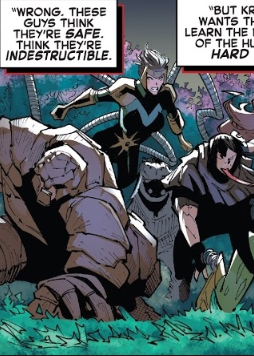
A few months later, though, she appears in a brand new costume with the new Sinister Syndicate in Amazing Spider-Man #25 (July 2019).
What's the deal? Well, only a few months earlier - December 2018 - a movie called Spider-Man: Into the Spider-Verse was released. And one of the many villains who appeared in that movie was a female Doctor Octopus. To be clear, she is not Carolyn Trainer. She's Olivia Octavius, the CEO of Alchemax. She looks like this.
Clearly it's not an exact match. But side-by-side, it's easy to spot the similarities. The long, pulled-up brown hair instead of the short brown, black, or pink hair. The green, round goggles. The cream chestpiece. The green abdomen. The black arms and legs, and the lighter colored...thigh-highs, for lack of a better word.
One thing I wish they would've adapted was Olivia's clear, more lifelike tentacles, which would have made her more distinct from the original Doc Ock. But either way, it's nice to see a great movie like Into the Spider-Verse already impacting the comics!
Subheader
A forever in-work compendium of Marvel and DC canon immigrants. What's a canon immigrant? Go here to find out!
Showing posts with label 2010s. Show all posts
Wednesday, October 9, 2019
Wednesday, September 25, 2019
Star-Lord's and Gamora's Relationship
The current and most well-known version of the Guardians of the Galaxy team formed in the 2006 event, Annihilation. Eight years later, they received their own movie, 2014's Guardians of the Galaxy. In that time, they appeared in 75 issues across multiple titles. In the five years since then, they have appeared in over 200 issues. That is almost entirely due to the success they've had on film. So it's no surprise the comics have steadily changed to make them more like their movie counterparts, from character designs like Star-Lord and Nebula, to new concepts like the Milano and the Ravagers, to relationships like Nebula and Gamora. It's another Gamora relationship we'll talk about today, this time between her and Star-Lord.
In the comics, Gamora does have a romantic relationship with a fellow Guardian, but it's Nova, aka Richard Rider. This is first seen in Annihilation #1 (August 2006) and lasts until his death in the Cancerverse (Guardians of the Galaxy #20, June 2014).
In the films, however, Gamora has a relationship with Star-Lord. In the first film it's mostly flirting, but they're officially together during the second film.
But this all changed in the latest volume of Guardians of the Galaxy. Although it's been building since Infinity Wars, they officially get together in Guardians of the Galaxy #7 (July 2019).
Is this a temporary thing or will they go the distance? Only time will tell.
In the comics, Gamora does have a romantic relationship with a fellow Guardian, but it's Nova, aka Richard Rider. This is first seen in Annihilation #1 (August 2006) and lasts until his death in the Cancerverse (Guardians of the Galaxy #20, June 2014).
In the films, however, Gamora has a relationship with Star-Lord. In the first film it's mostly flirting, but they're officially together during the second film.
But this all changed in the latest volume of Guardians of the Galaxy. Although it's been building since Infinity Wars, they officially get together in Guardians of the Galaxy #7 (July 2019).
Is this a temporary thing or will they go the distance? Only time will tell.
Wednesday, September 11, 2019
Appearance Spotlight: Killmonger
Black Panther's Killmonger is easily among the best Marvel Cinematic Universe villains, due to a combination of a sympathetic backstory and goal and being played by the charismatic Michael B. Jordan.
In the comics, Killmonger's backstory is pretty much the same although his goal is exactly the opposite (making Wakanda even more isolationist rather than sharing its technology with the world), but another important difference is their appearance. While the movie's Killmonger where's a leopard-inspired take on Black Panther's armor...
...the comics version of Killmonger goes for more a gladiator-esque look.
And that's still true today, for this Killmonger. But it's not true for another Killmonger. See, in Black Panther volume 7 by Ta-Nehisi Coates establishes an "Intergalactic Empire of Wakanda" that's some combination of in another reality and 2000 years in the future. I'm a little unclear based on what I could find online. Regardless, many of the people in this storyline share their names with Wakandans we know, including Emperor N'Jadaka, who's named after Killmonger. And his armor looks like this:
Note that it's not an exact recreation, and the MCU's Killmonger certainly doesn't have a cape made from a Symbiote, but it's still close enough that it's easy to tell what they were going for.
In the comics, Killmonger's backstory is pretty much the same although his goal is exactly the opposite (making Wakanda even more isolationist rather than sharing its technology with the world), but another important difference is their appearance. While the movie's Killmonger where's a leopard-inspired take on Black Panther's armor...
...the comics version of Killmonger goes for more a gladiator-esque look.
And that's still true today, for this Killmonger. But it's not true for another Killmonger. See, in Black Panther volume 7 by Ta-Nehisi Coates establishes an "Intergalactic Empire of Wakanda" that's some combination of in another reality and 2000 years in the future. I'm a little unclear based on what I could find online. Regardless, many of the people in this storyline share their names with Wakandans we know, including Emperor N'Jadaka, who's named after Killmonger. And his armor looks like this:
Note that it's not an exact recreation, and the MCU's Killmonger certainly doesn't have a cape made from a Symbiote, but it's still close enough that it's easy to tell what they were going for.
Wednesday, July 24, 2019
Character Spotlight: Howard the Duck on Film (a 2-for-1!)
In SHIELD #10 (September 2015), guest star Howard the Duck has to deal with a cosmic entity called The Liverer, whose goal is to eat a cosmic pate made from the livers of one million Howard the Ducks. His torso has a portal through which you can see alternate worlds, and Howard the Duck enters it, causing him to see alternate Howard the Ducks.
Among the many versions of himself he sees, including Howard the Human, Spider-Howard, and Indiana Howard, he sees the two film versions of himself!
The scruffy-looking one is the MCU version of Howard. He first appeared in Guardians of the Galaxy (2014), and then later, Guardians of the Galaxy vol. 2 (2017) and Avengers: Endgame (2019).
The one with the guitar is the Howard that starred in Howard the Duck (1986), Marvel's first theatrical film.
I admit these aren't true examples because they are still presented as alternate realities, but if Spider-Verse counts, so do these!
Among the many versions of himself he sees, including Howard the Human, Spider-Howard, and Indiana Howard, he sees the two film versions of himself!
The scruffy-looking one is the MCU version of Howard. He first appeared in Guardians of the Galaxy (2014), and then later, Guardians of the Galaxy vol. 2 (2017) and Avengers: Endgame (2019).
The one with the guitar is the Howard that starred in Howard the Duck (1986), Marvel's first theatrical film.
I admit these aren't true examples because they are still presented as alternate realities, but if Spider-Verse counts, so do these!
Wednesday, July 17, 2019
Nebula's Relationship with Gamora
One of the things the movie Guardians of the Galaxy (2014) and its sequel did really well was take a lot of disparate cosmic Marvel characters and form them into a cohesive whole. Credit where credit's due, the process was started by the 2006 event Annihilation, which the movies take a lot of inspiration from, but the movies really ran with it. One example of this is the relationship between Gamora and Nebula.
Gamora, aka The Deadliest Woman in the Whole Galaxy, first appeared in Strange Tales #180 (April 1975) as a bounty hunter looking for Adam Warlock. Only a few months later in Warlock #10 (October 1975), we learn that she was rescued by Thanos as a little girl and raised as his daughter to kill an evil version of Adam Warlock called The Magus.
Meanwhile, Nebula is introduced in Avengers #257 (May 1985) as a pirate who has taken over Thano's ship, the Sanctuary II. We learn there's more to the story in #260 (August 1985), however, when she reveals that she's Thanos's granddaughter.
In Infinity Gauntlet #1 (May 1991), Thanos calls the legitimacy of this claim into question, but accepts her as his granddaughter anyway.
For the next two decades, Gamora and Nebula only appear in a handful of issues together. In fact, they don't interact until Annihilation: Ronan #2 (May 2006), and don't show any sign of familiarity. In Annihilation: Ronan #4 (July 2006), Nebula has joined Gamora's team, the Graces, but they still don't seem to have any level of relationship beyond that.
Guardians of the Galaxy (2014) changes this drastically. In the Marvel Cinematic Universe, Gamora and Nebula are both Children of Thanos, and they have an intense rivalry as he constantly pits them against each other in combat. The reason Nebula is a cyborg in this universe is that, every time Nebula lost a fight against Gamora, Thanos would upgrade her to make her better. By this point, she's mostly machine. However, once they each turn on Thanos for their own reasons, they grow closer together and treat each other like sisters.
In Thanos Annual #1 (May 2014), Nebula is referred to as a daughter of Thanos for the first time. As it came out a few months before Guardians of the Galaxy was released, I don't know if it was planned to be roughly in time with the movie, or if it's just a coincidence. Either way, the Nebula discussed in this issue is from an alternate reality, so it doesn't really count one way or the other.
Guardians Team-Up #2 (March 2015) complicates things. Nebula and Gamora interact more than ever before, and it seems like they have personal history. Nebula in particular says she has many things she could blame Gamora for. That being said, the person who has hired Nebula to capture Gamora doesn't like Gamora because she's the daughter of Thanos, which implies Nebula is NOT a daughter of Thanos.
Guardians of the Galaxy: Best Story Ever #1 (April 2015) doesn't clear up anything. On one page, it re-affirms that Nebula is a granddaughter of Thanos, yet later Gamora refers to Nebula as her "sister" (quotes hers). Either way, there's clearly an animosity between them.
I thought Gamora #1 (December 2016) settled the issue. In it, Gamora and Nebula consider each other sisters and act as if they were raised together. But I don't actually know if it's continuity. The writer says it's set in the MCU, but nothing in the comic itself claims that (not to mention that Gamora and Thanos use their comics designs, not their movie ones). To make it worse, the genocide of Gamora's people, as depicted, doesn't match the movies OR the comics. So we'll just disregard the whole thing.
Unfortunately, that means this entry won't end with the smoking gun I thought it would. But I feel that the two Guardians stories from 2015, and the recent Asgardians of the Galaxy #3 (November 2018) that shows Nebula has a clear rivalry with Gamora, add up to make essentially the same point.
Gamora, aka The Deadliest Woman in the Whole Galaxy, first appeared in Strange Tales #180 (April 1975) as a bounty hunter looking for Adam Warlock. Only a few months later in Warlock #10 (October 1975), we learn that she was rescued by Thanos as a little girl and raised as his daughter to kill an evil version of Adam Warlock called The Magus.
Meanwhile, Nebula is introduced in Avengers #257 (May 1985) as a pirate who has taken over Thano's ship, the Sanctuary II. We learn there's more to the story in #260 (August 1985), however, when she reveals that she's Thanos's granddaughter.
In Infinity Gauntlet #1 (May 1991), Thanos calls the legitimacy of this claim into question, but accepts her as his granddaughter anyway.
For the next two decades, Gamora and Nebula only appear in a handful of issues together. In fact, they don't interact until Annihilation: Ronan #2 (May 2006), and don't show any sign of familiarity. In Annihilation: Ronan #4 (July 2006), Nebula has joined Gamora's team, the Graces, but they still don't seem to have any level of relationship beyond that.
Guardians of the Galaxy (2014) changes this drastically. In the Marvel Cinematic Universe, Gamora and Nebula are both Children of Thanos, and they have an intense rivalry as he constantly pits them against each other in combat. The reason Nebula is a cyborg in this universe is that, every time Nebula lost a fight against Gamora, Thanos would upgrade her to make her better. By this point, she's mostly machine. However, once they each turn on Thanos for their own reasons, they grow closer together and treat each other like sisters.
In Thanos Annual #1 (May 2014), Nebula is referred to as a daughter of Thanos for the first time. As it came out a few months before Guardians of the Galaxy was released, I don't know if it was planned to be roughly in time with the movie, or if it's just a coincidence. Either way, the Nebula discussed in this issue is from an alternate reality, so it doesn't really count one way or the other.
Guardians Team-Up #2 (March 2015) complicates things. Nebula and Gamora interact more than ever before, and it seems like they have personal history. Nebula in particular says she has many things she could blame Gamora for. That being said, the person who has hired Nebula to capture Gamora doesn't like Gamora because she's the daughter of Thanos, which implies Nebula is NOT a daughter of Thanos.
Guardians of the Galaxy: Best Story Ever #1 (April 2015) doesn't clear up anything. On one page, it re-affirms that Nebula is a granddaughter of Thanos, yet later Gamora refers to Nebula as her "sister" (quotes hers). Either way, there's clearly an animosity between them.
I thought Gamora #1 (December 2016) settled the issue. In it, Gamora and Nebula consider each other sisters and act as if they were raised together. But I don't actually know if it's continuity. The writer says it's set in the MCU, but nothing in the comic itself claims that (not to mention that Gamora and Thanos use their comics designs, not their movie ones). To make it worse, the genocide of Gamora's people, as depicted, doesn't match the movies OR the comics. So we'll just disregard the whole thing.
Unfortunately, that means this entry won't end with the smoking gun I thought it would. But I feel that the two Guardians stories from 2015, and the recent Asgardians of the Galaxy #3 (November 2018) that shows Nebula has a clear rivalry with Gamora, add up to make essentially the same point.
Wednesday, July 10, 2019
Nebula's Appearance
Sometimes, in comic book adaptations, a detail can be based on something that's already extant in the comics, but changed ever so slightly for the new medium. When it comes to designs, this usually means making the design more intricate. Of course, because canon immigration is essentially inescapable, then the more intricate design finds its way into the comics. This is what happened with Nebula.
Sometimes when this happens, it takes me a while to learn it happened. This is also what happened with Nebula.
When Nebula first appeared in The Avengers #257 (May 1985), she was a pirate who had seized control of Thanos's ship, the Sanctuary II, in a period when he was presumed dead. She claimed to be his granddaughter, and she looked like this:
In Silver Surfer #69 (June 1992), she's catatonic, so one of the people looking after her takes her to Dr. Mandibus to get her back to normal. In Silver Surfer #72 (July 1992), we see that Dr. Mandibus was able to restore her mental capacity, but turned her into a cyborg to do so.
She shows up again in Silver Surfer #110 (September 1995), and she mostly looks the same except she's grown her hair out again.
In Nova #1 (March 1999), however, she's back to her original look.
But in her next appearance, Annihilation: Ronan #1 (April 2006), she's back to being a bald cyborg. She continues to look this way through the rest of the Annihilation event.
The modern Guardians of the Galaxy spun out of the Annihilation event, so it's no surprise that, when Guardians of the Galaxy was released in 2014, Nebula's look was based on how she appeared in Annihilation. Overall it's simply a more detailed version of the look above. The most major change is the stripe down the middle of her face, which I believe is meant to mimic the stripe down her chest that's present in most of the images above.
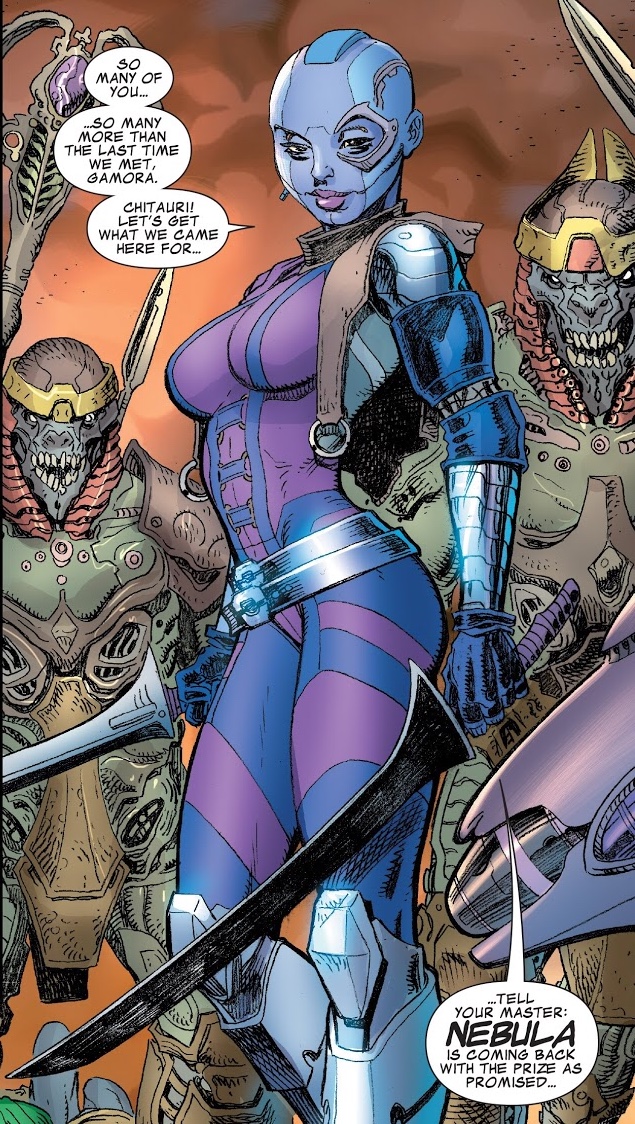
Guardians of the Galaxy was a huge hit, so it's no surprise that, when she appeared in Guardians Team-Up #1 (March 2015) - itself a book that wouldn't exist without the movie - she appeared as she does in the movie. Notably, she's flanked by Chitauri, another case of appearance canon immigration.
And she's appeared that way ever since!
That's not the only change to Nebula the movie made, but we'll get to that next week.
Sometimes when this happens, it takes me a while to learn it happened. This is also what happened with Nebula.
When Nebula first appeared in The Avengers #257 (May 1985), she was a pirate who had seized control of Thanos's ship, the Sanctuary II, in a period when he was presumed dead. She claimed to be his granddaughter, and she looked like this:
In Silver Surfer #69 (June 1992), she's catatonic, so one of the people looking after her takes her to Dr. Mandibus to get her back to normal. In Silver Surfer #72 (July 1992), we see that Dr. Mandibus was able to restore her mental capacity, but turned her into a cyborg to do so.
She shows up again in Silver Surfer #110 (September 1995), and she mostly looks the same except she's grown her hair out again.
In Nova #1 (March 1999), however, she's back to her original look.
But in her next appearance, Annihilation: Ronan #1 (April 2006), she's back to being a bald cyborg. She continues to look this way through the rest of the Annihilation event.
The modern Guardians of the Galaxy spun out of the Annihilation event, so it's no surprise that, when Guardians of the Galaxy was released in 2014, Nebula's look was based on how she appeared in Annihilation. Overall it's simply a more detailed version of the look above. The most major change is the stripe down the middle of her face, which I believe is meant to mimic the stripe down her chest that's present in most of the images above.
Guardians of the Galaxy was a huge hit, so it's no surprise that, when she appeared in Guardians Team-Up #1 (March 2015) - itself a book that wouldn't exist without the movie - she appeared as she does in the movie. Notably, she's flanked by Chitauri, another case of appearance canon immigration.
And she's appeared that way ever since!
That's not the only change to Nebula the movie made, but we'll get to that next week.
Wednesday, July 3, 2019
Character Spotlight: Codec
It's no longer June, but Agents of ATLAS Month continues! Greg Pak apparently doesn't mess around when he makes a series about Marvel's Asian superheroes, so there are more canon immigrants than the ones who were advertised. We'll talk about one of them today, and who knows, there might be more next week.
In April 2017, a new series called Marvel Future Avengers debuted in Shogakukan’s Bessatsu Coro Coro Comics Special. An animated series debuted in July 2017. Both follow a kid named Makoto, who was given superpowers in a Hydra experiment, then gets trained by the Avengers with two more kids with superpowers. It's a very Super Friends set-up, but there's nothing wrong with that.
One of the other kids is named Akiyadi, aka Codec. Unfortunately, I can't tell you anything more about him since information is scarce about this whole project online. Even what little I've said so far had to be pieced together from multiple sources. But Future Avengers will be receiving an English dub soon, so hopefully that'll change (ideally before this post goes up, but we'll see about that).
Regardless, Codec appears in War of the Realms: New Agents of ATLAS #3 (June 2019), and he's mentioned as being a part of the Future Avengers, so we know that team exists as well in some capacity.
In April 2017, a new series called Marvel Future Avengers debuted in Shogakukan’s Bessatsu Coro Coro Comics Special. An animated series debuted in July 2017. Both follow a kid named Makoto, who was given superpowers in a Hydra experiment, then gets trained by the Avengers with two more kids with superpowers. It's a very Super Friends set-up, but there's nothing wrong with that.
One of the other kids is named Akiyadi, aka Codec. Unfortunately, I can't tell you anything more about him since information is scarce about this whole project online. Even what little I've said so far had to be pieced together from multiple sources. But Future Avengers will be receiving an English dub soon, so hopefully that'll change (ideally before this post goes up, but we'll see about that).
Regardless, Codec appears in War of the Realms: New Agents of ATLAS #3 (June 2019), and he's mentioned as being a part of the Future Avengers, so we know that team exists as well in some capacity.
Wednesday, June 26, 2019
Character Spotlight: Sword Master
Last month, as a lead-in to a new event called "War of Realms", Marvel released a book called New Agents of Atlas that featured a team of all-Asian superheroes. Several of those superheroes were canon immigrants, and there just so happened to be four of them. So this month is Agents of Atlas month!
This week: Sword Master!
Last year, Marvel teamed up with a Chinese telecommunications company called NetEase to create its first fully Chinese superheroes (meaning Chinese characters made in China; it has other Chinese superheroes, such as the People's Defense Force). The goal was to increase their brand awareness in the East. Sword Master debuted in the first issue of an online manhua called Warriors of Three Sovereigns in May 2010, which can be found at 163.com.
Unlike Cyclone's more modern bent, Warriors of Three Sovereigns has a more antique flair. Sword Master is a college student named Lin Lie who takes up an ancient sword discovered by his archaeologist father to battle Chiyou, a reincarnated villain from the Imperial era. The sword belonged to one of the three emperors that reigned during that time.
Sword Master debuts in War of the Realms: New Agents of ATLAS #2 (May 2019) fighting fire goblins in Shanghai. He joins the New Agents of ATLAS at the end of the issue, despite being against the idea because he has his own stuff going on - a sentiment shared by several of the new members.
Two other superheroes feature in Cyclone. Will we see them in future issues of New Agents of ATLAS? Only time will tell!
This week: Sword Master!
Last year, Marvel teamed up with a Chinese telecommunications company called NetEase to create its first fully Chinese superheroes (meaning Chinese characters made in China; it has other Chinese superheroes, such as the People's Defense Force). The goal was to increase their brand awareness in the East. Sword Master debuted in the first issue of an online manhua called Warriors of Three Sovereigns in May 2010, which can be found at 163.com.
Unlike Cyclone's more modern bent, Warriors of Three Sovereigns has a more antique flair. Sword Master is a college student named Lin Lie who takes up an ancient sword discovered by his archaeologist father to battle Chiyou, a reincarnated villain from the Imperial era. The sword belonged to one of the three emperors that reigned during that time.
Sword Master debuts in War of the Realms: New Agents of ATLAS #2 (May 2019) fighting fire goblins in Shanghai. He joins the New Agents of ATLAS at the end of the issue, despite being against the idea because he has his own stuff going on - a sentiment shared by several of the new members.
Two other superheroes feature in Cyclone. Will we see them in future issues of New Agents of ATLAS? Only time will tell!
Wednesday, June 19, 2019
Character Spotlight: Aero
Last month, as a lead-in to a new event called "War of Realms", Marvel released a book called New Agents of Atlas that featured a team of all-Asian superheroes. Several of those superheroes were canon immigrants, and there just so happened to be four of them. So this month is Agents of Atlas month!
This week: Aero!
Last year, Marvel teamed up with a Chinese telecommunications company called NetEase to create its first fully Chinese superheroes (meaning Chinese characters made in China; it has other Chinese superheroes, such as the People's Defense Force). The goal was to increase their brand awareness in the East. Aero debuted in the first issue of an online manhua called Cyclone in May 2010, which can be found at 163.com.
Unlike Warriors of Three Sovereigns's more old-fashioned flair, Cyclone has a more modern bent. In her original comic, Aero is an architect that has control over the air and protects Shanghai after a resettlement project goes awry.
In New Agents of ATLAS #1 (May 2019), Aero debuts on the first page in a jurisdiction dispute with a new character, Wave. They get attacked and we don't see them for the rest of the issue, but I'm sure we haven't seen the last of them.
Two other superheroes feature in Cyclone. Will we see them in future issues of New Agents of ATLAS? Only time will tell!
This week: Aero!
Last year, Marvel teamed up with a Chinese telecommunications company called NetEase to create its first fully Chinese superheroes (meaning Chinese characters made in China; it has other Chinese superheroes, such as the People's Defense Force). The goal was to increase their brand awareness in the East. Aero debuted in the first issue of an online manhua called Cyclone in May 2010, which can be found at 163.com.
Unlike Warriors of Three Sovereigns's more old-fashioned flair, Cyclone has a more modern bent. In her original comic, Aero is an architect that has control over the air and protects Shanghai after a resettlement project goes awry.
In New Agents of ATLAS #1 (May 2019), Aero debuts on the first page in a jurisdiction dispute with a new character, Wave. They get attacked and we don't see them for the rest of the issue, but I'm sure we haven't seen the last of them.
Two other superheroes feature in Cyclone. Will we see them in future issues of New Agents of ATLAS? Only time will tell!
Wednesday, June 12, 2019
Character Spotlight: Crescent and Io
Last month, as a lead-in to a new event called "War of Realms", Marvel released a book called New Agents of Atlas that featured a team of all-Asian superheroes. Several of those superheroes were canon immigrants, and there just so happened to be four of them. So June is going to be Agents of Atlas month!
This week: Crescent (and Io)!
Marvel Future Fight is a mobile fighting game that pits Marvel characters from different dimensions against each other. Occasionally, that means creating original characters from the multiverse we've never seen before. The first example of this was a new version of Captain America (Steve's daughter from a world where he was never frozen), and the second example we saw last week: Luna Snow.
Crescent's story is that she's a kid from Korea whose antique dealer father disappears one night. She finds a red bear mask in his room, and when she puts it on, it summons Io, a moon bear spirit. Together, they track down her father and rescue him from the clutches of Morgan le Fey. Crescent and Io joined Marvel Future Fight in November 2018.
In New Agents of Atlas #1 (May 2019), Crescent and Io debut fighting alongside Luna Snow and White Fox to protect Korea from an invasion by Fire Demons.
This week: Crescent (and Io)!
Marvel Future Fight is a mobile fighting game that pits Marvel characters from different dimensions against each other. Occasionally, that means creating original characters from the multiverse we've never seen before. The first example of this was a new version of Captain America (Steve's daughter from a world where he was never frozen), and the second example we saw last week: Luna Snow.
Crescent's story is that she's a kid from Korea whose antique dealer father disappears one night. She finds a red bear mask in his room, and when she puts it on, it summons Io, a moon bear spirit. Together, they track down her father and rescue him from the clutches of Morgan le Fey. Crescent and Io joined Marvel Future Fight in November 2018.
In New Agents of Atlas #1 (May 2019), Crescent and Io debut fighting alongside Luna Snow and White Fox to protect Korea from an invasion by Fire Demons.
Wednesday, June 5, 2019
Character Spotlight: Luna Snow
Last month, as a lead-in to a new event called "War of Realms", Marvel released a book called New Agents of Atlas that featured a team of all-Asian superheroes. Several of those superheroes were canon immigrants, and there just so happened to be four of them. So June is going to be Agents of Atlas month!
This week: Luna Snow!
Marvel Future Fight is a mobile fighting game that pits Marvel characters from different dimensions against each other. Occasionally, that means creating original characters from the multiverse we've never seen before. The first example of this was a new version of Captain America (Steve's daughter from a world where he was never frozen), and another example we'll see next week: Crescent.
Luna Snow was added to Marvel Future Fight in January 2018. What's interesting is that, since she's a K-pop idol, she's also had a few singles: "Tonight" (July 2018) and "I Really Wanna (feat. Krysta Youngs)" (December 2018).
Luna Snow's story is a little wild. She was a K-pop singer who was performing at a Stark Industries event when AIM attacked and locked her in an experimental cold storage container, where the exposure to new cold fusion technology gave her ice powers. Notably, as you'll see again next week, all of Marvel Future Fight's original characters are Korean; this even includes the first - Captain America, aka Sharon Rogers - who was born in South Korean while Steve Rogers and Peggy Carter were stationed there. This is because the creators of Future Fight, NetMarble Games, is a Korean company.
In New Agents of ATLAS #1 (May 2019), Luna Snow debuts fighting alongside Crescent and Io and White Fox to protect Korea against an invasion of Dark Elves.
This week: Luna Snow!
Marvel Future Fight is a mobile fighting game that pits Marvel characters from different dimensions against each other. Occasionally, that means creating original characters from the multiverse we've never seen before. The first example of this was a new version of Captain America (Steve's daughter from a world where he was never frozen), and another example we'll see next week: Crescent.
Luna Snow was added to Marvel Future Fight in January 2018. What's interesting is that, since she's a K-pop idol, she's also had a few singles: "Tonight" (July 2018) and "I Really Wanna (feat. Krysta Youngs)" (December 2018).
Luna Snow's story is a little wild. She was a K-pop singer who was performing at a Stark Industries event when AIM attacked and locked her in an experimental cold storage container, where the exposure to new cold fusion technology gave her ice powers. Notably, as you'll see again next week, all of Marvel Future Fight's original characters are Korean; this even includes the first - Captain America, aka Sharon Rogers - who was born in South Korean while Steve Rogers and Peggy Carter were stationed there. This is because the creators of Future Fight, NetMarble Games, is a Korean company.
In New Agents of ATLAS #1 (May 2019), Luna Snow debuts fighting alongside Crescent and Io and White Fox to protect Korea against an invasion of Dark Elves.
Wednesday, May 29, 2019
Character Spotlight: Luis
I feel a little uneasy about this one, but I think there's enough evidence for it to count. (And, if we're being honest, I have a gap to fill and I'll take what I can get.)
2015's Ant-Man was a surprise hit for the Marvel Cinematic Universe. Although all their movies do well, people weren't expecting much from this one, and on top of that, there was a lot of controversy surrounding the movie thanks to Edgar Wright's departure.
I'm going to get on my soapbox for a second to say that I'm completely on Marvel's side for this one. I respect his decision to leave if he was being asked to make changes to his script he didn't want to make, but also...come on, dude. He knew what he was getting into when he signed up for it back in 2006. And if he didn't then, he certainly knew by the time they started production if he had paid attention to the 11 other movies (and multiple shows) made in the meantime. Marvel allowed him to delay Ant-Man until he was ready to make it - almost ten years, if you're keeping track - and agreed to his request to cut all references to the Ant-Man franchise until the movie was released, yet he still couldn't bring himself to play ball. But that's ok; by all accounts, we received a better movie for it.
Anyway, one of the most breakout parts of the movie was Luis, Scott Lang's cellmate/friend/literal partner-in-crime. Played by Michael Pena, he elevated the fun energy of a movie that already had quite a bit of it, and his storytelling became a trademark that people still talk about today.
Thanks to the movie, Ant-Man received a new comic called The Astonishing Ant-Man, which premiered in October 2015 (three months after the movie came out). The series finds Scott back in prison, with the first arc an extended flashback to how he got there. And his cellmate, true to form, is Luis.
Here's the thing, though: he's never called Luis. He never speaks so I don't know his personality. In fact, I can't even tell you if the person I've pictured is, in fact, Scott's cellmate because his face is never shown when they're in the cell. But this character, who looks a lot like Luis, is seen near Scott twice.
Normally, that wouldn't be enough for me. Even if the internet has decided this is Luis, I usually need some hard proof. If not actual in-comic evidence, then a quote from the writer or something. However, taking the rest of the book into account, I'm willing to go ahead with this one. After all, the series is meant to benefit from the heat of the movie. It uses the movie's logo. It puts Scott back in prison (just like the movie), has Cross Technologies as the villain (just like the movie), and focuses on Scott's relationship with Cassie (just like the movie). So I think it's safe to say that, just like the movie, Scott's cellmate is Luis.
2015's Ant-Man was a surprise hit for the Marvel Cinematic Universe. Although all their movies do well, people weren't expecting much from this one, and on top of that, there was a lot of controversy surrounding the movie thanks to Edgar Wright's departure.
I'm going to get on my soapbox for a second to say that I'm completely on Marvel's side for this one. I respect his decision to leave if he was being asked to make changes to his script he didn't want to make, but also...come on, dude. He knew what he was getting into when he signed up for it back in 2006. And if he didn't then, he certainly knew by the time they started production if he had paid attention to the 11 other movies (and multiple shows) made in the meantime. Marvel allowed him to delay Ant-Man until he was ready to make it - almost ten years, if you're keeping track - and agreed to his request to cut all references to the Ant-Man franchise until the movie was released, yet he still couldn't bring himself to play ball. But that's ok; by all accounts, we received a better movie for it.
Anyway, one of the most breakout parts of the movie was Luis, Scott Lang's cellmate/friend/literal partner-in-crime. Played by Michael Pena, he elevated the fun energy of a movie that already had quite a bit of it, and his storytelling became a trademark that people still talk about today.
Thanks to the movie, Ant-Man received a new comic called The Astonishing Ant-Man, which premiered in October 2015 (three months after the movie came out). The series finds Scott back in prison, with the first arc an extended flashback to how he got there. And his cellmate, true to form, is Luis.
Here's the thing, though: he's never called Luis. He never speaks so I don't know his personality. In fact, I can't even tell you if the person I've pictured is, in fact, Scott's cellmate because his face is never shown when they're in the cell. But this character, who looks a lot like Luis, is seen near Scott twice.
Normally, that wouldn't be enough for me. Even if the internet has decided this is Luis, I usually need some hard proof. If not actual in-comic evidence, then a quote from the writer or something. However, taking the rest of the book into account, I'm willing to go ahead with this one. After all, the series is meant to benefit from the heat of the movie. It uses the movie's logo. It puts Scott back in prison (just like the movie), has Cross Technologies as the villain (just like the movie), and focuses on Scott's relationship with Cassie (just like the movie). So I think it's safe to say that, just like the movie, Scott's cellmate is Luis.
Wednesday, March 27, 2019
Character Spotlight: Arkham Knight
Way back in 2009, Rocksteady Studios released a game called Batman: Arkham Asylum that redefined what a Batman game could be. Set in Arkham Asylum, it featured a creepy atmosphere, a wide variety of Batman villains used in clever ways, a dynamic fighting system, good storytelling, and most important of all, a focus on stealth that really put you in the mindset of Batman and feel what it's like to use his tricks to fight bad guys. There are few things more exhilarating than sneaking up behind a henchman, stringing him up from a gargoyle before he can alert the others, than lying in wait for another henchman to spot him so you can incapacitate him as well while he's distracted.
Needless to say, it was a hit.
This led to sequels, with Arkham City coming out in 2011 and Arkham Knight in 2015. (There was also Arkham Origins in 2013, but that was by a different studios, and a few mobile games, but none of those really count.)
In Batman: Arkham Knight, the Scarecrow has decided to unleash a series of attacks on Gotham and enlisted the help of the Arkham Knight to help him. The Arkham Knight is a more militarized take on Batman who wears the Arkham Asylum logo on his chest. By the end of the game, you learn that the Arkham Knight is Jason Todd, looking for revenge after Batman supposedly let him die. After the events of the main game, Jason takes on his standard mantle of the Red Hood for some DLC (downloadable content).
In Detective Comics #1000 (March 2019), which comes out today!, the Arkham Knight makes his comics debut. In a suit that looks very similar to his digital counterpart. This version believes that Batman is a cancer on Gotham and plans to eradicate him. He is almost certainly NOT Jason Todd, so who could he be? Time will tell.
Needless to say, it was a hit.
This led to sequels, with Arkham City coming out in 2011 and Arkham Knight in 2015. (There was also Arkham Origins in 2013, but that was by a different studios, and a few mobile games, but none of those really count.)
In Batman: Arkham Knight, the Scarecrow has decided to unleash a series of attacks on Gotham and enlisted the help of the Arkham Knight to help him. The Arkham Knight is a more militarized take on Batman who wears the Arkham Asylum logo on his chest. By the end of the game, you learn that the Arkham Knight is Jason Todd, looking for revenge after Batman supposedly let him die. After the events of the main game, Jason takes on his standard mantle of the Red Hood for some DLC (downloadable content).
In Detective Comics #1000 (March 2019), which comes out today!, the Arkham Knight makes his comics debut. In a suit that looks very similar to his digital counterpart. This version believes that Batman is a cancer on Gotham and plans to eradicate him. He is almost certainly NOT Jason Todd, so who could he be? Time will tell.
Subscribe to:
Posts (Atom)