Each Friday, I take one of the entries from my old Super Posts and expand it into its own featured article.
This week: Marsha, Queen of Diamonds!
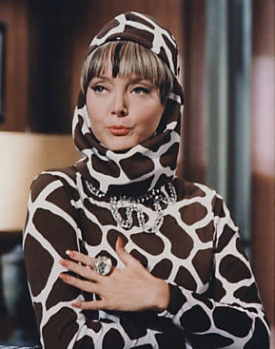
Marsha is a diamond thief who first appears in the episode of the same name (November 1966). She wants to get her hands on the Bat-Diamond, so she blackmails Batman into marrying her, which would have the added benefit of giving her access to the Batcave and his secret identity. Needless to say, Batman manages to find a way to escape and save Robin, Commissioner Gordon, and Chief O'Hara in the process.
Although this villain from the Batman tv series (1966-1968) hasn't yet made a real appearance in comics, she was mentioned by the Riddler in Secret Origins Special #1 (June 1989). At the time, the rights to the 60s series were in a strange sort of limbo, which is why the tv-original characters were never used in the comics. But that's all sorted out now, so there's no telling when Marsha will appear for real!
Subheader
A forever in-work compendium of Marvel and DC canon immigrants. What's a canon immigrant? Go here to find out!
Showing posts with label 1960s. Show all posts
Friday, December 6, 2019
Wednesday, October 30, 2019
Character Spotlight: Cousin Ambrose
Cousin Ambrose is Sabrina the Teenage Witch's cousin. It's right there in the name. He's one of the lesser known Sabrina characters because he never appeared in the Sabrina the Teenage Witch TGIF series from the 90s, the version most people are familiar with.
That's somewhat ironic since he debuted on television. He first appeared in Filmation's Sabrina the Teenage Witch cartoon, in the second segment of the first episode, titled "Hiccups" (September 1969). He's a foppish gentleman with a mustache who Sabrina summons to help her cure her hiccups, which are causing her magic to malfunction.
He later appeared in Archie's TV Laugh-Out #1 (October 1969), which I've mentioned before. His comics version has a more modern style than his animated counterpart.
He's continually appeared in comics since then, including The Chilling Adventures of Sabrina. This series reinterpreted him as a young adult who has to live with the Spellmans as punishment for revealing himself to mortals.
He likewise appears in the Netflix series of the same name, as the same basic character. I assume this will be where most people know him from.
That's somewhat ironic since he debuted on television. He first appeared in Filmation's Sabrina the Teenage Witch cartoon, in the second segment of the first episode, titled "Hiccups" (September 1969). He's a foppish gentleman with a mustache who Sabrina summons to help her cure her hiccups, which are causing her magic to malfunction.
He later appeared in Archie's TV Laugh-Out #1 (October 1969), which I've mentioned before. His comics version has a more modern style than his animated counterpart.
He's continually appeared in comics since then, including The Chilling Adventures of Sabrina. This series reinterpreted him as a young adult who has to live with the Spellmans as punishment for revealing himself to mortals.
He likewise appears in the Netflix series of the same name, as the same basic character. I assume this will be where most people know him from.
Wednesday, October 23, 2019
Character Spotlight: Harvey Kinkle
Last week I showed you how Sabrina the Teenage Witch joined the Archie Universe, and today we'll continue along that path with the introduction of Sabrina's boyfriend, Harvey Kinkle!
I should point out that Harvey was not the first boyfriend Sabrina had, which makes him all the more interesting. Information online is scant about Tommy Baker, but I know he at least appeared in Archie's Madhouse #55 and #59 (June and December 1967, respectively) and he was Sabrina's boyfriend in both appearances. He also knew about Sabrina's powers.
When the time came for Sabrina to have her own show, she needed a supporting cast. Filmation brought over Hilda, Zelda, and Salem from the comics, liberally used the existing Archie cast, and then also introduced Sabrina's best friend, Ophelia; Ophelia's crush, Spencer; and Sabrina's boyfriend, Harvey Kinkle. Why didn't they use the already existing Tommy Baker? I'm not sure, but Sabrina seemed to interact with people sporadically in her stories (usually only one or two per story, from what I've seen), so it's possible the writers didn't know he existed. Regardless, Harvey took his place and first appeared in the first episode, "The Fairy Godmother", in September 1969.
Notably, Harvey doesn't know Sabrina is a witch, because he's dumb as a brick and can't piece together obvious clues, like in this episode when he sees her in the window on the second floor and then she's instantly sitting in his car behind him.
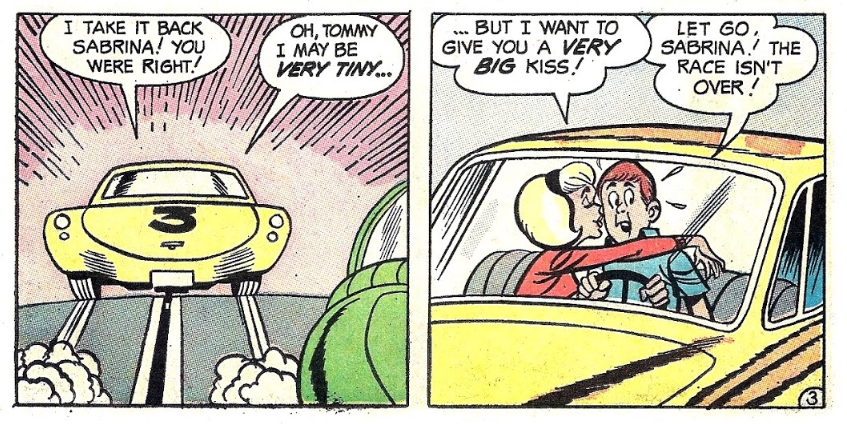
Anyway, ComicVine says he first appeared in comics in Archie's TV Laugh-Out #1 (October 1969), the same comic that integrated Sabrina into Archie's world. Unfortunately, I could not find photographic proof of that, so here he is in Archie's TV Laugh-Out #3 (December 1969). He appears in nearly every Sabrina story in this issue, so they were really pushing him as a major member of the cast.
Since then, Harvey has become a mainstay of the Sabrina brand, appearing in everything from the TGIF series with Melissa Joan Hart to Sabrina The Animated Series and The Chilling Adventures of Sabrina.
I should point out that Harvey was not the first boyfriend Sabrina had, which makes him all the more interesting. Information online is scant about Tommy Baker, but I know he at least appeared in Archie's Madhouse #55 and #59 (June and December 1967, respectively) and he was Sabrina's boyfriend in both appearances. He also knew about Sabrina's powers.
When the time came for Sabrina to have her own show, she needed a supporting cast. Filmation brought over Hilda, Zelda, and Salem from the comics, liberally used the existing Archie cast, and then also introduced Sabrina's best friend, Ophelia; Ophelia's crush, Spencer; and Sabrina's boyfriend, Harvey Kinkle. Why didn't they use the already existing Tommy Baker? I'm not sure, but Sabrina seemed to interact with people sporadically in her stories (usually only one or two per story, from what I've seen), so it's possible the writers didn't know he existed. Regardless, Harvey took his place and first appeared in the first episode, "The Fairy Godmother", in September 1969.
Notably, Harvey doesn't know Sabrina is a witch, because he's dumb as a brick and can't piece together obvious clues, like in this episode when he sees her in the window on the second floor and then she's instantly sitting in his car behind him.
Anyway, ComicVine says he first appeared in comics in Archie's TV Laugh-Out #1 (October 1969), the same comic that integrated Sabrina into Archie's world. Unfortunately, I could not find photographic proof of that, so here he is in Archie's TV Laugh-Out #3 (December 1969). He appears in nearly every Sabrina story in this issue, so they were really pushing him as a major member of the cast.
Since then, Harvey has become a mainstay of the Sabrina brand, appearing in everything from the TGIF series with Melissa Joan Hart to Sabrina The Animated Series and The Chilling Adventures of Sabrina.
Wednesday, October 16, 2019
Sabrina in the Archie Universe
I love when one of these surprises me, and this one certainly surprised me.
Sabrina the Teenage Witch is one of those characters that people know but don't necessarily know she's a comic book characters. I'd wager most people know her from her numerous adaptations, especially the 90s TGIF series starring Melissa Joan Hart (though I'm sure the numbers will quickly lean in favor of the current Netflix series, The Chilling Adventures of Sabrina). And I'm sure that many people who know she has comics don't necessarily know she's an Archie Comics character. I've pretty much always known that, but here's what I only just learned: although she's always been published by Archie Comics, she wasn't always part of their world. In fact, in her first appearance - Archie's Mad House #22 (August 1962) - she's watching Archie on tv!
This is especially strange because an Archie show - The Archie Show, in fact - wouldn't exist until 1968. And when it was created, it needed characters to play bit parts and Sabrina was pulled in. Although I can't find any definite screenshots from this first season, she did prominently appear (by name, even! Always helpful) in the video for "Sugar, Sugar", interacting with Betty. The video was released in May 1969.
Her appearances on this show led to her getting her own animated series - likewise called Sabrina the Teenage Witch - as part of The Archie Comedy Hour, which later became The Archie/Sabrina Hour. Over time, both The Archie Show and Sabrina the Teenage Witch would morph into other forms, with "Sabrina" becoming Sabrina and the Groovy Ghoulies and then Super Witch. As both series took place in Riverdale, characters and locations would also cross over frequently.
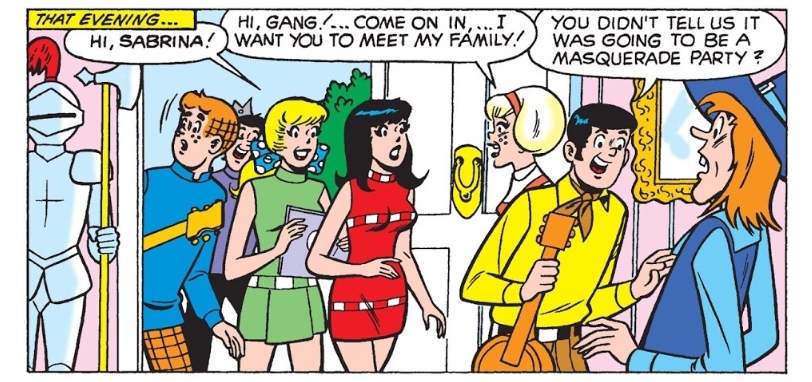
Sabrina was then integrated into Archie's comics world in Archie's TV Laugh-Out #1 (October 1969), in a story where Sabrina throws a party at home and the Archie gang attends.
She's been part of the universe ever since! She even almost appeared in Riverdale, although it didn't work out. But The Chilling Adventures of Sabrina still mentions Riverdale (and Riverdale likewise mentions Greendale), and the 1996 tv movie is set in Riverdale.
Sabrina the Teenage Witch is one of those characters that people know but don't necessarily know she's a comic book characters. I'd wager most people know her from her numerous adaptations, especially the 90s TGIF series starring Melissa Joan Hart (though I'm sure the numbers will quickly lean in favor of the current Netflix series, The Chilling Adventures of Sabrina). And I'm sure that many people who know she has comics don't necessarily know she's an Archie Comics character. I've pretty much always known that, but here's what I only just learned: although she's always been published by Archie Comics, she wasn't always part of their world. In fact, in her first appearance - Archie's Mad House #22 (August 1962) - she's watching Archie on tv!
This is especially strange because an Archie show - The Archie Show, in fact - wouldn't exist until 1968. And when it was created, it needed characters to play bit parts and Sabrina was pulled in. Although I can't find any definite screenshots from this first season, she did prominently appear (by name, even! Always helpful) in the video for "Sugar, Sugar", interacting with Betty. The video was released in May 1969.
Her appearances on this show led to her getting her own animated series - likewise called Sabrina the Teenage Witch - as part of The Archie Comedy Hour, which later became The Archie/Sabrina Hour. Over time, both The Archie Show and Sabrina the Teenage Witch would morph into other forms, with "Sabrina" becoming Sabrina and the Groovy Ghoulies and then Super Witch. As both series took place in Riverdale, characters and locations would also cross over frequently.
Sabrina was then integrated into Archie's comics world in Archie's TV Laugh-Out #1 (October 1969), in a story where Sabrina throws a party at home and the Archie gang attends.
She's been part of the universe ever since! She even almost appeared in Riverdale, although it didn't work out. But The Chilling Adventures of Sabrina still mentions Riverdale (and Riverdale likewise mentions Greendale), and the 1996 tv movie is set in Riverdale.
Friday, July 5, 2019
Flashback Friday: Professor Gorilla
Each Friday, I take one of the entries from my old Super Posts and expand it into its own featured article.
This week: Professor Gorilla!
In 1966, at the height of Bat-Mania thanks to the hit tv show starring Adam West, DC released a Batman manga in Japan called バットマン (Battoman), and colloquially known as Batmanga in the West. It only ran for a year and featured a mixture of original material and material based on Batman comics of the time. Professor Gorilla is a bit of both.
Detective Comics #339 (March 1965) tells the story of a scientist who invented a machine that could transfer the abilities of one animal to another - he essentially invented a scientific version of Vixen's animal totem. However, the experiment didn't quite go according to plan, so he and his test subject actually switched abilities instead. He got the strength and speed of a gorilla and the gorilla, Karmak, got his intelligence. So Karmak started using the scientist to rob banks. You know, like gorillas do.
Issues 10-12 of the Batman manga (July 1966) loosely adapts this story. Although the first issue is a pretty faithful adaptation of the backstory, it then veers off into its own story for the next two chapters. Karmak dons a costume, starts going by "Professor Gorilla", and attacks people for mistreating animals. The story ends when the effects of the machine wear off and Karmak goes back to being a normal gorilla.
In 2010, Grant Morrison launched a new series called Batman, Incorporated. For about three years at this point, Morrison was telling an epic Batman story over several series that tried to make every Batman story canon in one way or another. "Batman, Incorporated" was an expansion of the Club of Heroes/Batman of All Nations idea that he brought back in 2007, and saw Bruce Wayne traveling around the world to find heroes to be their country's Batman and be funded by the Wayne Corporation. In issue 2 (December 2010), he travels to Japan, which allows Morrison to bring in some details from the Batman manga. Most of the issue concerns itself with the Japanese hero Mr. Unknown fighting Lord Death Man, but after he "dies" and is reborn as Batman Japan, we get a splash page of him fighting Professor Gorilla.
This week: Professor Gorilla!
In 1966, at the height of Bat-Mania thanks to the hit tv show starring Adam West, DC released a Batman manga in Japan called バットマン (Battoman), and colloquially known as Batmanga in the West. It only ran for a year and featured a mixture of original material and material based on Batman comics of the time. Professor Gorilla is a bit of both.
Detective Comics #339 (March 1965) tells the story of a scientist who invented a machine that could transfer the abilities of one animal to another - he essentially invented a scientific version of Vixen's animal totem. However, the experiment didn't quite go according to plan, so he and his test subject actually switched abilities instead. He got the strength and speed of a gorilla and the gorilla, Karmak, got his intelligence. So Karmak started using the scientist to rob banks. You know, like gorillas do.
Issues 10-12 of the Batman manga (July 1966) loosely adapts this story. Although the first issue is a pretty faithful adaptation of the backstory, it then veers off into its own story for the next two chapters. Karmak dons a costume, starts going by "Professor Gorilla", and attacks people for mistreating animals. The story ends when the effects of the machine wear off and Karmak goes back to being a normal gorilla.
In 2010, Grant Morrison launched a new series called Batman, Incorporated. For about three years at this point, Morrison was telling an epic Batman story over several series that tried to make every Batman story canon in one way or another. "Batman, Incorporated" was an expansion of the Club of Heroes/Batman of All Nations idea that he brought back in 2007, and saw Bruce Wayne traveling around the world to find heroes to be their country's Batman and be funded by the Wayne Corporation. In issue 2 (December 2010), he travels to Japan, which allows Morrison to bring in some details from the Batman manga. Most of the issue concerns itself with the Japanese hero Mr. Unknown fighting Lord Death Man, but after he "dies" and is reborn as Batman Japan, we get a splash page of him fighting Professor Gorilla.
Friday, June 7, 2019
Flashback Friday: Chief O'Hara
Each Friday, I take one of the entries from my old Super Posts and expand it into its own featured article.
This week: Chief O' Hara!
Chief O'Hara was a creation of the 1966 Batman series that first appeared in the premiere episode, "Hi Diddle Riddle" (January 1966). In the series, he worked in conjunction with Commissioner Gordon as a reflection of the New York Police Department, where the chief is the most senior sworn officer and the commissioner is a civilian overseer.
As Batman was an instant hit, and really the thing that made him as popular as he is today, it didn't take long for it to affect the comics. O'Hara was first mentioned in comics in World's Finest #159 (June 1966), and brought with him the hotline from the show.
He appeared mostly off-panel in Detective Comics #461 (April 1976)...
...and then appeared on-panel in Detective Comics #470 (April 1977), though his face was obscured.
But that's Earth-1 Chief O'Hara. Later that same year, Earth-2 Chief O'Hara debuted in All-Star Comics #67 (June 1977).
His first Post-Crisis appearance was as Police Chief Clancy O'Hara in Batman: Dark Victory #1 (December 1999), where he was the first victim of the Hangman.
To my knowledge, he has not appeared in the New 52/Rebirth, but you never know when that will change!
This week: Chief O' Hara!
Chief O'Hara was a creation of the 1966 Batman series that first appeared in the premiere episode, "Hi Diddle Riddle" (January 1966). In the series, he worked in conjunction with Commissioner Gordon as a reflection of the New York Police Department, where the chief is the most senior sworn officer and the commissioner is a civilian overseer.
As Batman was an instant hit, and really the thing that made him as popular as he is today, it didn't take long for it to affect the comics. O'Hara was first mentioned in comics in World's Finest #159 (June 1966), and brought with him the hotline from the show.
He appeared mostly off-panel in Detective Comics #461 (April 1976)...
...and then appeared on-panel in Detective Comics #470 (April 1977), though his face was obscured.
But that's Earth-1 Chief O'Hara. Later that same year, Earth-2 Chief O'Hara debuted in All-Star Comics #67 (June 1977).
He briefly replaced Bruce Wayne as commissioner beginning in Wonder Woman #281 (May 1981).
His first Post-Crisis appearance was as Police Chief Clancy O'Hara in Batman: Dark Victory #1 (December 1999), where he was the first victim of the Hangman.
To my knowledge, he has not appeared in the New 52/Rebirth, but you never know when that will change!
Wednesday, May 1, 2019
Character Spotlight: Piston Puss
A character who's been around as long as Dick Tracy is bound to have some canon immigrants, so I don't know why it took me this long to learn about them. But I found a few that we'll talk about over the next several weeks.
This week: Piston Puss!
Piston Puss was one of a series of characters that appeared in ads for an auto parts store called Autolite. In the 60s and 70s, it was common for ads to feature comic book and comic strip characters and be done in the same style as the real stories featuring those characters. Although the ads were often made by the real comics creators - because ads had a higher pay rate - they were designed by the ad teams who often put no thought into the world these stories are taking place in, meaning they often used original villains. This phenomenon is no stranger to this blog. This particular ad is from 1966.
Much later, Piston Puss would appear in a Minit Mystery on November 20, 2017...
...and gets named the next day. Spoiler alert: he did it.
This week: Piston Puss!
Piston Puss was one of a series of characters that appeared in ads for an auto parts store called Autolite. In the 60s and 70s, it was common for ads to feature comic book and comic strip characters and be done in the same style as the real stories featuring those characters. Although the ads were often made by the real comics creators - because ads had a higher pay rate - they were designed by the ad teams who often put no thought into the world these stories are taking place in, meaning they often used original villains. This phenomenon is no stranger to this blog. This particular ad is from 1966.
Much later, Piston Puss would appear in a Minit Mystery on November 20, 2017...
...and gets named the next day. Spoiler alert: he did it.
Friday, March 29, 2019
Flashback Friday: Lord Death Man's Name and Location
Each Friday, I take one of the entries from my old Super Posts and expand it into its own featured article.
This week: The name and location of Lord Death Man!
In 1966, at the height of Bat-Mania thanks to the hit tv show starring Adam West, DC released a Batman manga in Japan called バットマン (Battoman), and colloquially known as Batmanga in the West. It only ran for a year and featured a mixture of original material and material based on Batman comics of the time. One of the the examples of the latter category is Lord Death Man.
In Batman #180 (March 1966), Batman faces off against a foe known as Death Man, who dies as he's about to be brought to justice, only to later return. After this happens several times, Batman realizes he is simply faking his death each time, and at the end of the issue, he's struck by lightning and dies for real.
In the first three issues of the Batman manga (April 1966), Death Man appears as Lord Death Man, but otherwise follows the same plot as Batman #180.
Lord Death Man was later brought to comics by Grant Morrison in Batman, Incorporated #1 (November 2010). Grant Morrison's goal with his run on Batman was to make as much of his history as canon as possible. That included bringing back the Batman of All Nations, aka the Club of Heroes, and then expanded that idea into Batman, Incorporated in the series of the same name. Thus, Lord Death Man appeared as a villain of Mr. Unknown, a potential recruit as the Batman of Japan. Batman, Incorporated #2 then established that he and Death Man are the same person, although Batman suspects he's gotten some sort of upgrade in the years since they first fought.
This week: The name and location of Lord Death Man!
In 1966, at the height of Bat-Mania thanks to the hit tv show starring Adam West, DC released a Batman manga in Japan called バットマン (Battoman), and colloquially known as Batmanga in the West. It only ran for a year and featured a mixture of original material and material based on Batman comics of the time. One of the the examples of the latter category is Lord Death Man.
In Batman #180 (March 1966), Batman faces off against a foe known as Death Man, who dies as he's about to be brought to justice, only to later return. After this happens several times, Batman realizes he is simply faking his death each time, and at the end of the issue, he's struck by lightning and dies for real.
In the first three issues of the Batman manga (April 1966), Death Man appears as Lord Death Man, but otherwise follows the same plot as Batman #180.
Lord Death Man was later brought to comics by Grant Morrison in Batman, Incorporated #1 (November 2010). Grant Morrison's goal with his run on Batman was to make as much of his history as canon as possible. That included bringing back the Batman of All Nations, aka the Club of Heroes, and then expanded that idea into Batman, Incorporated in the series of the same name. Thus, Lord Death Man appeared as a villain of Mr. Unknown, a potential recruit as the Batman of Japan. Batman, Incorporated #2 then established that he and Death Man are the same person, although Batman suspects he's gotten some sort of upgrade in the years since they first fought.
Wednesday, March 6, 2019
Character Spotlight: Cousin Itt
I have to be honest: I'm not completely comfortable with this post. I'm going through with it based on much less concrete information than my usual standard, but the information I do have comes from the Paley Center for Media, and I'm willing to trust them.
The Addams Family is a franchise I'm sure you're all familiar with. Everyone knows the hit 60s tv show and its famous theme song, along with the two movies. Fewer people, but still many, know about the two cartoons, the 90s tv movie and series, and the pinball machine (and yes, as the best-selling pinball machine of all time, it deserves a mention). But relatively few people know that these characters originated as a series of New Yorker cartoons by Charles Addams, which debuted in August 1938.
Over time, the two characters presented in this panel - I hesitate to call them Morticia and Lurch because almost none of the characters have names in the comics - were joined by the patriarch of the family, the two children, the grandma, and the bald man. They didn't feature in every Charles Addams panel, but all of his work had a similar air of the strange and macabre that felt like it belonged in the same world.
One of the most memorable Addams Family members is Cousin Itt, who debuted in the episode "Cousin Itt Visits the Addams Family" (February 1965). He's a small, hirsute character who talks in squeaks and is apparently quite the ladies' man.
In The Paley Center's "We're Gonna Pay a Call on...The Addams Family", they write about Itt's creation:
As you can see, this panel was published over a year before the episode that introduced Cousin Itt. But as I said, I'm inclined to believe the Paley Center. For one thing, they're the Paley Center. But for another, this is the only character in the entire series of New Yorker cartoons that gets a name. And I think it makes a lot of sense if that's because the character originated on the tv show, where the rest of the characters got their names.
The Addams Family is a franchise I'm sure you're all familiar with. Everyone knows the hit 60s tv show and its famous theme song, along with the two movies. Fewer people, but still many, know about the two cartoons, the 90s tv movie and series, and the pinball machine (and yes, as the best-selling pinball machine of all time, it deserves a mention). But relatively few people know that these characters originated as a series of New Yorker cartoons by Charles Addams, which debuted in August 1938.
Over time, the two characters presented in this panel - I hesitate to call them Morticia and Lurch because almost none of the characters have names in the comics - were joined by the patriarch of the family, the two children, the grandma, and the bald man. They didn't feature in every Charles Addams panel, but all of his work had a similar air of the strange and macabre that felt like it belonged in the same world.
One of the most memorable Addams Family members is Cousin Itt, who debuted in the episode "Cousin Itt Visits the Addams Family" (February 1965). He's a small, hirsute character who talks in squeaks and is apparently quite the ladies' man.
In The Paley Center's "We're Gonna Pay a Call on...The Addams Family", they write about Itt's creation:
Two more characters were added at [producer David] Levy’s suggestion: a disembodied hand. . .and a hair-covered relative who spoke total gibberish. The first became Thing, a reference to a previous New Yorker cartoon that had warned a worried mailman to “Beware of the Thing.” (This sign, in fact, appeared in the pilot episode). . .The latter creature was dubbed “Cousin Itt” and would not be a weekly regular but show up on an erratic basis. His sporadic appearances, however, quickly made him a favorite. Approximately three feet in height, his hair ran to floor length covering him entirely. He sometimes sported a hat and a pair of sunglasses just to offset the shag look. In anticipation of his appearance on the show, Addams drew a cartoon starring the hirsute creature answering the telephone with “This is It speaking” for the October 12, 1963, New Yorker issue. (For the series the furry cousin added an extra “T” to his name).Here's the comic in question:
As you can see, this panel was published over a year before the episode that introduced Cousin Itt. But as I said, I'm inclined to believe the Paley Center. For one thing, they're the Paley Center. But for another, this is the only character in the entire series of New Yorker cartoons that gets a name. And I think it makes a lot of sense if that's because the character originated on the tv show, where the rest of the characters got their names.
Friday, February 22, 2019
Flashback Friday: HERBIE
Each Friday, I take one of the entries from my old Super Posts and expand it into its own featured article.
This week: H.E.R.B.I.E.!
Back in the 60s, Marvel was kind of a big deal. So it made sense that they would start branching out into toys, tv shows, and movies. They made several cartoon versions of their comics, one of which was Fantastic Four (1967). But there was a problem. Marvel had licensed Human Torch to Universal to get a solo cartoon that never happened, which means that when it came time to make Fantastic Four, they couldn't use him. You can't have a team called "Fantastic Four" with only three characters, so they introduced HERBIE, a robot created by Reed Richards.
HERBIE makes his first appearance in the comics in Fantastic Four #209 (June 1979), which even explains that the Human Torch didn't appear in the cartoon because he wasn't in town to sign the contract. If you're not aware, a strange quirk of the Marvel Universe is that Marvel Comics exists within it and publishes comics about the heroes, to varying degrees of accuracy. This mainly shows up in Fantastic Four, because they have public identities and license their likenesses for merchandising, and She-Hulk, because she frequently breaks the fourth wall. So it stands to reason that, if the comics exist, the comics adaptations can exist as well.
He sacrificed himself a few issues later because he was possessed by Doctor Sun, but you can't keep a good robot down. He has continued to appear in comics in a variety of roles, usually either performing security functions in the Baxter Building or being a companion for Franklin Richards.
Probably the most notable later appearance is in 1998 when Reed Richards becomes HERBIE! See, in What If...? #105 (December 1997) and the MC2 Universe that that issue spawned, it's about twenty years in the future and the marvel heroes have mostly been replaced by the next generation. In this world, the Fantastic Four is now the Fantastic Five, comprising an adult Franklin Richards, The Thing, the Human Torch, Lyja the Skrull, and Reed Richards...who's now just a brain in a HERBIE body.
HERBIE's latest appearance is in the pages of Moon Girl and Devil Dinosaur, where it was revealed Reed first built to HERBIE to monitor for Galactus. No one can say for sure why a small robot from a 50-year-old one-season cartoon has managed to have the staying power that it has, but I think it's safe to say that cuteness goes a long way!
This week: H.E.R.B.I.E.!
Back in the 60s, Marvel was kind of a big deal. So it made sense that they would start branching out into toys, tv shows, and movies. They made several cartoon versions of their comics, one of which was Fantastic Four (1967). But there was a problem. Marvel had licensed Human Torch to Universal to get a solo cartoon that never happened, which means that when it came time to make Fantastic Four, they couldn't use him. You can't have a team called "Fantastic Four" with only three characters, so they introduced HERBIE, a robot created by Reed Richards.
HERBIE makes his first appearance in the comics in Fantastic Four #209 (June 1979), which even explains that the Human Torch didn't appear in the cartoon because he wasn't in town to sign the contract. If you're not aware, a strange quirk of the Marvel Universe is that Marvel Comics exists within it and publishes comics about the heroes, to varying degrees of accuracy. This mainly shows up in Fantastic Four, because they have public identities and license their likenesses for merchandising, and She-Hulk, because she frequently breaks the fourth wall. So it stands to reason that, if the comics exist, the comics adaptations can exist as well.
He sacrificed himself a few issues later because he was possessed by Doctor Sun, but you can't keep a good robot down. He has continued to appear in comics in a variety of roles, usually either performing security functions in the Baxter Building or being a companion for Franklin Richards.
Probably the most notable later appearance is in 1998 when Reed Richards becomes HERBIE! See, in What If...? #105 (December 1997) and the MC2 Universe that that issue spawned, it's about twenty years in the future and the marvel heroes have mostly been replaced by the next generation. In this world, the Fantastic Four is now the Fantastic Five, comprising an adult Franklin Richards, The Thing, the Human Torch, Lyja the Skrull, and Reed Richards...who's now just a brain in a HERBIE body.
HERBIE's latest appearance is in the pages of Moon Girl and Devil Dinosaur, where it was revealed Reed first built to HERBIE to monitor for Galactus. No one can say for sure why a small robot from a 50-year-old one-season cartoon has managed to have the staying power that it has, but I think it's safe to say that cuteness goes a long way!
Wednesday, January 16, 2019
Name Spotlight: Harriet Cooper
Many people believe that Aunt Harriet is a creation of the Batman (1966) tv show. It's not true, but it's not surprising. After all, with only around 25 appearances until recently, and with most of those appearances being from an era that isn't often collected in trades, television is the only place fans have seen her.
Before I go further, I should probably explain who she is. Harriet is Dick Grayson's aunt, who came to live at Wayne Manor after Alfred died. This occurred in the last couple pages of Detective Comics #328 (April 1964). At this point, you may have the same concern I always have: if Dick has a living aunt that knows where he is, why is he living with Bruce? To my knowledge, this is never explained. This came up a lot in the Pre-Crisis world - basically, there's no reason for Bruce and Dick to grow up the way they did because they have family members coming out of the woodwork all the time.
So now we get to the point of the post: although the character herself was not a creation of the show, her name is! See, in her first appearance - and for most of her appearances afterward - she was simply "Aunt Harriet". Maybe the presumption was that her last name was Grayson, who knows. But the show gave her the last name "Cooper".
It's not a change that happened right away, but in Detective Comics #373 (January 1968), the comics address her by her full name for the first time, and we see that her last name is, in fact, Cooper. This particular issue also changed Mr. Zero's name to Mr. Freeze, so it's clear they had the show on their mind.
Before I go further, I should probably explain who she is. Harriet is Dick Grayson's aunt, who came to live at Wayne Manor after Alfred died. This occurred in the last couple pages of Detective Comics #328 (April 1964). At this point, you may have the same concern I always have: if Dick has a living aunt that knows where he is, why is he living with Bruce? To my knowledge, this is never explained. This came up a lot in the Pre-Crisis world - basically, there's no reason for Bruce and Dick to grow up the way they did because they have family members coming out of the woodwork all the time.
So now we get to the point of the post: although the character herself was not a creation of the show, her name is! See, in her first appearance - and for most of her appearances afterward - she was simply "Aunt Harriet". Maybe the presumption was that her last name was Grayson, who knows. But the show gave her the last name "Cooper".
It's not a change that happened right away, but in Detective Comics #373 (January 1968), the comics address her by her full name for the first time, and we see that her last name is, in fact, Cooper. This particular issue also changed Mr. Zero's name to Mr. Freeze, so it's clear they had the show on their mind.
Friday, January 11, 2019
Flashback Friday: Mr. Freeze
Each Friday, I take one of the entries from my old Super Posts and expand it into its own featured article.
This week: Mr. Freeze!
Mr. Freeze is an interesting case because he's not a canon immigrant...but pretty much everything about him is.
Mr. Freeze first appeared in Batman #121 (December 1958) as "Mr. Zero", a villain who spilled cryogenic chemicals on himself as he was creating an ice gun, causing him to only be able to survive in subzero temperatures. At the end of the story, Mr. Zero is cured of his condition and he's never seen again...or was he?
Almost ten years later, Batman got a hit tv show you may have heard of. At the time, Batman didn't have the robust rogues' gallery he's known for today, so the show mainly used a mixture of new characters and villains with only one or two appearances - with the exception of Joker, Catwoman, and Penguin, that's pretty much all there were. In fact, many characters - such as the Riddler - started to be seen as major Batman antagonists because they were featured on the show. This was the case with Mr. Zero...or should I say "Mr. Freeze".
Mr. Freeze first appeared in the Batman episodes "Instant Freeze/Rats Like Cheese" (1966), an adaptation of his comics appearance. In addition to the new name, he had a new outfit that emphasized his iciness. Mr. Freeze would go on to appear in two more two-parters, played by a different actor each time.
Since he now had a rising star thanks to the tv series, he appeared in comics again in Detective Comics #373 (January 1968), this time using the Mr. Freeze name. Surprisingly, they didn't use a more show-accurate costume for him.
He continued to show up here and there, and in 1986, received a costume based on a recent DC Super Powers action figure. You can read about that in more detail here.
TV would update the character again when the Batman: The Animated Series episode "Heart of Ice" (1992) updated his origin. He now had a name - Victor Fries - and his condition was still caused by exposure to cryogenic chemicals, but this time he felt into a vat of them during a fight with his boss, Ferris Boyle, over the misuse of company resources to keep his wife Nora in cryostasis. This was brought over to the comics in Batman: Mr. Freeze (1997), understandably written by Paul Dini, and was even used in the movie Batman and Robin (1997).
In fact, Batman: Mr. Freeze also introduced his animated appearance as well, and the trademark goggles later returned in The New 52. Conveniently, this one page includes all the changes I mentioned.
But the canon immigration doesn't end there. The New Batman Adventures episode "Cold Comfort" (1997) had Mr. Freeze surviving as just a head on a robotic spider body, and in DC's Flashpoint altered reality, he existed essentially the same way, as seen in Flashpoint: Citizen Cold #1 (August 2011), although with a design that more closely resembled his Animated Series depiction rather than New Batman Adventures.
This week: Mr. Freeze!
Mr. Freeze is an interesting case because he's not a canon immigrant...but pretty much everything about him is.
Mr. Freeze first appeared in Batman #121 (December 1958) as "Mr. Zero", a villain who spilled cryogenic chemicals on himself as he was creating an ice gun, causing him to only be able to survive in subzero temperatures. At the end of the story, Mr. Zero is cured of his condition and he's never seen again...or was he?
Almost ten years later, Batman got a hit tv show you may have heard of. At the time, Batman didn't have the robust rogues' gallery he's known for today, so the show mainly used a mixture of new characters and villains with only one or two appearances - with the exception of Joker, Catwoman, and Penguin, that's pretty much all there were. In fact, many characters - such as the Riddler - started to be seen as major Batman antagonists because they were featured on the show. This was the case with Mr. Zero...or should I say "Mr. Freeze".
Mr. Freeze first appeared in the Batman episodes "Instant Freeze/Rats Like Cheese" (1966), an adaptation of his comics appearance. In addition to the new name, he had a new outfit that emphasized his iciness. Mr. Freeze would go on to appear in two more two-parters, played by a different actor each time.
Since he now had a rising star thanks to the tv series, he appeared in comics again in Detective Comics #373 (January 1968), this time using the Mr. Freeze name. Surprisingly, they didn't use a more show-accurate costume for him.
He continued to show up here and there, and in 1986, received a costume based on a recent DC Super Powers action figure. You can read about that in more detail here.
TV would update the character again when the Batman: The Animated Series episode "Heart of Ice" (1992) updated his origin. He now had a name - Victor Fries - and his condition was still caused by exposure to cryogenic chemicals, but this time he felt into a vat of them during a fight with his boss, Ferris Boyle, over the misuse of company resources to keep his wife Nora in cryostasis. This was brought over to the comics in Batman: Mr. Freeze (1997), understandably written by Paul Dini, and was even used in the movie Batman and Robin (1997).
In fact, Batman: Mr. Freeze also introduced his animated appearance as well, and the trademark goggles later returned in The New 52. Conveniently, this one page includes all the changes I mentioned.
But the canon immigration doesn't end there. The New Batman Adventures episode "Cold Comfort" (1997) had Mr. Freeze surviving as just a head on a robotic spider body, and in DC's Flashpoint altered reality, he existed essentially the same way, as seen in Flashpoint: Citizen Cold #1 (August 2011), although with a design that more closely resembled his Animated Series depiction rather than New Batman Adventures.
But his New Batman Adventures design DID appear in Batman Beyond 2.0 #16 (March 2014)! Batman Beyond 2.0 takes place in the future of Earth-12, one of the 52 Earths, based on the DC Animated Universe.
All of these changes survived the New 52, with one minor exception: Nora. She still exists in the New 52 as well, but her story isn't quite the same. I'll talk more about that in a future Flashback Friday!
Subscribe to:
Posts (Atom)