Subheader

A forever in-work compendium of Marvel and DC canon immigrants. What's a canon immigrant? Go here to find out!
Showing posts with label 1940s. Show all posts

Friday, December 20, 2019

Flashback Friday: Perry White

Each Friday, I take one of the entries from my old Super Posts and expand it into its own featured article.

This week: Perry White!


Perry White is fascinating because most people don't realize he originated outside of comics. When Superman debuted in Action Comics #1 (April 1938), his editor didn't have a name. In Superman #2 (August 1939), we learn his name is George Taylor.


Around this same time, Superman gained his first adaptation, the Adventures of Superman radio show. In the second episode, "Clark Kent, Reporter" (February 1940), we meet Clark's editor, here named Perry White. This is not that out of the ordinary; adaptations trying to stay as faithful as possible to the comic books they're adapting is only a fairly recent phenomenon, and the farther back you go, the less they care. (For a particularly extreme example, check out the Captain America serial where he's a district attorney named Grant Gardner.) Of course, I should also mention that continuity was much less of a thing in comics in the early days, so basic details about characters could change on a whim from issue to issue.

Later that year, Perry White arrived in comics as the editor of the Daily Planet in Superman #7 (September 1940). There was no story about how or why he replaced George Taylor; he just did.


In the comics, George Taylor would not be forgotten, appearing on Earth-2 as that Superman's editor (at the Daily Star) and on the main earth as the Daily Planet's editor before Perry White and/or the editor of the Daily Star, the Planet's rival newspaper. As far as adaptations are concerned, however, Perry White is the only editor that matters. He has become a mainstay of Superman stories and has appeared in all adaptations (except for the Superboy tv show, though his son WAS in it).

Friday, November 1, 2019

Flashback Friday: Inspector Henderson

Each Friday, I take one of the entries from my old Super Posts and expand it into its own featured article.

This week: Inspector Henderson!


Inspector Henderson first appeared in the The Adventures of Superman radio show during the 1940s, although I can't find a specific first episode. I can confirm, however, that he appeared by 1945, as he is included in the 15-part episode, "The Atom Man", which has been published in book form.  His role was mainly to provide exposition for the story.

The radio show was very popular and had great influence on the comics, but Henderson wasn't one of them...yet. He did, however, appear in The Adventures of Superman tv show, as a way to keep Superman off-screen as long as possible (thanks to a limited budget).


His next appearance was also not in comics. It was in Filmation's "New Adventures of Superman" series. I can't confirm, but internet chatter leads me to believe he played a minor role in the episode, "Rain of Iron" (1968).


He finally made his first comics appearance in Action Comics #440 (August 1974) and became a minor recurring character until the New 52. He played a bigger part, however, in Black Lightning, which also took place in Metropolis.


He continued to be part of the Post-Crisis universe and made his first appearance there in Adventures of Superman #424 (November 1986).


Despite having a minor role in the comics nowadays, he has been a favorite of Superman adaptations, also appearing in Lois and Clark: The New Adventures of SupermanSuperman: The Animated Series, and Smallville. Most recently, he is a major supporting character in the CW's Black Lightning.


I should also probably note that Supergirl introduced an Inspector Mike Henderson in 2009, after Bill Henderson had been promoted to commissioner, but I don't know if that's coincidence.

Friday, October 18, 2019

Flashback Friday: The Batcave

Each Friday, I take one of the entries from my old Super Posts and expand it into its own featured article.

This week: The Batcave!


Originally, the closest thing Batman had to a Batcave was an old barn he used for a hangar/garage, which he accessed via underground tunnel connected to Wayne Manor. You can see it here in Detective Comics #48 (December 1940). 


In Batman #12 (June 1942), we see underground hangars as an extension of the above idea, but they're presented as man-made. Incidentally, Batman #12 is the first appearance of Batman's trophy room, which is housed in Wayne Manor and mainly exists as a way for Batman and Robin to talk about past cases.


In 1943, Batman received his first serial, also called Batman. In it, Batman was a government agent and his base was a cave called The Bat's Cave, which debuted in the chapter of the same name (July 1943). It didn't house much except a desk and some science equipment. Although it was thematically appropriate, the only reason for it was as a money-saving measure since the studio already had a cave set.


It was thematically appropriate, though, so the Batcave itself first appeared in Detective Comics #83 (November 1943). Note that the image is essentially the same as the one above, only now drawn so that it exists in a natural cave. Also note that they've moved the trophy room into the Batcave.


Interestingly, Detective Comics #205 (January 1954) shows that Bruce originally planned to use the barn as his base of operations, but he fell through the floor and discovered the cave. That's a neat way to smooth that history!...although you'll also notice this says Bruce bought Wayne Manor as an adult, which is its own continuity snafu.


The Batcave, of course, has become a major part of the Batman mythos, appearing in every film and tv adaptation since, even the "grounded" Christopher Nolan films. It also, of course, continued to appear in comics after the New 52 and Rebirth.

Friday, September 6, 2019

Flashback Friday: Kal-El's (and Kal-L's) Name

Each Friday, I take one of the entries from my old Super Posts and expand it into its own featured article.

This week: Kal-El's name (and Kal-L's)!

Everyone knows Superman debuted in Action Comics #1 (April 1938), and that's where his origin was told for the first time. What many people don't realize is how bare-bones the origin was at the time. A scientist on a dying planet sent his infant son into space, where he landed on Earth, grew up as Clark Kent, and used his superpowers as Superman.


All of that is still accurate today, but it's missing a lot of detail. Luckily, Superman became very popular very quickly, so in January 1939, a Superman comic strip started - which, incidentally, was Jerry Siegel and Joe Shuster's preferred format for Superman in the first place (the first Superman story was simply the first 38 strips they had produced when they were shopping the character around). This new strip allowed them a do-over, so it started with a more detailed origin, where we learn the baby's name is Kal-L in the first strip ("Superman Comes to Earth").


Superman's origin was re-told again when he got his own series (Superman #1, April 1939), but it didn't include the baby's Kryptonian name.

Soon after, Superman got a radio adaptation and one of the radio show's writers, George Lowther, wrote a book called The Adventures of Superman (1942). In this re-telling of his origin, his name is spelled "Kal-el" for the first time. I couldn't find proof of that, but here is an image from the book of "Jor-el" being spelled the same way.


Surprisingly, the spelling "Kal-El" (with or without a capital) wouldn't appear in comics until Superman #113 (March 1957).


Over time, it was established that one of the differences between Earth-One and Earth-Two is Kryptonian naming conventions, with Earth-One using "-El" and Earth-Two using "-L". The name "Kal-L" would appear as the birthname of the Superman of Earth-Two in Action Comics #484 (April 1978).


In the New 52, the primary Earth's Superman is still called Kal-El, but Earth-2's Superman is also called Kal-El. However, the Pre-Crisis Earth-Two's Superman is still known as Kal-L when he appears (such as in Convergence: Action Comics #1, April 2015).

Friday, July 19, 2019

Flashback Friday: John Malcolm

Each Friday, I take one of the entries from my old Super Posts and expand it into its own featured article.

This week: John Malcolm!

John Malcolm is an archaeologist and the leader of the Malcolm Expedition in The Adventures of Captain Marvel serial (March 1941). The goal of the Malcolm Expedition was to find the Scorpion Machine and keep it out of the hands of the villain, the Scorpion.


His first appearance in print was Captain Marvel Adventures #2 (Summer 1941). It doesn't really count, but I'll mention it anyway. For one thing, he was called JAMES Malcolm. Normally that's not a deal breaker, but the more important reason it doesn't count is that it's simply a text adaptation of the first chapter of the serial - and specifically mentions the serial, so they're not even pretending this story is about the comics version of Captain Marvel.


His first actual comics appearance was as John Malcolm in Whiz Comics #22 (July 1941), which was something of a sequel to the serial. In the story, "Capt. Marvel and the Temple of Itzalotahui", Malcolm gets captured on an expedition to South America, so Whitey Murphy enlists the help of Billy Batson/Captain Marvel to rescue him.


To my knowledge, that's the only time he's appeared. But it's not the only time he's been mentioned. In Power of Shazam! #24 (January 1997), Spy Smasher tells Billy and Mary Batson a story about the Scorpion Machine, and Billy mentions that it was recovered by the Malcolm Expedition.


What I find most interesting about this is that most serials didn't have any sort of real impact on their comics. There are a few one-off examples here and there, but nothing major. Captain America never became a lawyer, for instance. But for whatever reason, The Adventures of Captain Marvel did, in several respects. I can't speak to why that is, but I find it fascinating.

Friday, June 21, 2019

Flashback Friday: Sgt. Casey

Each Friday, I take one of the entries from my old Super Posts and expand it into its own featured article.

This week: Sgt. Casey!


Sergeant Casey is a Metropolis police that doesn't trust Superman and is constantly trying to catch him doing something illegal.  He first appeared in the Superman newspaper strip (Episode 14: "The Unknown Strikes", May 1940). Ironically, Lois calls him their "old friend" in his first appearance.


He quickly made the jump to comics in Superman #6 (July 1940) and became a mainstay of Earth-2 Superman stories. Over time he got promoted to lieutenant, and he made his final appearance in Superman Family #219 (April 1982).


A police officer named Casey was mentioned in Action Comics #1 (September 2011), but unfortunately hasn't been seen since.


Wednesday, May 8, 2019

Character Spotlight: Mel O. Dee

A character who's been around as long as Dick Tracy is bound to have some canon immigrants, so I don't know why it took me this long to learn about them. But I found a few that we'll talk about over the next several weeks.

This week: Mel O. Dee!


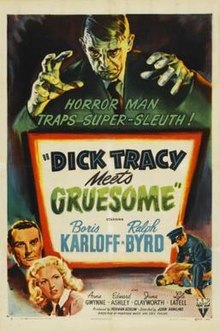
Mel O. Dee first appeared in the film Dick Tracy Meets Gruesome (1947), which may sound familiar to you if you regularly follow this blog, only his name was Melody. Melody was a former criminal turned pianist at a club called The Hangman's Knot, who's pulled back into a life of crime to be Gruesome's getaway driver.


When he appeared in the strip for October 27, 2014, his name was changed to Mel O. Dee. I'm not sure if that is to give him a more masculine first name or if it's because he's not a musician anymore, but either way, Mel remains a former associate of Gruesome's, only now he's a fellow actor and they perform in Arsenic and Old Lace together.


To learn about the significance of Arsenic and Old Lace, visit Gruesome's entry!

Wednesday, April 17, 2019

Character Spotlight: Cueball

A character who's been around as long as Dick Tracy is bound to have some canon immigrants, so I don't know why it took me this long to learn about them. But I found a few that we'll talk about over the next several weeks.

This week: Cueball!


Cueball is a criminal that first appeared as the eponymous villain in the movie Dick Tracy vs. Cueball (1946), portrayed by Dick Wessel. He was a diamond thief who killed people by strangling them with a leather hatband.


He didn't appear in the comic strip until all the way in July (10th) 2011, as seen below. The comic gave him a brother named Screwball.


He continued to appear until his death in January 2012. I don't know how Dick Tracy handles death, so maybe he'll be back? Either way, you should be back next Wednesday, because the Dick Tracy bonanza is just getting started!

Wednesday, April 10, 2019

Character Spotlight: Gruesome

A character who's been around as long as Dick Tracy is bound to have some canon immigrants, so I don't know why it took me this long to learn about them. But I found a few that we'll talk about over the next several weeks.

This week: Gruesome!


Gruesome originated as the villain in Dick Tracy Meets Gruesome (1947), the last picture in the RKO Dick Tracy film series. As played by Boris Karloff, Gruesome is essentially Tim Burton's version of the Joker: a professional criminal who gets a distinctive face because of a botched plastic surgery job.


In October 2014, Gruesome made his debut in the Dick Tracy comic strip, complete with a reference to the actor that played him - a double reference, in fact, since the line quotes a character in Arsenic and Old Lace that was originally played by Boris Karloff.


He has since appeared many times, and he's far from the only character from this movie to do so. Come back next Wednesday for another example!

Friday, March 22, 2019

Flashback Friday: The Scorpion Machine

Each Friday, I take one of the entries from my old Super Posts and expand it into its own featured article.

This week: The Scorpion Machine!

Way back in the long ago, when Shazam was still called Captain Marvel, he was the most popular superhero. So he got the first superhero serial, The Adventures of Captain Marvel, in 1941. The plot involved a criminal mastermind called The Scorpion trying to find an artifact called the Scorpion Machine that could supposedly turn sunlight into gold. It’s a serial so there’s a lot more to it than that, but that’s the gist.


The Scorpion Machine makes its comics debut in The Power Of Shazam #24 (January 1997) as part of a story Spy Smasher is telling Billy and Mary Batson. In the story, Spy Smasher enlisted the help of their dad to help him find a machine called The Scorpion that was originally found by the Malcolm Expedition, which Batson’s father (Billy’s grandfather) was a part of. It was lost for a time and then turned up again, and Spy Smasher wanted to keep it out of Nazis’ hands.


Unfortunately that was the only time we saw it, but DC loves referencing that serial. Look up Whitey Murphy for another example!

Friday, February 15, 2019

Flashback Friday: Whitey Murphy

Each Friday, I take one of the entries from my old Super Posts and expand it into its own featured article.

This week: “Whitey” Murphy!


It’s hard to believe now, but there was a time when Captain Marvel was the most popular superhero in the world. Even more popular than Superman. But it’s true! And all you need to look at to realize that is a list of comic book film adaptations, because you’ll see that first in the list is The Adventures of Captain Marvel. (Though, to be fair, Superman was already on the radio by this time.)


The Adventures of Captain Marvel is a 12-part Republic serial released in March 1941. Like many adaptations of the time - and still today, who are we kidding - it played fast and loose with the established mythology. Billy Batson is still a young reporter (though not a kid; more like a teen or young adult) and he still gets the power to turn into Captain Marvel from the wizard Shazam, but everything else is original.

One of those original elements is “Whitey” Murphy, a companion of Billy’s and fellow member of the Malcolm Expedition.


Whitey made his first comics appearance in Whiz Comics #22 (July 1941) in the story “Captain Marvel and the Temple of Itsalotahui”, a sequel to The Adventures of Captain Marvel. Strangely, it seems as though the expedition was real, but they also made a movie during it. So how much of the movie actually happened in this world? I’m not entirely sure.


Whitey became a recurring character in the comics, such as this bit in Captain Marvel Adventures #12 (March 1942) when he gets a promotion in the Army.


Eventually, Fawcett Comics folded and their superhero characters were licensed and then bought outright by DC Comics.So in Shazam! #15 (October 1974), he makes his DC debut...or so the DC Wiki claims. The only character I could find who might be Whitey is this guy...


...and not only is he never named, he doesn't even have white hair. Shazam! #26 (October 1976) is a more concrete first appearance.


He continued to make a few more sporadic appearances, with his last being in 1981. But is this really the last we've seen of him? With the new Shazam! movie coming out later this year, there's no telling what kind of bump Shazam will get, nor can we know which of his supporting characters will come along for the ride. We may see Whitey again sooner than you think!

Saturday, December 29, 2018

Character Spotlight: Split-Face

This one's very interesting, but a great blog called The Absorbascon got to before I could. I would recommend clicking that link before reading any further because it's a great article with a lot of twists and turns.

But if you must have some idea of what you're getting into before you click through, just know that the first Dick Tracy film (1945) featured a villain called Split-Face...


...and that villain was brought into the Dick Tracy comic strip (which seems to treat all previous Dick Tracy stories as canon) two days ago.


Seriously, though: just read the article.

Wednesday, June 20, 2018

Action Comics #1000

Action Comics #1000 came out back in April. Not only was it the 1000th issue of Action Comics, but DC also timed the scheduling of the series so that its publication would coincide with the 80th anniversary of Action Comics #1 (I can't prove that's why Action has been shipping semi-monthly for a while now, but that's a pretty big coincidence if it's not).

Because of this, DC released #1000 as an 80-page giant that featured several different stories that celebrated the scope of Superman's history. One of the stories really took that to heart and told a reality-bending tale with shout-outs to several Superman adaptations over the years.

“Never-Ending Battle” by Peter J. Tomasi and Patrick Gleason

The first to be seen was the black Superman shield that first appeared in the Fleischer cartoons from the 40s. Although we've seen this S recently, this is the first time to my knowledge that it's appeared on a full Superman outfit in a canon comic book.


Next up is a black-and-white adventure that clearly represents Superman and the Mole Men (1951), the pilot to the Adventures of Superman tv series, and technically the first Superman theatrical film.


Eventually, Superman gets caught in a fight of multiple versions of himself, one of which is clearly the Superman that appeared in Super Friends (1978). You can tell by the simpler lines, lack of shading, and the distinctive spit curl.


Finally, there's these depictions of The Phantom Zone, the Fortress of Solitude, and Jax-Ur & Mala.


I've had the flat-square Phantom Zone and the crystalline Fortress of Solitude on this blog before, and in the same post, even. This version of Jax-Ur has likewise been seen before. Mala, however, is brand new. She and Jax-Ur first appeared in the Superman: The Animated series episode "Blasts from the Past, Part 1" (September 1997), and although they're both based on Kryptonian characters from the comics, Mala was originally a male.


(Note: “Actionland!” by Paul Dini and Jose Luis Garcia-Lopez also included two canon immigrants, but one of them, the Mechanical Monsters, has already been featured on this site in a more concretely canon capacity, and the other, Miss Gsptlsnz's looks, will be featured in two weeks.)

So yeah, this post is kind of two months late, but it's completely fine because it's just celebrating the 80th anniversary of Action Comics #1's cover date. See? Totally works!