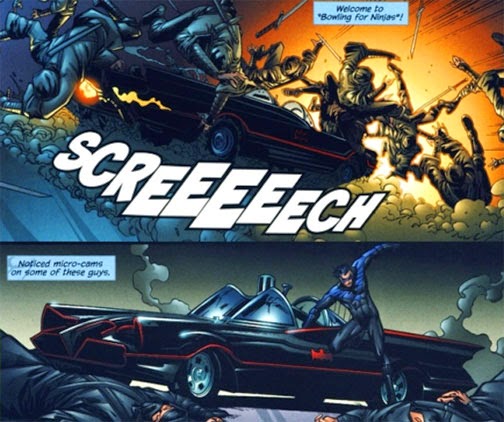
The Batmobile has been a mainstay of Batman's world since its inception, and it pretty much always has a very distinctive look in adaptations, which goes on to influence the Batmobile designs in the comics, when not outright being featured (usually as a cameo in a garage scene). I've posted about Batmobiles on this page before, but for my 300th post, I thought I'd try to do something a little more thorough. I don't pretend it's comprehensive, and it probably can't ever be, but it does give a pretty full picture regardless.
Batmobile '66
This vehicle from the 1966
Batman tv series is arguably the most influential and well-known of all the Batmobiles, its impact can still be seen today. Although rarely brought into the comics as-is, it changed how Batmobiles were drawn for a long time. Some examples:
 |
| Detective Comics #356 (Aug 1966) |
 |
| Brave and the Bold #68 (September 1966) |
 |
| Batman #204 (June 1968) |
 |
| Detective Comics #362 (Feb 1967) |
 |
| Detective Comics #371 (Nov 1967) |
 |
| Detective Comics #377 (May 1968) |
The top left picture was a slow beginning, mainly taking the "double bubble" aspect of the tv car. And the
Brave and the Bold example mainly highlights the addition of the rear afterburner, which becomes a design mainstay, especially in adaptations. But after that, it really takes shape.
Also, the 60s Batmobile does appear in a show-accurate form a few times:
 |
| Superman/Batman #2 (September 2003) |
 |
| Detective Comics #850 (Nov 2008) |
 |
| Nightwing #152 (Jan 2009) |
 |
| (Prime Earth) - Batman Beyond #14 (Nov 2017) |
Batmobile '89
If the 60s Batmobile isn't the most influential, then this one is. Actually this one may have that one beat, since some of the following Batmobiles - each with their own share of influence - are ultimately based on this one as well. Some examples:
 |
| Legends of the Dark Knight #29 (Feb 1992) |
 |
| Batman: Run, Riddler, Run #1 (Mar 1992) |
 |
| Batman: Black & White #2 (May 1996) |
 |
| Legends of the Dark Knight #64 (July 1994) |
 |
| Legends of the Dark Knight #95 (Apr 1997) |
 |
| Legends of the Dark Knight #156 (June 2002) |
 |
| Catwoman #35 (Sep 2004) |
 |
| Superman/Batman #21 (May 2005) |
 |
| Batman: The Return (Nov 2010) |
 |
| Batman & Robin #25 (July 2011) |
Just like with the 60s Batmobile, although the design is almost never 100% authentic, you can clearly see how the shape of these Batmobiles is inspired by Anton Furst's Batmobile. And occasionally a film-accurate design does emerge:
 |
| Batman & Robin #19 (Jan 2011) |
 |
| Batman #1 (Sep 2011) |
Batman: The Animated Series
This Batmobile is inspired by the one above, but as you can see, it went in its own direction. And since many people consider
Batman: The Animated Series (1992) to be best depiction of Batman, you better believe it's influenced comics designs. Interestingly, the cars based on this design tend to be more accurate overall than most of the other ones.
 |
| Detective Comics #784 (July 2003) |
 |
| Detective Comics #840 (Jan 2008) |
 |
| Batman & The Outsiders #14 (Dec 2008) |
 |
| Batman #1 (June 2016) |
Batman Forever
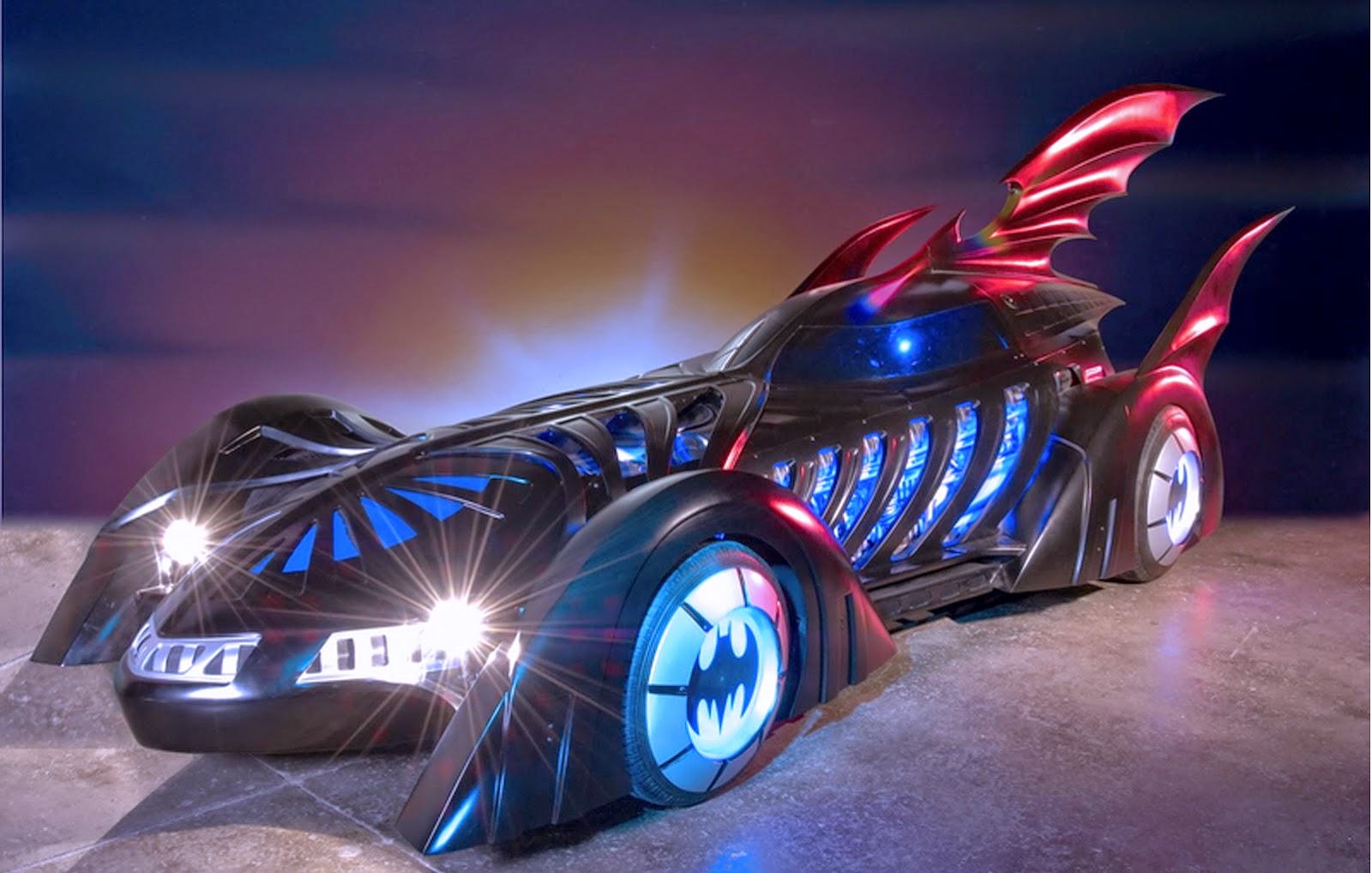
This Batmobile was designed by H. R. Giger for
Batman Forever (1995), with some Schumacher neon added, but at its heart, it's still has a lot in common with the previous two Batmobiles. Although as striking design, it has - to my knowledge - only inspired one Batmobile, the toned-down version seen below. But it has also appeared in group shots, as you can see at the bottom of the page.
 |
| Batman 80-Page Giant (2011) |
Batman and Robin
This one has not yet appeared in the comics on its own or inspired any comics Batmobiles, but it does appear in a group shot below.
The New Batman Adventures
This one is possible my favorite Batmobile design, but again, it's essentially the Anton Furst Batmobile. Really, it's the back half of '89 with the front half of
Batman and Robin. But hey, whatever works. It's appeared twice in somewhat modified forms.
 |
| Legends of the Dark Knight #208 (July 2006) |
 |
| Batman #5 (Oct 2016) |
Tumbler
Batman Begins (2005) took a different approach to the Batmobile. For one thing, it wasn't called that. For another, it was originally created as a military vehicle and then modified by Bruce Wayne. So it has more of a tank-like appearance than the sports car look it usually has.
Surprisingly, as successful as Christopher Nolan's trilogy of Batman films has been all around, the Tumbler hasn't made much impact on the comics. But that's not to say it's never appeared, and the one time it did (and was actually used, I mean) was pretty faithful.
 |
| Detective Comics #20 (July 2013) |
DCCU Batmobile
Like the
Batman & Robin Batmobile, this one has not yet appeared in the comics on its own or inspired any comics Batmobiles, but it does appear in a group shot below.
Group Shots
Occasionally, artists will like to do a wide shot of the Batcave featuring a wide variety of vehicles from Batman's history. I believe the first people to do this were Jeph Loeb and Jim Lee in
Batman: Hush (seen below). In any case, these shots always include at least one screen Batmobile. I've provided three examples below. I don't believe these are the only time a shot like this is done, but they were the only ones I could find.
Batman #615 (May 2003): (bottom left) Batman Forever (1995), (top middle) Batman (1989), (bottom middle) Batman (1966), (above Batman '66) Batman: The Animated Series (1992), (above Batman: TAS) Batman & Robin (1997)
Detective Comics #850 (November 2008): (L to R) Batman (1989), Batman Begins (2005), Batman: The Animated Series (1992), and The New Batman Adventures (1998)
Detective Comics #988 (September 2018): (L to R)
Batman v Superman: Dawn of Justice (2016),
Batman (1989),
Batman Begins (2005),
Batman Forever (1995)