I can't believe this blog has over 300 posts. Back when this whole thing started, it was on one of those build-your-own-website things. And that lasted for a while, but I eventually ran out of space so I moved it to Blogger. At that point, I thought I had pretty much catalogued everything there was, and I was afraid that if I didn't move it over quickly, I would lose it. So I made a lot of what I called "Super Posts", which were collections of related entries. The idea was that eventually I would go back and give each of those things its own post, but for various reasons that never happened.
Well, eventually comes today. Each Friday, I'll take something from the old Super Posts and give it its own spotlight. The Super Posts will still be there, but the individual entries will be erased and replaced by links to the Flashback Friday posts. And I can't think of anyone better to kick it off than Harley Quinn.
Harley Quinn, to put it simply, is the poster child for canon immigrants. She's not the first, she's arguably not even the most successful, but she's the one everyone knows. But in case you don't know her, what's her story?
Harley Quinn first appeared in the Batman: The Animated Series episode "Joker's Favor" (1992), and the only reason she exists is a scene where someone pops out of a cake. The writers went back and forth on the Joker being the one to do it, but that didn't quite work with other scenes. So they wrote her in, and she became a hit. I don't know exactly when they decided to keep using her, but over the course of the series - including The New Batman Adventures - she appeared in 15 episodes, making her second only to the Joker himself in terms of villain appearances.
Her first ever comics appearance was in The Batman Adventures: Mad Love (December 1993), a prestige format one-shot that told her origin story. This Eisner Award-winning story eventually got adapted into "Mad Love", an episode of The New Batman Adventures (1999).
She made many more appearances in the various comics based on the DC Animated Universe over the years, but her first appearance in a comic not related to that world was a surprising choice. Batgirl + Robin: Thrillkiller was an Elseworlds story that reinterpreted Batman's world as part of the 1960s counterculture. It was followed by a sequel, Batgirl + Batman: Thrillkiller '62 (February 1998) that introduced a character named Hayley Fitzpatrick, who was the partner of Bianca Steeplechase, this world's version of the Joker.
In June 1999, she had a brief mention in Elseworlds 80-Page Giant as part of a folk music group called Harley & Ivy. But her first real appearance in the DC Universe was in Batman: Harley Quinn #1 (August 1999), another prestige format one-shot that once again told her origin. This one-shot was part of the No Man's Land crossover.
As the years went on, Harley's star continually rose. In 2001, she received her own ongoing series that lasted two years. She was featured as the primary villain in the WB's Birds of Prey (2002). She appeared in most Batman adaptations, got a cameo in the Arrow episode "Suicide Squad" (March 2014), was arguably the main character in Suicide Squad (2016), and will be the title character in Birds of Prey (and the Fantabulous Emancipation of One Harley Quinn) (2020).
Around the time of the New 52, she really blew up. I can't really say why, although I'm sure it has something to do with her popularity as cosplay at comic-cons. Her first New 52 appearance was Suicide Squad #1 (September 2011), with a new design reminiscent of her appearance in Batman: Arkham Asylum (2009) and its sequels.
Since DC Rebirth is in a weird continuity flux that's sort of a continuation of the DCU pre-New 52 and sort of a continuation of the New 52 (which itself is sort of a continuation of pre-New 52 and sort of its own thing), I'll go ahead and mention her first Rebirth appearances as well. Harley appeared in both Harley Quinn #1 and Suicide Squad #1 in August 2016. By this time, her look also evolved to better match Margot Robbie in Suicide Squad (2016), which itself was inspired by her Arkham appearance.
You can read about the first time that look debuted here, and you can also read about her hyenas from the Animated Series, Bud and Lou.
Harley Quinn has left her mark on the canon without a doubt, and I think in time, she'll become one of the characters people forget are canon immigrants entirely, like Perry White and Jimmy Olsen.
Subheader
A forever in-work compendium of Marvel and DC canon immigrants. What's a canon immigrant? Go here to find out!
Friday, January 4, 2019
Wednesday, January 2, 2019
Appearance Spotlight: Killmonger’s Scars
I don't know if you've heard, but Black Panther - which came out all the way back in February 2018, almost a year ago - is a pretty big deal. It's the most successful MCU domestically, even beating all the Avengers films; it's the ninth most successful movie of all time worldwide (it doesn't beat the Avengers movies there); it's appearing on every "top 10 movies of 2018" list; it was nominated for a Best Picture Golden Globe; and most importantly, it was a cultural revolution.
So, of course, it elevated the status of all characters associated with it, turning them into household names. Not least among these was Killmonger, a character many call Marvel's best. It's no surprise, then, that Killmonger received a miniseries last month to delve into his origins, and it's even less of a surprise that this new story is influenced a bit by Black Panther.
When Killmonger first appeared in Jungle Action #6 (July 1973), he had a look similar to Kraven's in that it's like a tribal warrior look filtered through superhero comics.
He keeps that basic look throughout his history, though it becomes more involved and gains a mask.
But this style didn't carry through to the Black Panther movie. That movie got him looking straight like Vegeta. But it added a new detail, too: in keeping with the afro-futuristic design sense the movie went for, the Earth-199999 version of Killmonger had ritual scarring, one bump for each person he's killed.
On the first page of Killmonger #1 (December 2018), we see him with the same scarring:
The rest of the series is a flashback, so this is the only time we've seen it so far. But with three issues still to come, I imagine we'll see him get them at some point.
So, of course, it elevated the status of all characters associated with it, turning them into household names. Not least among these was Killmonger, a character many call Marvel's best. It's no surprise, then, that Killmonger received a miniseries last month to delve into his origins, and it's even less of a surprise that this new story is influenced a bit by Black Panther.
When Killmonger first appeared in Jungle Action #6 (July 1973), he had a look similar to Kraven's in that it's like a tribal warrior look filtered through superhero comics.
He keeps that basic look throughout his history, though it becomes more involved and gains a mask.
But this style didn't carry through to the Black Panther movie. That movie got him looking straight like Vegeta. But it added a new detail, too: in keeping with the afro-futuristic design sense the movie went for, the Earth-199999 version of Killmonger had ritual scarring, one bump for each person he's killed.
On the first page of Killmonger #1 (December 2018), we see him with the same scarring:
The rest of the series is a flashback, so this is the only time we've seen it so far. But with three issues still to come, I imagine we'll see him get them at some point.
Saturday, December 29, 2018
Character Spotlight: Split-Face
This one's very interesting, but a great blog called The Absorbascon got to before I could. I would recommend clicking that link before reading any further because it's a great article with a lot of twists and turns.
But if you must have some idea of what you're getting into before you click through, just know that the first Dick Tracy film (1945) featured a villain called Split-Face...
...and that villain was brought into the Dick Tracy comic strip (which seems to treat all previous Dick Tracy stories as canon) two days ago.
Seriously, though: just read the article.
But if you must have some idea of what you're getting into before you click through, just know that the first Dick Tracy film (1945) featured a villain called Split-Face...
...and that villain was brought into the Dick Tracy comic strip (which seems to treat all previous Dick Tracy stories as canon) two days ago.
Seriously, though: just read the article.
Group Spotlight: Ten Rings
This is an important one! But CBR already wrote about it, so I’ll defer to them.
The gist is that the Ten Rings are a terrorist organization led by the Mandarin that debuted in Iron Man (May 2008), and Ironheart #1 (November 2018) has finally brought it into the comics ten years later. You can read about it in more detail at the following link:
https://www.cbr.com/mcu-ten-rings-iron-man-ironheart/
As you can see, the symbol isn’t completely the same, but it’s close enough.
Wednesday, December 26, 2018
Wolverine's Heat Claws
I don't know what to make of this one, I really don't. It may very well be the strangest entry on this blog, and may I remind you we've had characters imported before they debuted, characters imported as different characters, characters that technically immigrated but never appeared in the thing they immigrated from, whatever oddness was going on with Venom's Spawn, and more. But first, some backstory.
As you may know, Wolverine died back in 2014 in the aptly named miniseries Death of Wolverine. Everyone knew at the time that his death was a stunt, but what people didn't realize was how long it would take for him to come back. Four years gone for a character of his magnitude is a lifetime, especially since there was a reality reboot in the middle there. Marvel had the perfect opportunity to erase Wolverine's death during the Secret Wars event and they chose not to use it. That's huge.
But now Wolverine has returned, in the equally aptly titled miniseries Return of Wolverine (September 2018), except there's something different about him. His claws, specifically. There's something different about his claws. They're "heat claws".
At San Diego Comic-Con in July, the writer, Charles Soule, stated in a video message that the heat claws are based on Wolverine's appearance in the fighting game Marvel vs. Capcom. But here's where it gets weird: nobody knows what he's talking about.
Basically, Wolverine doesn't have heat claws in Marvel vs. Capcom (1997). He doesn't have special claws of any kind. The closest thing people can figure is that he's actually talking about Marvel vs. Capcom 3 (2011). In that game, Wolverine's special moves are depicted as a series of flashing slashes. This could've given Soule the idea for Wolverine to have energy claws.
Some other fans have suggested that Soule is mistaken about the video game that influenced him, and that he was actually talking about the X-Men arcade game from 1992. Although Wolverine didn't have heat claws in that, either, his swipes were often illustrated with an energetic effect.
No matter how you slice it, everyone agrees they're a canon immigrant but no one is sure where from. And that's nuts.
As you may know, Wolverine died back in 2014 in the aptly named miniseries Death of Wolverine. Everyone knew at the time that his death was a stunt, but what people didn't realize was how long it would take for him to come back. Four years gone for a character of his magnitude is a lifetime, especially since there was a reality reboot in the middle there. Marvel had the perfect opportunity to erase Wolverine's death during the Secret Wars event and they chose not to use it. That's huge.
But now Wolverine has returned, in the equally aptly titled miniseries Return of Wolverine (September 2018), except there's something different about him. His claws, specifically. There's something different about his claws. They're "heat claws".
At San Diego Comic-Con in July, the writer, Charles Soule, stated in a video message that the heat claws are based on Wolverine's appearance in the fighting game Marvel vs. Capcom. But here's where it gets weird: nobody knows what he's talking about.
Basically, Wolverine doesn't have heat claws in Marvel vs. Capcom (1997). He doesn't have special claws of any kind. The closest thing people can figure is that he's actually talking about Marvel vs. Capcom 3 (2011). In that game, Wolverine's special moves are depicted as a series of flashing slashes. This could've given Soule the idea for Wolverine to have energy claws.
Some other fans have suggested that Soule is mistaken about the video game that influenced him, and that he was actually talking about the X-Men arcade game from 1992. Although Wolverine didn't have heat claws in that, either, his swipes were often illustrated with an energetic effect.
No matter how you slice it, everyone agrees they're a canon immigrant but no one is sure where from. And that's nuts.
Wednesday, December 19, 2018
Batmobile Through the Ages
The Batmobile has been a mainstay of Batman's world since its inception, and it pretty much always has a very distinctive look in adaptations, which goes on to influence the Batmobile designs in the comics, when not outright being featured (usually as a cameo in a garage scene). I've posted about Batmobiles on this page before, but for my 300th post, I thought I'd try to do something a little more thorough. I don't pretend it's comprehensive, and it probably can't ever be, but it does give a pretty full picture regardless.
Batmobile '66
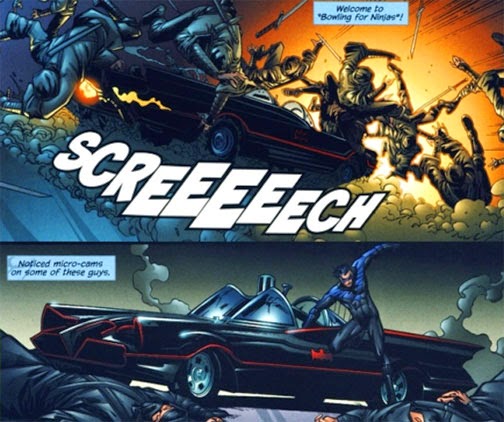
This vehicle from the 1966 Batman tv series is arguably the most influential and well-known of all the Batmobiles, its impact can still be seen today. Although rarely brought into the comics as-is, it changed how Batmobiles were drawn for a long time. Some examples:
The top left picture was a slow beginning, mainly taking the "double bubble" aspect of the tv car. And the Brave and the Bold example mainly highlights the addition of the rear afterburner, which becomes a design mainstay, especially in adaptations. But after that, it really takes shape.
Also, the 60s Batmobile does appear in a show-accurate form a few times:
Batmobile '89
If the 60s Batmobile isn't the most influential, then this one is. Actually this one may have that one beat, since some of the following Batmobiles - each with their own share of influence - are ultimately based on this one as well. Some examples:
Just like with the 60s Batmobile, although the design is almost never 100% authentic, you can clearly see how the shape of these Batmobiles is inspired by Anton Furst's Batmobile. And occasionally a film-accurate design does emerge:
Batman: The Animated Series
This Batmobile is inspired by the one above, but as you can see, it went in its own direction. And since many people consider Batman: The Animated Series (1992) to be best depiction of Batman, you better believe it's influenced comics designs. Interestingly, the cars based on this design tend to be more accurate overall than most of the other ones.
Batman Forever
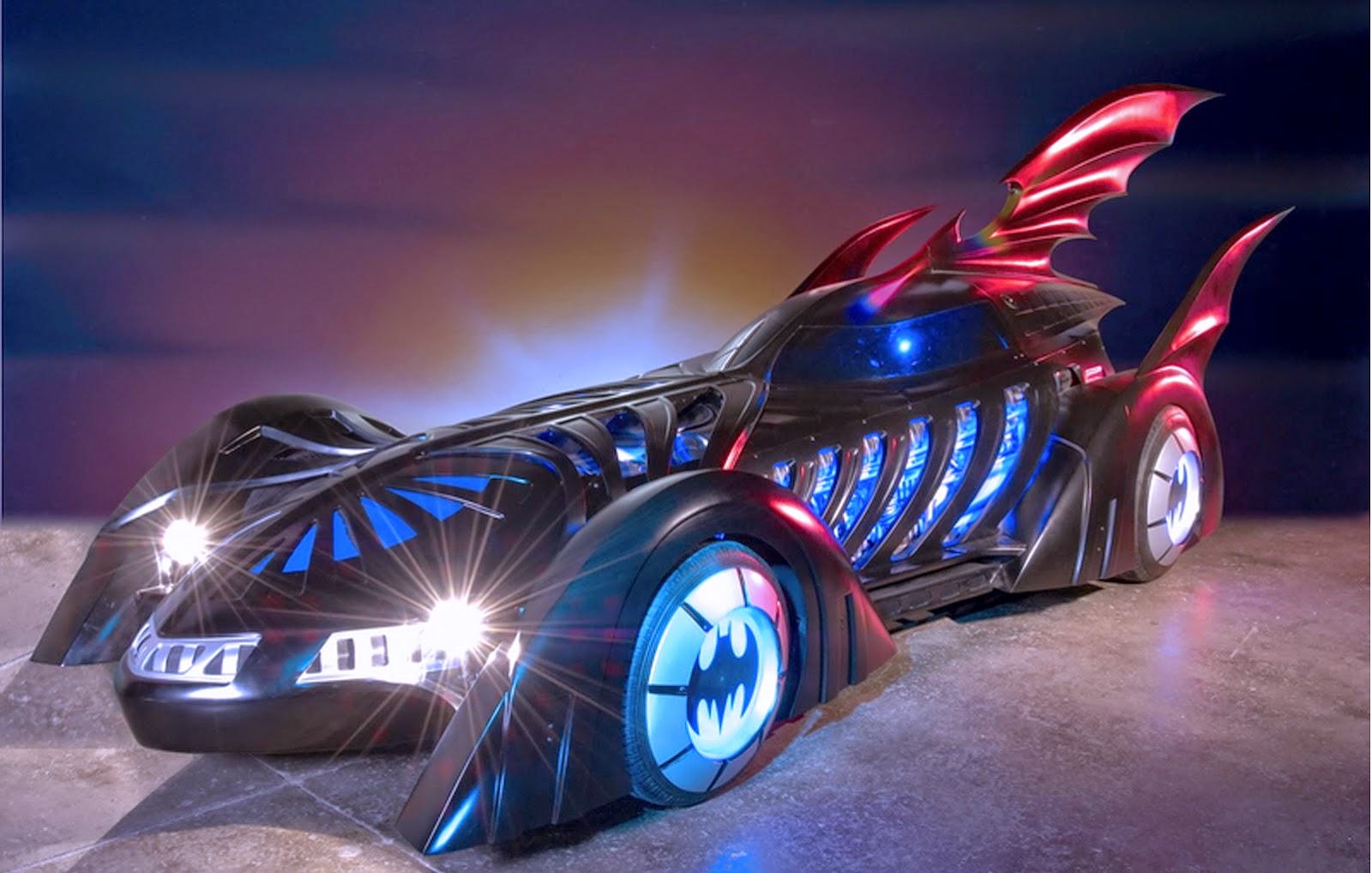
This Batmobile was designed by H. R. Giger for Batman Forever (1995), with some Schumacher neon added, but at its heart, it's still has a lot in common with the previous two Batmobiles. Although as striking design, it has - to my knowledge - only inspired one Batmobile, the toned-down version seen below. But it has also appeared in group shots, as you can see at the bottom of the page.
Batman and Robin
This one has not yet appeared in the comics on its own or inspired any comics Batmobiles, but it does appear in a group shot below.
The New Batman Adventures
This one is possible my favorite Batmobile design, but again, it's essentially the Anton Furst Batmobile. Really, it's the back half of '89 with the front half of Batman and Robin. But hey, whatever works. It's appeared twice in somewhat modified forms.
Tumbler
Batman Begins (2005) took a different approach to the Batmobile. For one thing, it wasn't called that. For another, it was originally created as a military vehicle and then modified by Bruce Wayne. So it has more of a tank-like appearance than the sports car look it usually has.
Surprisingly, as successful as Christopher Nolan's trilogy of Batman films has been all around, the Tumbler hasn't made much impact on the comics. But that's not to say it's never appeared, and the one time it did (and was actually used, I mean) was pretty faithful.
DCCU Batmobile
Like the Batman & Robin Batmobile, this one has not yet appeared in the comics on its own or inspired any comics Batmobiles, but it does appear in a group shot below.
Group Shots
Occasionally, artists will like to do a wide shot of the Batcave featuring a wide variety of vehicles from Batman's history. I believe the first people to do this were Jeph Loeb and Jim Lee in Batman: Hush (seen below). In any case, these shots always include at least one screen Batmobile. I've provided three examples below. I don't believe these are the only time a shot like this is done, but they were the only ones I could find.
Detective Comics #988 (September 2018): (L to R) Batman v Superman: Dawn of Justice (2016), Batman (1989), Batman Begins (2005), Batman Forever (1995)
Batmobile '66
This vehicle from the 1966 Batman tv series is arguably the most influential and well-known of all the Batmobiles, its impact can still be seen today. Although rarely brought into the comics as-is, it changed how Batmobiles were drawn for a long time. Some examples:
![]() |
| Detective Comics #356 (Aug 1966) |
![]() |
| Brave and the Bold #68 (September 1966) |
![]() |
| Batman #204 (June 1968) |
![]() |
| Detective Comics #362 (Feb 1967) |
![]() |
| Detective Comics #371 (Nov 1967) |
![]() |
| Detective Comics #377 (May 1968) |
Also, the 60s Batmobile does appear in a show-accurate form a few times:
![]() |
| Superman/Batman #2 (September 2003) |
![]() |
| Detective Comics #850 (Nov 2008) |
![]() |
| Nightwing #152 (Jan 2009) |
| (Prime Earth) - Batman Beyond #14 (Nov 2017) |
Batmobile '89
If the 60s Batmobile isn't the most influential, then this one is. Actually this one may have that one beat, since some of the following Batmobiles - each with their own share of influence - are ultimately based on this one as well. Some examples:
![]() |
| Legends of the Dark Knight #29 (Feb 1992) |
![]() |
| Batman: Run, Riddler, Run #1 (Mar 1992) |
![]() |
| Batman: Black & White #2 (May 1996) |
![]() |
| Legends of the Dark Knight #64 (July 1994) |
![]() |
| Legends of the Dark Knight #95 (Apr 1997) |
![]() |
| Legends of the Dark Knight #156 (June 2002) |
![]() |
| Catwoman #35 (Sep 2004) |
![]() |
| Superman/Batman #21 (May 2005) |
![]() |
| Batman: The Return (Nov 2010) |
![]() |
| Batman & Robin #25 (July 2011) |
![]() |
| Batman & Robin #19 (Jan 2011) |
![]() |
| Batman #1 (Sep 2011) |
Batman: The Animated Series
This Batmobile is inspired by the one above, but as you can see, it went in its own direction. And since many people consider Batman: The Animated Series (1992) to be best depiction of Batman, you better believe it's influenced comics designs. Interestingly, the cars based on this design tend to be more accurate overall than most of the other ones.
![]() |
| Detective Comics #784 (July 2003) |
![]() |
| Detective Comics #840 (Jan 2008) |
![]() |
| Batman & The Outsiders #14 (Dec 2008) |
![]() |
| Batman #1 (June 2016) |
Batman Forever
This Batmobile was designed by H. R. Giger for Batman Forever (1995), with some Schumacher neon added, but at its heart, it's still has a lot in common with the previous two Batmobiles. Although as striking design, it has - to my knowledge - only inspired one Batmobile, the toned-down version seen below. But it has also appeared in group shots, as you can see at the bottom of the page.
![]() |
| Batman 80-Page Giant (2011) |
Batman and Robin
This one has not yet appeared in the comics on its own or inspired any comics Batmobiles, but it does appear in a group shot below.
The New Batman Adventures
This one is possible my favorite Batmobile design, but again, it's essentially the Anton Furst Batmobile. Really, it's the back half of '89 with the front half of Batman and Robin. But hey, whatever works. It's appeared twice in somewhat modified forms.
![]() |
| Legends of the Dark Knight #208 (July 2006) |
| Batman #5 (Oct 2016) |
Tumbler
Batman Begins (2005) took a different approach to the Batmobile. For one thing, it wasn't called that. For another, it was originally created as a military vehicle and then modified by Bruce Wayne. So it has more of a tank-like appearance than the sports car look it usually has.
Surprisingly, as successful as Christopher Nolan's trilogy of Batman films has been all around, the Tumbler hasn't made much impact on the comics. But that's not to say it's never appeared, and the one time it did (and was actually used, I mean) was pretty faithful.
![]() |
| Detective Comics #20 (July 2013) |
DCCU Batmobile
Like the Batman & Robin Batmobile, this one has not yet appeared in the comics on its own or inspired any comics Batmobiles, but it does appear in a group shot below.
Group Shots
Occasionally, artists will like to do a wide shot of the Batcave featuring a wide variety of vehicles from Batman's history. I believe the first people to do this were Jeph Loeb and Jim Lee in Batman: Hush (seen below). In any case, these shots always include at least one screen Batmobile. I've provided three examples below. I don't believe these are the only time a shot like this is done, but they were the only ones I could find.
Batman #615 (May 2003): (bottom left) Batman Forever (1995), (top middle) Batman (1989), (bottom middle) Batman (1966), (above Batman '66) Batman: The Animated Series (1992), (above Batman: TAS) Batman & Robin (1997)
Detective Comics #850 (November 2008): (L to R) Batman (1989), Batman Begins (2005), Batman: The Animated Series (1992), and The New Batman Adventures (1998)
Detective Comics #988 (September 2018): (L to R) Batman v Superman: Dawn of Justice (2016), Batman (1989), Batman Begins (2005), Batman Forever (1995)
Labels:
1960s,
1980s,
1990s,
2000s,
2010s,
52 Shakeup,
Animated,
Appearances,
Batman,
Batman 66,
Batman Beyond,
DC Appearances,
DCCU,
Film,
Gadget Spotlight,
Live Action,
Television,
Tim Burton
Subscribe to:
Posts (Atom)